
 Quality Management



















 IT Service Management



 Project Management



 Agile Management




 Web Development



 Cloud Computing


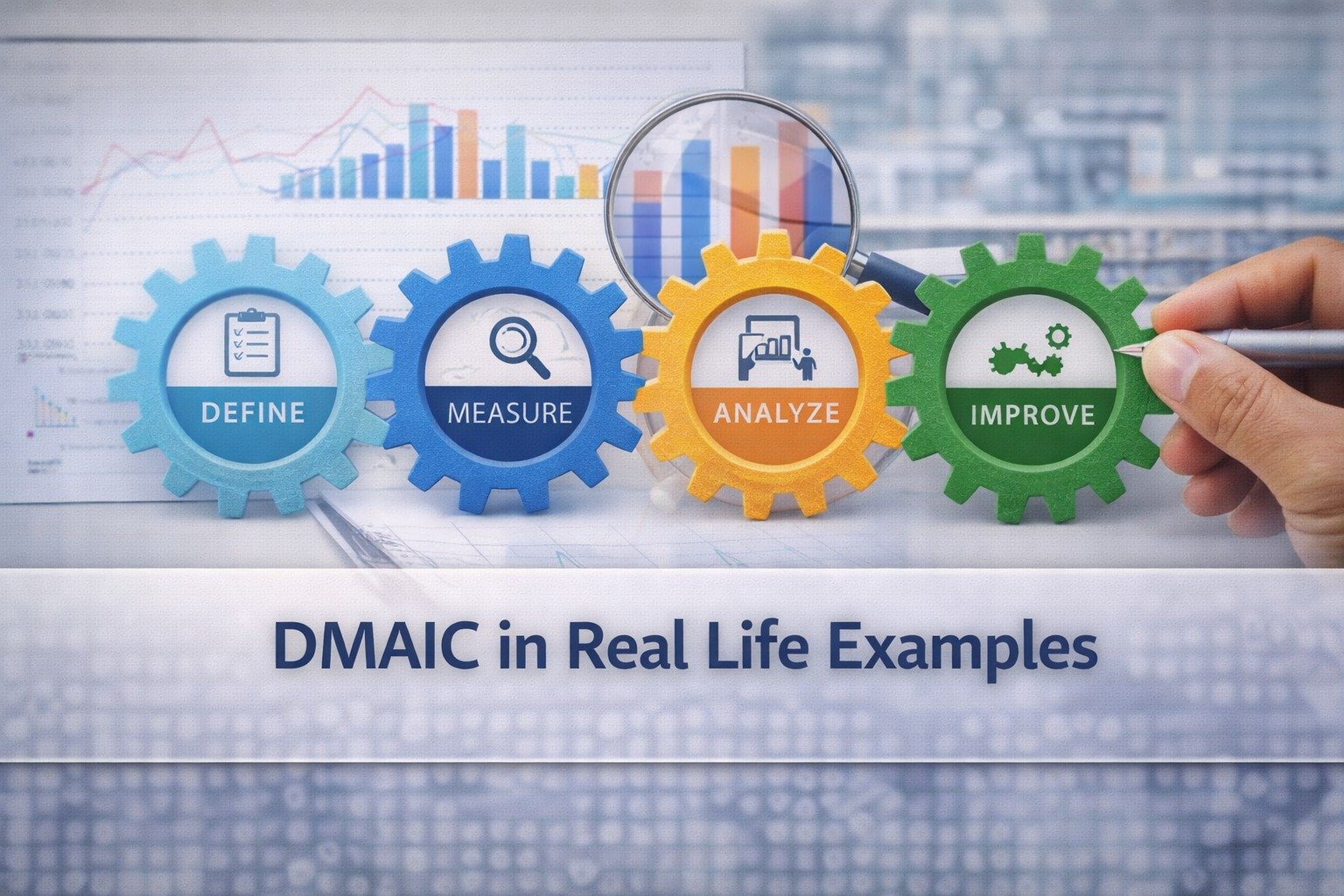
DMAIC in Real Life Examples
11:00 AM – 12:00 PM (IST)
Live Virtual Classroom

What is in DMAIC in Real Life Examples
This course explains the DMAIC methodology using real-life examples, helping learners understand how each phase is applied in practical business scenarios.
DMAIC (Define, Measure, Analyze, Improve, Control) is the core methodology of Six Sigma used for structured problem-solving and process improvement. While the framework is widely taught, its real value lies in how it is applied in real-world situations.
This course focuses on explaining each phase of DMAIC through simple and relatable examples from business and daily operations. It enables learners to connect theory with practice and understand how organizations use DMAIC to solve problems, improve efficiency, and achieve measurable results.
Course Highlights
Practical understanding of DMAIC methodology
Real-life examples for each phase
Simplified explanation of complex concepts
Application across industries
Focus on problem-solving approach
Who can join DMAIC in Real Life Examples
Students and
fresh graduates
Working professionals across industries
Operations and quality management professionals
Individuals interested in Six Sigma
Anyone looking
to learn practical process improvement
Students and fresh graduates
Working professionals across industries
Operations and quality management professionals
Individuals interested in Six Sigma
Anyone looking to learn practical process improvement
Course Features
Example-driven learning approach
Beginner-friendly and easy-to-understand content
Designed for a 45-minute focused session
Real-world scenarios for better clarity
Industry-relevant insights
Benefits of the Course
Bridges the gap between theory and practice
Enhances problem-solving skills
Improves understanding of DMAIC application
Supports real-world decision-making
Builds confidence in using Six Sigma concepts
Haworth's Advantages
Industry-experienced trainers
Practical and application-focused teaching
Structured and concise curriculum
Real-world case-based explanations
Continuous learner support
Our Trainers
Abhishek Kumar
Senior Leader – Strategy, Transformation
Experience: 15+ years
Senior strategy and business transformation leader with 15+ years of cross-industry impact

What will you learn in DMAIC in Real Life Examples
Understand the purpose and structure of the DMAIC methodology
Learn how real problems are identified and scoped
Understand how data is collected and how performance is assessed
Learn how root causes are identified using real examples
Understand how solutions are implemented and sustained
Prerequisites and Eligibility
-
A basic understanding of Six Sigma is helpful but not mandatory
-
No prior technical knowledge required
-
Suitable for beginners and professionals
-
Open to all industries and roles
-
Ideal for those interested in practical process improvement
Curriculum
- Recap of DMAIC methodology
- Importance of practical application
- How DMAIC applies beyond industries
- Everyday problem-solving using DMAIC
- Define: identifying real-life problems (e.g., delays, errors)
- Setting clear goals • Measure: understanding current situation
- Identifying simple metrics (time, errors, cost)
- Example: Reducing waiting time in daily routine
- Identifying root causes in real-life situations
- Using 5 Whys for everyday problems
- Observing patterns and common issues
- Example: Finding reasons for repeated delays
- Generating simple solutions
- Implementing quick improvements
- Monitoring results over time
- Maintaining consistency and discipline
- Example: Improving study schedule or daily productivity
- Apply DMAIC to a personal or daily-life problem
- Identify improvement actions
- Key takeaways and practical understanding
DMAIC in Real Life Examples FAQs
Recommended by our Participants Globally