 Quality Management


















 IT Service Management



 Project Management



 Agile Management



 Web Development


 Cloud Computing



PfMP® Certification Training
04:00 PM – 08:00 PM (IST)
Live Virtual Classroom

What is in PfMP® Certification Training
PfMP® Certification training prepares senior leaders to manage and align portfolios of programs and projects with organizational strategy. The program focuses on governance, strategic prioritization, resource optimization, and enterprise value realization.
PfMP® (Portfolio Management Professional) Certification training is an elite-level program designed for senior executives and portfolio leaders responsible for managing multiple programs and projects at the enterprise level. The course provides in-depth understanding of portfolio governance, strategic alignment, investment prioritization, risk balancing, and performance optimization. Participants learn how to evaluate initiatives, allocate resources efficiently, and ensure that organizational investments generate measurable business value. The program prepares candidates to successfully clear the PfMP® certification examination while strengthening their ability to lead large-scale strategic portfolios across industries such as IT, infrastructure, manufacturing, finance, healthcare, and consulting.
Top Hiring Companies



Course Highlights

Comprehensive coverage of project management domains aligned with PMI® standards and the PMP® exam content outline

In-depth understanding of predictive, agile, and hybrid project delivery approaches

Advanced leadership and stakeholder management capabilities for complex projects

Structured exam preparation with practice questions and mock assessments

Who can join PfMP® Certification Training
Project managers and senior project
coordinators
Program and delivery managers
Operations and functional managers
IT, construction, manufacturing, and service professionals
Consultants and business leaders managing complex initiatives
Project managers and senior project coordinators
Program and delivery managers
Operations and functional managers
IT, construction, manufacturing, and service professionals
Consultants and business leaders managing complex initiatives
Tools You’ll Learn




Course Features

PMI®-aligned curriculum based on the latest PMP Exam Content Outline

Comprehensive coverage of predictive, agile, and hybrid methodologies

Focus on people, process, and business environment domains

Real-world project scenarios and case-based learning

Extensive exam-oriented practice questions and mock tests

Instructor-led training with a structured exam preparation strategy

Continuous learning support until exam completion
Benefits of the Course

Eligibility to earn a globally respected PMP® credential

Strong command over end-to-end project management practice

Enhanced leadership, stakeholder, and risk management skills

Improved ability to manage complex and cross-functional projects

Significant career credibility and global mobility

Increased potential for senior project and program roles
Haworth's Advantages

PMI®-aligned training framework and structured exam preparation

Experienced trainers with real-world project leadership exposure

Clear focus on exam readiness and concept mastery

High-quality study materials and exam simulators

Personalized guidance for the PMP application and audit process

Flexible training delivery models

Proven success in professional certification training
Certification Process
Enrollment
Register for the PMP® certification training program.
Training Completion
Complete the mandatory 35 hours of formal project management education.
Application Approval
Receive authorization to schedule the PMP® certification exam.
Certification Awarded
Earn the globally recognized Project Management Professional (PMP®) credential upon passing the exam.
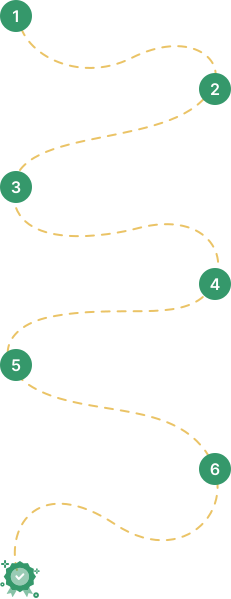
Eligibility Assessment
Verify educational background and required project management experience as per PMI® criteria.
Application Submission
Submit the PMP® examination application through PMI®.
Certification Examination
Successfully clear the PMP® examination.
Enrollment
Register for the PMP® certification training program.
Eligibility Assessment
Verify educational background and required project management experience as per PMI® criteria.
Training Completion
Complete the mandatory 35 hours of formal project management education.
Application Submission
Submit the PMP® examination application through PMI®.
Application Approval
Receive authorization to schedule the PMP® certification exam.
Certification Examination
Successfully clear the PMP® examination.
Certification Awarded
Earn the globally recognized Project Management Professional (PMP®) credential upon passing the exam.
What will you learn in PfMP® Certification Training
Develop an in-depth understanding of people, process, and business environment domains aligned with PMI® standards.
Build the capability to manage cross-functional teams, stakeholders, and high-impact initiatives effectively.
Strengthen expertise in traditional, agile, and hybrid project delivery methodologies.
Align projects with organizational goals to deliver measurable value and competitive advantage.
Enhance exam readiness through structured preparation aligned with the PMP® exam content outline.
Prerequisites and Eligibility
-
Four-year degree with at least 36 months of project management experience
or -
Secondary degree with at least 60 months of project management experience
-
35 contact hours of project management education (fulfilled through this course)
Curriculum
- Fundamentals of portfolio management
- Portfolio vs Program vs Project
- Role of Portfolio Manager
- Strategic alignment and value delivery
- Framework by Project Management Institute
- Aligning portfolio with organizational strategy
- Vision, mission, and strategic objectives
- Portfolio roadmap development
- Investment decision frameworks
- Benefits realization approach
- Governance structures and frameworks
- Policy development and compliance
- Decision-making models
- Portfolio oversight and control
- Risk governance
- Defining portfolio KPIs and metrics
- Performance monitoring and reporting
- Value tracking and optimization
- Dashboard and reporting techniques
- Continuous performance improvement
- Identifying portfolio-level risks
- Risk analysis and prioritization
- Risk mitigation strategies
- Managing interdependencies
- Uncertainty management
- Stakeholder identification and analysis
- Communication strategies at portfolio level
- Executive reporting and dashboards
- Managing stakeholder expectations
- Transparency and governance communication
- Resource allocation across projects/programs
- Capacity planning
- Resource optimization techniques
- Managing constraints and conflicts
- Talent and capability planning
- Budgeting and financial planning
- Investment prioritization
- Cost-benefit analysis
- Financial performance tracking
- ROI and value realization
- Portfolio creation and structuring
- Prioritization and selection techniques
- Balancing portfolio components
- Portfolio optimization
- Portfolio closure and transition
- Agile portfolio concepts
- Lean portfolio management
- Hybrid portfolio environments
- Adaptive planning and governance
- Scaling Agile across portfolios
- Executive leadership in portfolio management
- Influencing senior stakeholders
- Change management at strategic level
- Conflict resolution and negotiation
- Building high-performing teams
- Portfolio dashboards and reporting tools
- Prioritization models (scoring, ranking)
- Financial modeling tools
- Risk assessment frameworks
- Data-driven decision-making tools
- PfMP exam structure and format
- Key concept revision
- Scenario-based questions
- Case study discussions
- Exam strategies and time management
Aspirants Trained
Industries Covered
Success Rate
Years Experience
Authorized Trainers
Case Studies
PfMP® Certification Training FAQs
Recommended by our Participants Globally