
 Quality Management



















 IT Service Management



 Project Management



 Agile Management



 Web Development



 Cloud Computing



Lean Six Sigma Black Belt Training
12:00 PM – 04:45 PM (IST)
Live Virtual Classroom

What is in Lean Six Sigma Black Belt Training
Lean Six Sigma Black Belt training equips professionals with advanced problem-solving, statistical analysis, and process optimization skills to lead high-impact improvement initiatives. The program enables participants to drive measurable business results, reduce operational inefficiencies, and implement data-driven strategies across organizational functions.
Lean Six Sigma Black Belt training is an advanced program designed to develop leaders capable of driving enterprise-wide process improvement initiatives. The course provides in-depth expertise in statistical analysis, data-driven decision-making, and the DMAIC methodology to solve complex business problems and eliminate inefficiencies. Participants gain the skills to lead cross-functional teams, optimize operational performance, and deliver measurable financial impact across manufacturing, service, healthcare, IT, and other industries.
Top Hiring Companies


Course Highlights

In-depth training in statistical analysis and data-driven decision-making using practical tools and real-world scenarios

Hands-on project guidance focused on delivering measurable financial and operational improvements

Leadership development to effectively manage cross-functional teams and drive enterprise-level transformation


Who can join Lean Six Sigma Black Belt Training
Lean Six Sigma Green Belt–certified professionals
Senior
operations and quality managers
Process excellence and continuous improvement leaders
Project managers handling complex initiatives
Supply chain, manufacturing, and service operations leaders
Professionals responsible for organizational performance
improvement
Lean Six Sigma Green Belt–certified professionals
Process excellence and continuous improvement leaders
Project managers handling complex initiatives
Supply chain, manufacturing, and service operations leaders
Professionals responsible for organizational performance
improvement
Tools You’ll Learn

Pareto Chart

KAIZEN

5 Whys

Root Cause Analysis

Control Chart

Statistical Process Control

FMEA

DoE

Regression Analysis

DMAIC
Course Features

Advanced Lean and Six Sigma methodology integration.

Deep dive into DMAIC with complex problem-solving

Extensive use of advanced statistical and analytical tools

Multiple real-world, high-impact case studies

Project leadership and mentoring focus

Emphasis on financial impact and business alignment

Structured certification with rigorous evaluation standards
Benefits of the Course
Ability to lead enterprise-level improvement programs
Advanced data analysis and decision-making capability
Expertise in solving complex, cross-functional problems
Strong credibility as a process excellence leader
Capability to mentor Green and Yellow Belt professionals
Direct contribution to cost reduction and profitability
Eligibility for senior operational and quality leadership roles
Haworth's Advantages

Advanced curriculum aligned with global Lean Six Sigma standards

Training delivered by Master Black Belt–certified professionals

Strong emphasis on real business impact and ROI

One-to-one mentoring for project execution

Comprehensive statistical toolkits and learning resources

Rigorous assessment and quality assurance framework

Proven track record in enterprise-scale transformation programs
Our Trainers
Abhishek Kumar
Senior Leader – Strategy, Transformation
Experience: 15+ years
Senior strategy and business transformation leader with 15+ years of cross-industry impact

Certification Process
Step 1: Enrollment
Register for the Lean Six Sigma Black Belt training program.
Step 3: Advanced Training Completion
Attend and complete comprehensive instructor-led Black Belt training sessions.
Step 5: Project Execution
Apply advanced statistical tools and DMAIC methodology to deliver measurable results.
Step 7: Certification Awarded
Receive the Lean Six Sigma Black Belt Certificate upon meeting all program requirements.
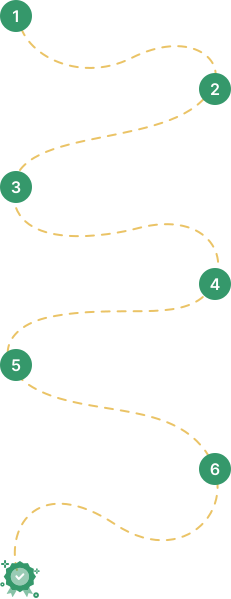
Step 2: Foundation Review
Strengthen your understanding of Lean Six Sigma concepts and DMAIC fundamentals.
Step 4: Practical Application
Identify and initiate high-impact improvement projects within your organization.
Step 6: Certification Examination
Successfully clear the Lean Six Sigma Black Belt assessment.
Step 1: Enrollment
Register for the Lean Six Sigma Black Belt training program.
Step 2: Foundation Review
Strengthen your understanding of Lean Six Sigma concepts and DMAIC fundamentals.
Step 3: Advanced Training Completion
Attend and complete comprehensive instructor-led Black Belt training sessions.
Step 4: Practical Application
Identify and initiate high-impact improvement projects within your organization.
Step 5: Project Execution
Apply advanced statistical tools and DMAIC methodology to deliver measurable results.
Step 6: Certification Examination
Successfully clear the Lean Six Sigma Black Belt assessment.
Step 7: Certification Awarded
Receive the Lean Six Sigma Black Belt Certificate upon meeting all program requirements.
What will you learn in Lean Six Sigma Black Belt Training
Develop the expertise to lead complex improvement
initiatives using the Define, Measure, Analyze, Improve, and Control framework
with precision and strategic alignment.
Gain the ability to interpret complex data sets, perform hypothesis testing, regression analysis, and other advanced statistical techniques to support data-driven decisions.
Build leadership capabilities to manage teams, engage stakeholders, and drive sustainable process transformation across departments.
Learn to identify cost reduction opportunities, eliminate process variation, and generate quantifiable business results aligned with organizational objectives.
Establish control mechanisms and governance structures to ensure long-term performance stability and continuous improvement culture.
Prerequisites and Eligibility
-
Valid Lean Six Sigma Green Belt certification
-
Prior completion of at least one Green Belt project
-
Professional experience in operations, quality, or process roles
-
Willingness to complete complex, high-impact projects
Curriculum
- Evolution of Lean and Six Sigma
- Integration of Lean and Six Sigma methodologies
- Roles and responsibilities of Black Belt professionals
- Organizational goals and strategic alignment
- Overview of DMAIC framework
- Voice of Customer (VOC) analysis
- Critical to Quality (CTQ) identification
- Stakeholder analysis and project charter development
- SIPOC (Supplier-Input-Process-Output-Customer) mapping
- Measurement system analysis (MSA)
- Data types and measurement scales
- Descriptive statistics
- Process capability analysis (Cp, Cpk)
- Baseline performance measurement
- Fishbone Diagram
- 5 Whys
- Hypothesis testing (t-test, chi-square, ANOVA)
- Correlation and regression analysis
- Failure Mode and Effects Analysis (FMEA)
- Identifying critical input variables (X’s)
- Design of Experiments (DOE)
- Lean tools application:
- Kaizen
- 5S
- Value Stream Mapping (VSM)
- Risk analysis and pilot testing
- Cost-benefit analysis
- Statistical Process Control (SPC)
- Control charts (X-bar, R, p, np, c, u charts)
- Standard Operating Procedures (SOPs)
- Sustaining improvements and documentation
- Handover and project closure
- Types of waste (TIMWOODS)
- Just-in-Time (JIT)
- Continuous flow and pull systems
- Kanban systems
- Poka-Yoke (Error Proofing)
- Non-parametric tests
- Multivariate analysis
- Time series analysis
- Simulation techniques
- Change management models
- Communication and stakeholder engagement
- Conflict resolution
- Coaching and mentoring Green Belts
- Risk management
- Resource allocation
- Integration with Agile and traditional project management frameworks
Industries Served
Lean Six Sigma Black Belt Training FAQs
Recommended by our Participants Globally