 Quality Management



















 IT Service Management



 Project Management


 Agile Management



 Web Development


 Cloud Computing
Six Sigma in IT Industry - Introduction
11:00 AM – 12:00 PM (IST)
Live Virtual Classroom

What is in Six Sigma in IT Industry - Introduction
This course introduces how Six Sigma is applied in the IT industry to improve processes, reduce defects, and enhance service quality.
The IT industry relies heavily on efficient processes, quality delivery, and minimal errors to meet client expectations. Six Sigma provides a structured, data-driven approach to improve software development, IT services, and operational workflows.
This course offers a clear introduction to how Six Sigma is used in the IT industry, including its applications in reducing defects, improving service quality, and optimizing project performance. Learners will understand how these methodologies contribute to better outcomes in IT projects and services.
Course Highlights
Introduction to Six Sigma in IT
Understanding process improvement in IT services
Reducing defects in software and operations
Real-world IT industry applications
Focus on quality and efficiency
Who can join Six Sigma in IT Industry - Introduction
Students and
fresh graduates
IT and software professionals
Operations and project management professionals
Individuals interested in Six Sigma applications
Anyone exploring
IT process improvement
Students and fresh graduates
IT and software professionals
Operations and project management professionals
Individuals interested in Six Sigma applications
Anyone exploring IT process improvement
Course Features
Beginner-friendly and easy-to-understand content
Practical IT-based examples
Designed for a 45-minute focused session
Industry-relevant insights
Simplified explanation of concepts
Benefits of the Course
Enhances understanding of quality in IT processes
Improves efficiency in project and service delivery
Supports career growth in IT roles
Builds a foundation in process improvement
Helps reduce errors and improve outcomes
Haworth's Advantages
Industry-experienced trainers
Practical and application-focused learning
Concise and structured curriculum
Real-world IT scenarios
Continuous learner support
Our Trainers
Abhishek Kumar
Senior Leader – Strategy, Transformation
Experience: 15+ years
Senior strategy and business transformation leader with 15+ years of cross-industry impact

What will you learn in Six Sigma in IT Industry - Introduction
Understand how Six Sigma applies to IT services and projects
Learn how errors in software and processes are minimized
Understand how workflows are optimized for better performance
Learn how Six Sigma improves service and product quality
Explore how organizations use Six Sigma in IT environments
Prerequisites and Eligibility
-
No prior Six Sigma knowledge required
-
A basic understanding of IT or software processes is helpful
-
Suitable for beginners and professionals
-
Open to students and working professionals
-
Ideal for those interested in IT and process improvement
Curriculum
- What is Six Sigma
- Why is it relevant in the IT industry
- Common challenges in IT (delays, defects, rework)
- Need for process improvement
- Defects in IT (bugs, errors, failures)
- Process variation in software development
- Importance of quality and customer satisfaction
- Data-driven decision making
- Software development lifecycle (SDLC)
- Testing and quality assurance
- IT services and support processes
- Project management and delivery
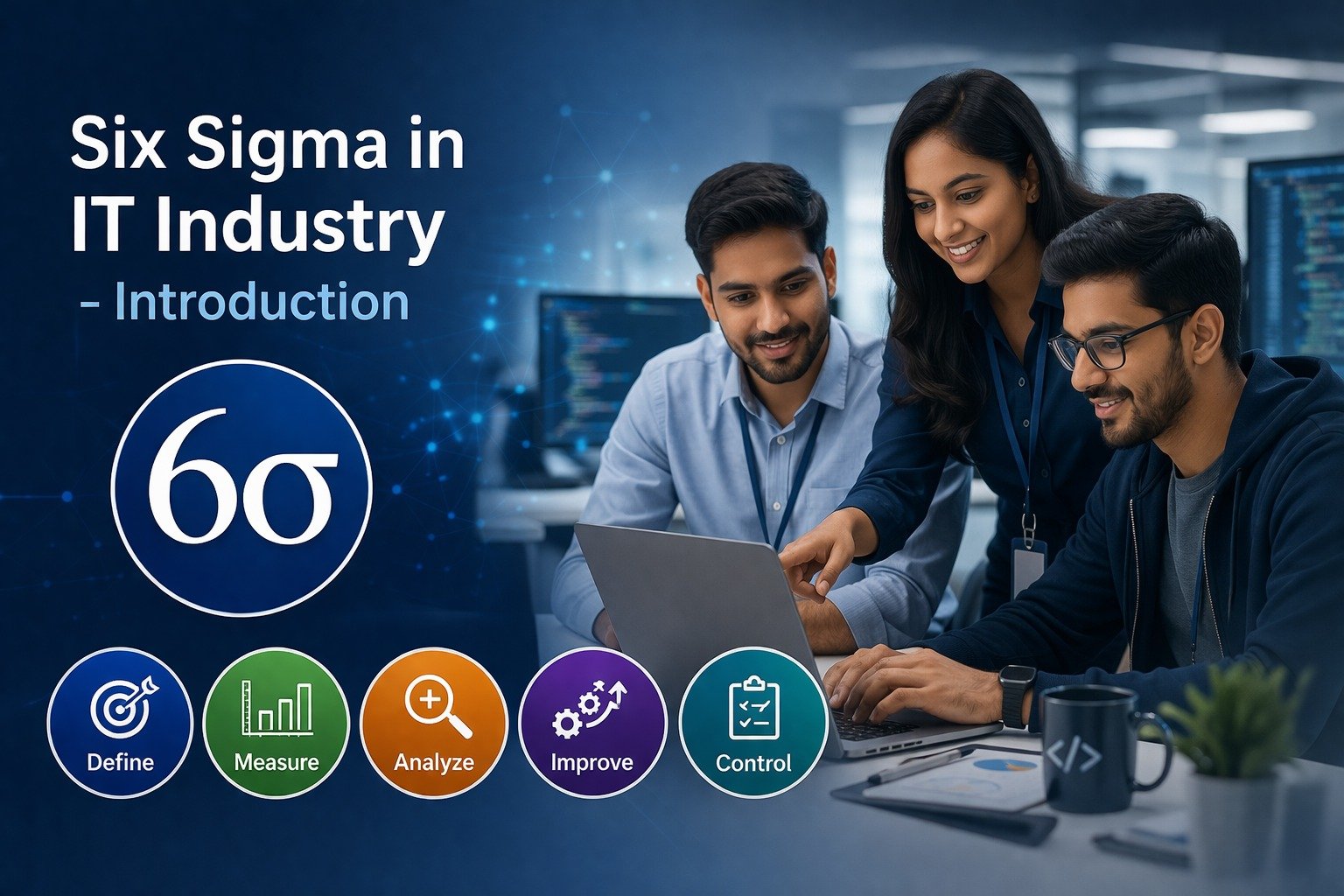
- Define: identifying project issues
- Measure: tracking defects and performance
- Analyze: finding root causes
- Improve: implementing solutions
- Control: maintaining improvements
- Identify common issues in an IT process (e.g., bug fixing, ticket handling)
- Map them to Six Sigma concepts
- Suggest simple improvements
- Key takeaways: better quality, fewer defects, improved efficiency
Six Sigma in IT Industry - Introduction FAQs
Recommended by our Participants Globally