 Quality Management



















 IT Service Management



 Project Management



 Agile Management



 Web Development


 Cloud Computing
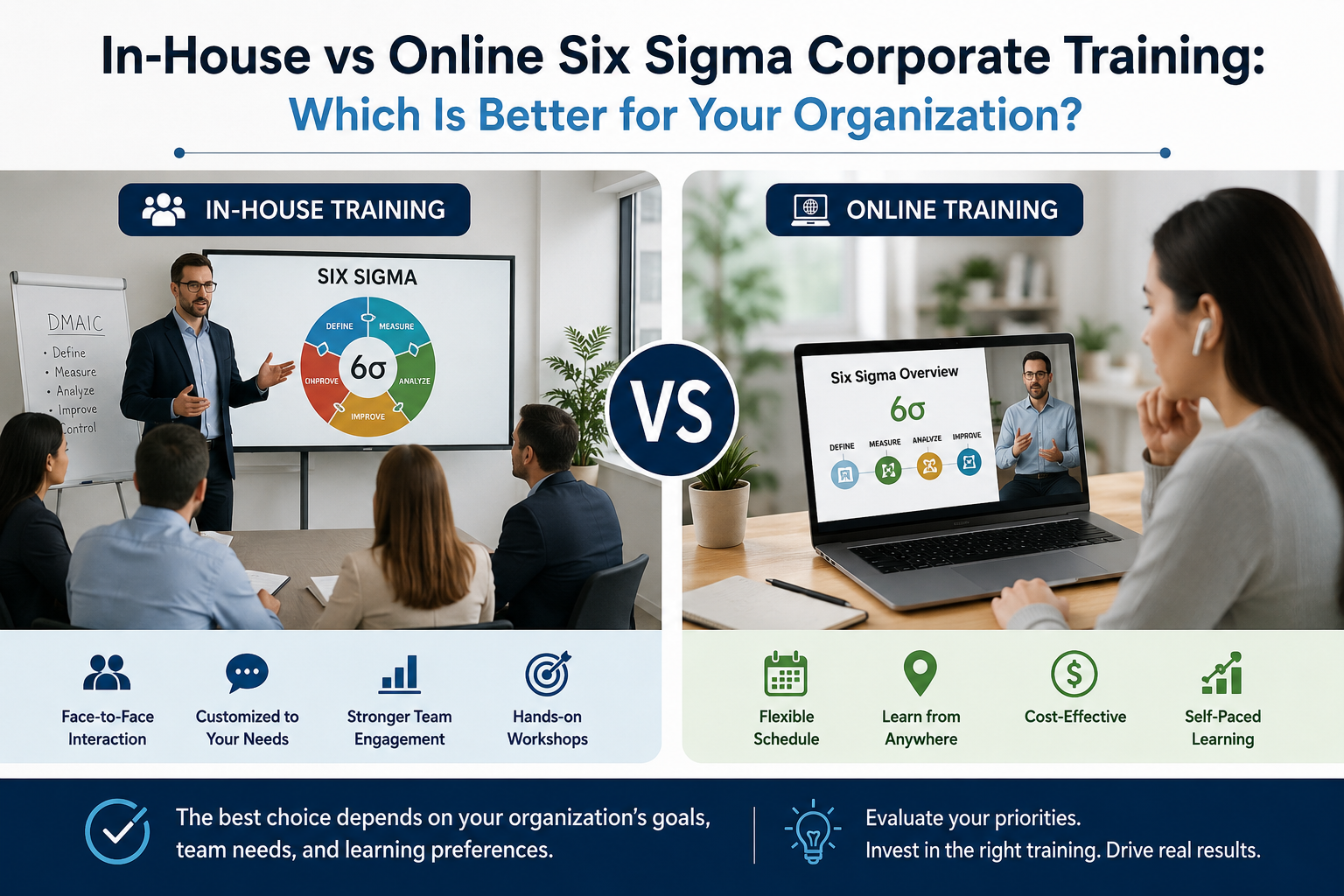
In today's competitive business environment, organizations are continually seeking ways to improve their processes, enhance productivity, and reduce waste. One of the most effective methodologies for achieving these goals is Six Sigma. However, when it comes to implementing Six Sigma training within your organization, a critical decision arises: should you opt for in-house training or online Six Sigma certification? In this blog, we will explore both options to help you determine the best fit for your corporate learning programs and employee training solutions.
Understanding Six Sigma
Before diving into the pros and cons of in-house and online training, it's essential to understand what Six Sigma entails. Developed in the 1980s by Motorola, Six Sigma is a data-driven approach aimed at process improvement and quality management. The term "Six Sigma" refers to the statistical representation of a process that is highly efficient and minimizes defects. By implementing Six Sigma methodologies, organizations can streamline operations, boost employee productivity, and enhance customer satisfaction.
In-House Six Sigma Training
Benefits of In-House Training
In-house Six Sigma training refers to programs conducted on-site at your organization. Here are some of the key benefits:
- Tailored Content: In-house training can be customized to meet the specific needs of your organization, addressing unique challenges and processes.
- Team Cohesion: Conducting training sessions with employees from various departments fosters teamwork and collaboration, enhancing the implementation of Six Sigma practices.
- Immediate Application: Employees can apply what they learn in real-time, allowing for immediate feedback and process improvement.
- Cost-Effectiveness: For larger teams, in-house training can be more cost-effective compared to individual online courses.
Challenges of In-House Training
Despite its advantages, in-house training also has its challenges:
- Resource Intensive: Organizing and facilitating training can be resource-intensive, requiring time and effort from both trainers and participants.
- Access to Experts: Finding qualified trainers who are experienced in Six Sigma methodologies can be a challenge.
- Scheduling Conflicts: Coordinating schedules for all participants can be difficult, especially in larger organizations.
Online Six Sigma Certification
The Rise of Online Training
Online Six Sigma certification has gained popularity in recent years, particularly due to its flexibility and accessibility. Let's explore the benefits and challenges of this format:
Benefits of Online Training
- Flexibility: Employees can learn at their own pace and on their own schedule, making it easier to balance work and training.
- Wider Access to Resources: Online platforms provide access to a wealth of resources, including videos, case studies, and interactive quizzes.
- Cost-Effective for Small Teams: For organizations with fewer employees, online certification can be more economical than arranging in-house training.
- Global Expertise: Online training allows access to expert trainers from around the world, ensuring high-quality instruction.
Challenges of Online Training
- Lack of Personal Interaction: Online training may lack the personal touch that in-house training provides, making it harder for employees to ask questions and engage.
- Self-Motivation Required: Employees must be self-motivated to complete online courses, which can be a barrier for some.
- Implementation Difficulties: Applying learned concepts to real-world scenarios may be challenging without immediate support from instructors.
Which Option is Best for Your Organization?
Deciding between in-house and online Six Sigma training depends on several factors unique to your organization.
Considerations for Choosing
- Organizational Size: Larger organizations with multiple teams may benefit more from in-house training, while smaller teams might find online options more practical.
- Training Objectives: If your goal is to foster collaboration and teamwork, in-house training may be the way to go. However, if flexibility and accessibility are paramount, online certification could be a better fit.
- Budget Constraints: Evaluate your budget for training. In-house training may require more upfront investment, while online courses often come with lower costs.
- Employee Learning Preferences: Consider how your employees prefer to learn. Some may thrive in a collaborative environment, while others may prefer the flexibility of online learning.
Conclusion
Both in-house and online Six Sigma corporate training options have their unique benefits and challenges. The choice between onsite Six Sigma training and online certification ultimately depends on your organization's size, budget, training objectives, and employee learning preferences. By carefully considering these factors, you can make an informed decision that will enhance your corporate learning programs and employee training solutions.
FAQs
1. What is Six Sigma certification?
Six Sigma certification is a credential that demonstrates an individual's proficiency in Six Sigma methodologies and tools. It indicates that the individual is capable of leading process improvement projects effectively.
2. How long does it take to complete Six Sigma training?
The duration of Six Sigma training varies based on the format. In-house training can take days or weeks, while online courses can be completed at your own pace, typically ranging from a few weeks to several months.
3. Is online Six Sigma certification recognized in India?
Yes, online Six Sigma certification is recognized in India, especially when obtained from reputable institutions or organizations. It's crucial to verify the credibility of the certification provider.
4. Can I combine in-house and online training?
Yes, many organizations choose to implement a blended learning approach, combining in-house training for team-building and immediate application with online courses for flexibility and broader content access.
5. How do I choose the right Six Sigma training provider?
When selecting a Six Sigma training provider, consider factors such as accreditation, trainer expertise, training format (online or in-house), and reviews from previous participants.
Call to Action
Are you ready to enhance your organization's performance through Six Sigma training? Whether you choose onsite Six Sigma training or online Six Sigma certification, investing in your employees' skills is crucial for future success. Contact us today to explore our tailored corporate learning programs and find the right employee training solutions for your organization!


Leave a Comment