
 Quality Management



















 IT Service Management



 Project Management



 Agile Management




 Web Development



 Cloud Computing


.png)
Search "Six Sigma" on any Indian job portal and you will find openings at IT service companies, banks, hospitals, auto component makers and global capability centres. Some ask for a belt outright. Many more want someone who can "drive process improvement" or "own operational excellence", which is Lean Six Sigma work under a different name.
This guide covers the roles that open up at each belt level, what they pay according to current salary data, the skills that actually get people hired, and how to move up from your first project to leading a programme.
Quick Answer
Lean Six Sigma opens roles such as process improvement analyst, quality engineer, continuous improvement manager, Six Sigma Black Belt and operational excellence lead across IT services, BPO, manufacturing, banking and healthcare in India. Green Belts typically start in analyst and engineer roles, while experienced Black Belts move into project manager, consultant and programme leadership roles. Pay rises sharply with experience and proven project results rather than with the certificate alone.
In this guide
- Why Indian employers hire for Lean Six Sigma
- Job roles by belt level
- Salary data for Six Sigma roles in India
- Industries hiring and what they look for
- Skills that get you hired
- Career roadmap: Yellow Belt to Master Black Belt
- Where to start, based on your background
- FAQs
Why Indian Employers Hire for Lean Six Sigma
Indian companies compete hard on cost and service quality, especially those serving global clients. A process that wastes 10% of its time or produces avoidable errors costs real money at scale. Lean Six Sigma gives employers a common, measurable way to find and fix those losses.
Three shifts have kept demand steady:
- Global capability centres and BPOs are contractually measured on service levels, accuracy and turnaround, so they hire people who can improve those numbers.
- Manufacturers supplying export markets and large OEMs are expected to show documented quality improvement.
- Automation and AI projects work far better on clean, stable processes. Many companies now pair process improvement with automation, as covered in how AI is transforming Six Sigma.
If you are new to the method itself, start with what Six Sigma is and how certification works.
Lean Six Sigma Job Roles by Belt Level
Job titles vary between companies, but the work tends to follow the belt structure. Use this table to see where you fit now and where you could go next.
| Job role | Typical belt | What you actually do |
|---|---|---|
| Process / Quality Analyst | Yellow or Green | Collect and analyse process data, track defects, support improvement projects |
| Quality Engineer / QA Engineer | Green | Run root cause analysis, set up control charts, reduce rejection and rework |
| Process Improvement Specialist | Green | Lead small DMAIC projects within one department |
| Continuous Improvement Manager | Green or Black | Run a pipeline of projects, coach teams, report savings to leadership |
| Six Sigma Black Belt / Project Manager | Black | Lead cross-functional projects with large business impact, mentor Green Belts |
| Quality / Operations Manager | Green or Black | Own quality and delivery metrics for a function, site or client account |
| Lean Six Sigma Consultant | Black | Diagnose and improve processes for client organisations |
| Operational Excellence Head / Master Black Belt | Master Black Belt | Set improvement strategy, train Black Belts, run the company-wide programme |
Not sure whether you need Green or Black Belt for the role you want? Read Green Belt vs Black Belt: which to choose.
Salary Data for Six Sigma Roles in India
Salary depends far more on your role, experience and industry than on the belt itself. The figures below come from salary platforms that collect self-reported data, so treat them as a guide to the range, not a promise.
| Role (India) | Reported pay | Source |
|---|---|---|
| QA Engineer with Six Sigma Green Belt skills | Average base ₹4.75 lakh a year | PayScale |
| Early-career Assistant Manager, Quality Control (Green Belt skills) | Median ₹4.76 lakh; most between ₹2.3 and ₹9.4 lakh | PayScale |
| Experienced Quality Assurance Manager (Green Belt skills) | Average base about ₹15.4 lakh a year | PayScale |
| Six Sigma Black Belt Engineer | Average base ₹7 lakh a year | PayScale |
| Six Sigma Black Belt Project Manager | Average base about ₹18.5 lakh a year | PayScale |
| Six Sigma Consultant | ₹6.5 lakh to ₹40 lakh a year | AmbitionBox |
Figures as of November 2026. Salary platforms update often, so open the source links for current numbers.
Notice the gap between an early-career quality role and an experienced manager or Black Belt project manager holding similar skills. The jump comes from leading projects with measurable results and from moving into roles that own a budget or a client account. That is why the next sections focus on projects and skills, not only on certificates.
Industries Hiring Lean Six Sigma Professionals
| Industry | Typical problems you would work on |
|---|---|
| IT services, BPO and KPO | Handling time, transaction accuracy, SLA misses, repeat tickets. See Six Sigma in BPO and services. |
| Manufacturing and automotive | Rejection rates, rework, machine downtime, supplier quality. See Six Sigma in manufacturing. |
| Banking, insurance and fintech | Loan and claim turnaround, KYC errors, reconciliation delays |
| Healthcare and hospitals | Patient waiting and discharge time, billing errors. See Lean Six Sigma in healthcare. |
| Logistics and e-commerce | Wrong deliveries, returns, warehouse picking errors |
| Pharma and FMCG | Batch consistency, line efficiency, packaging defects |
Hiring is concentrated where these industries cluster: Bengaluru, Hyderabad, Pune, Chennai, Gurugram, Noida and Mumbai for services, and industrial belts around Chennai, Pune, the NCR and Gujarat for manufacturing.
Skills That Get You Hired
Interviewers rarely ask you to define DMAIC. They ask you to walk them through a problem you solved. These are the skills that let you do that convincingly.
Technical skills
- Running a project end to end through DMAIC
- Basic statistics: process capability, hypothesis testing, regression
- Process mapping and value stream mapping
- Excel and Minitab, plus a dashboard tool such as Power BI. See KPI dashboards for Lean Six Sigma.
- Calculating financial impact: hours saved, cost avoided, revenue protected
People skills
- Getting buy-in from teams who did not ask to be "improved". Our post on change management in Lean Six Sigma projects covers this.
- Explaining data simply to managers who have five minutes
- Running workshops and brainstorming sessions
- Managing stakeholders across departments
Skills that pair well with Lean Six Sigma
Combining a belt with project management, ITIL or data analytics widens your options considerably. Project managers in particular benefit, as explained in Lean Six Sigma for project managers.
Career Roadmap: Yellow Belt to Master Black Belt
There is no fixed timeline, and you can skip levels. But most careers follow a pattern like this:
- Yellow Belt: learn the language. You understand DMAIC and contribute data and process knowledge to projects. Useful for freshers and support staff. Yellow Belt course.
- Green Belt: lead your first projects. You run small improvement projects in your own area. This is the level most job descriptions ask for. Follow our Green Belt certification guide or see the Green Belt course.
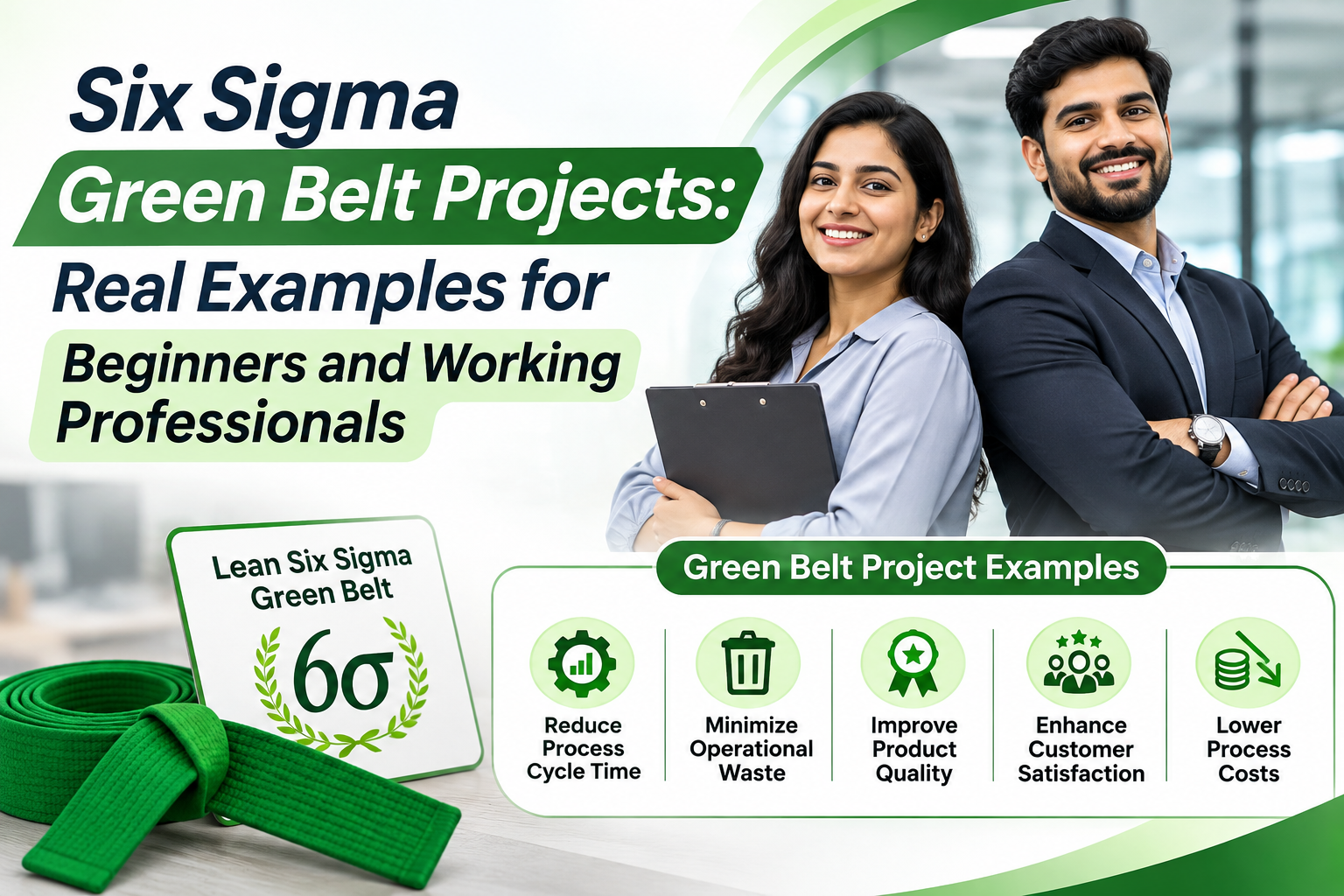
- Build a track record. Complete two or three projects with clear numbers before aiming higher. Our list of real Green Belt project examples helps you choose.
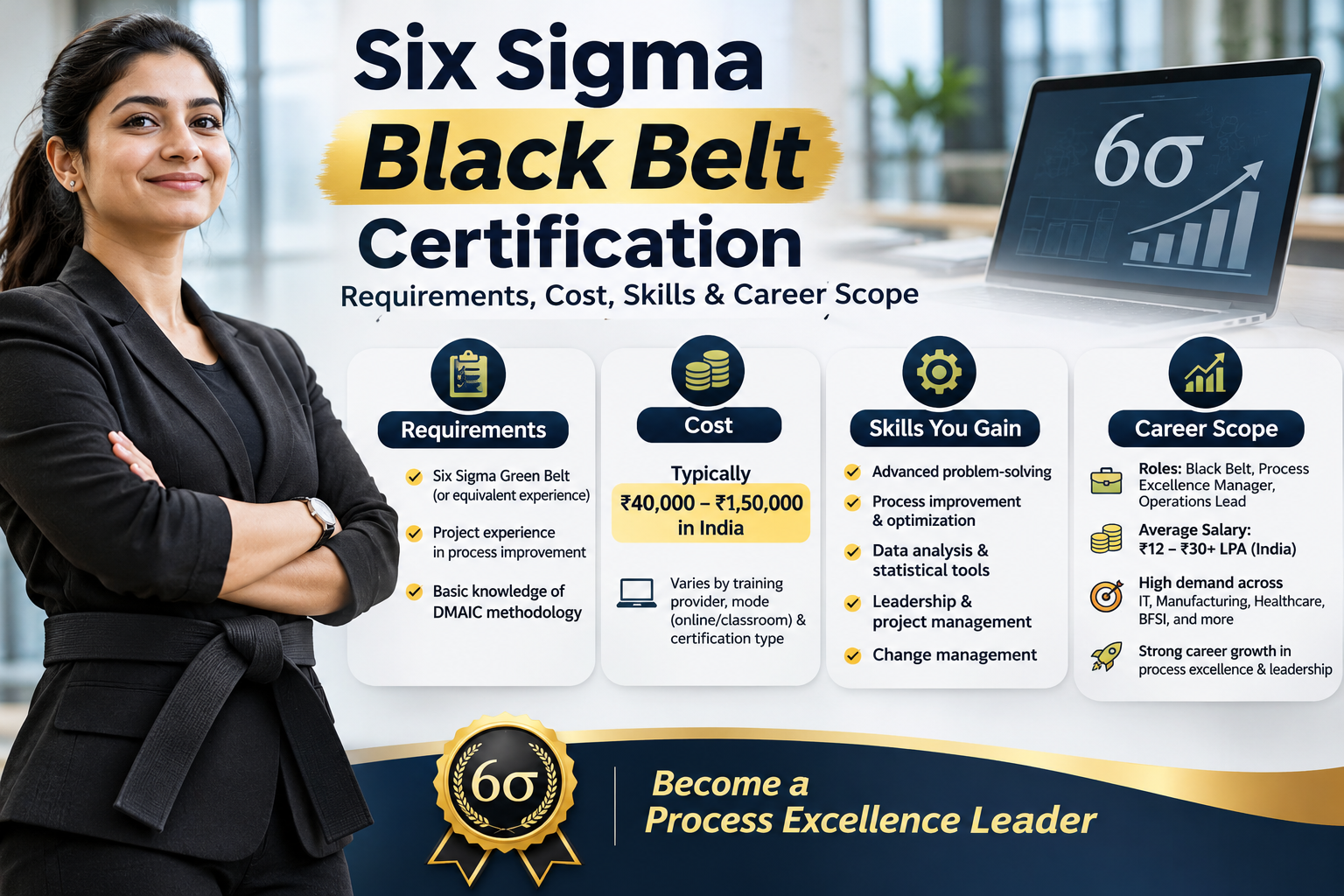
- Black Belt: lead across departments. You take on complex projects, coach Green Belts and report results to senior leaders. Read Black Belt requirements and career scope or see the Black Belt course.
- Master Black Belt or Operational Excellence Head: run the programme. You set strategy, choose which projects get funded, and develop other Black Belts. Some people move into general management from here, as explained in operational vs business excellence.
Where to Start, Based on Your Background
- Fresher or final-year student: Get a Green Belt (or Yellow Belt if statistics feels new), then do one small project, even in an internship or college process. Apply for analyst and quality roles.
- IT or software professional: Use Green Belt to move into service delivery, quality or transition roles. Projects on ticket backlogs or defect leakage work well.
- Manufacturing engineer: Green Belt fits naturally. Aim for Black Belt once you have led projects on rejection or downtime.
- BPO team leader: Green Belt projects on handling time or accuracy are the classic route into process excellence teams.
- Manager with 8+ years: Go straight to Black Belt if you already lead cross-functional work.
Before interviews, practise with our Six Sigma interview questions and answers.
Ready to start your Lean Six Sigma career?
Our live online Green Belt programme includes mock exams and project guidance, so you finish with both a certificate and a project to talk about in interviews.
Frequently Asked Questions
What jobs can I get with a Lean Six Sigma Green Belt in India?
Common roles include process analyst, quality analyst, quality engineer, process improvement specialist and continuous improvement executive, mainly in IT services, BPO, manufacturing, banking and healthcare.
Can a fresher get a job with Six Sigma certification?
Yes, but the certificate works best with proof that you can apply it. Pair a Green Belt with one small, measurable improvement project and target analyst and quality roles.
Does Six Sigma certification increase salary?
It helps, but salary depends mostly on role, experience and results. The biggest increases come when Six Sigma skills help you move into roles that lead projects, own metrics or manage client accounts.
Which industries pay the most for Six Sigma professionals?
Pay varies by company more than by industry, but global capability centres, BPO and KPO operations, IT services and large manufacturers tend to have the most dedicated process excellence roles.
Is Six Sigma a good career for IT professionals?
Yes. It opens paths into service delivery, quality, transition and transformation roles. It also combines well with ITIL and project management certifications.
How long does it take to move from Green Belt to Black Belt?
There is no fixed timeline. Most professionals spend a few years completing Green Belt projects before taking Black Belt, because Black Belt roles expect experience leading larger, cross-functional work.



Leave a Comment