 Quality Management



















 IT Service Management



 Project Management



 Agile Management




 Web Development



 Cloud Computing


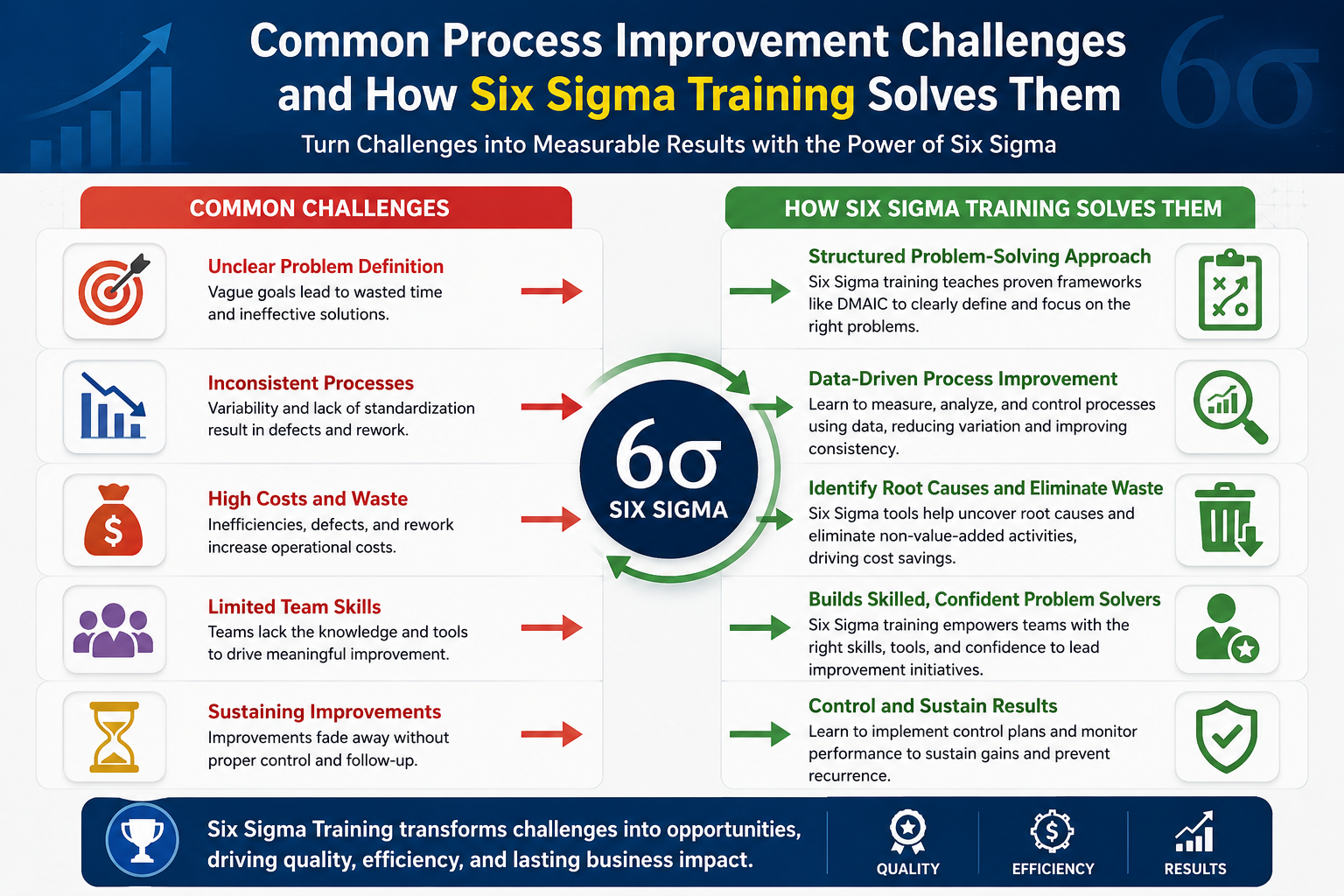
In today's fast-paced business environment, organizations in India are increasingly seeking effective solutions to enhance their operational efficiency and quality management. However, many face significant process improvement challenges that can hinder their growth. This is where Six Sigma methodology comes into play, offering a robust framework for addressing these challenges. In this blog, we will explore some common process improvement challenges and how Six Sigma training can provide effective solutions.
Understanding Process Improvement Challenges
Before delving into how Six Sigma can help, it's essential to understand the common challenges organizations face in their process improvement efforts:
1. Identifying Operational Bottlenecks
Operational bottlenecks can severely limit productivity and efficiency. These bottlenecks often result from outdated processes, lack of training, or insufficient resources. Without a clear understanding of where these bottlenecks occur, organizations struggle to implement effective solutions.
2. Resistance to Change
Change is often met with resistance, especially in traditional organizations. Employees may feel threatened by new processes or fear that they will not be able to adapt. This resistance can stall improvement initiatives and lead to a lack of engagement.
3. Inconsistent Quality Management
Quality management is crucial for customer satisfaction and retention. However, inconsistent quality standards across different departments can lead to varying results, damaging the brand's reputation. Organizations often find it challenging to maintain a consistent quality management system.
4. Lack of Data-Driven Decision Making
Many organizations rely on gut feelings or anecdotal evidence when making decisions. This lack of data-driven decision-making can lead to ineffective strategies and wasted resources. Without proper data analysis, identifying root causes of problems becomes nearly impossible.
5. Insufficient Employee Training
Process improvement initiatives often fail due to a lack of training. Employees need to understand new methodologies and tools for effective implementation. Without proper training, even the best strategies can fall flat.
How Six Sigma Training Addresses These Challenges
Six Sigma is a powerful methodology that utilizes data-driven techniques to eliminate defects and improve processes. Here’s how Six Sigma training can tackle the aforementioned challenges:
1. Identifying and Eliminating Operational Bottlenecks
Six Sigma training equips employees with tools like Value Stream Mapping and Process Mapping. These tools help identify bottlenecks in processes, allowing organizations to streamline operations and enhance efficiency. By focusing on the DMAIC (Define, Measure, Analyze, Improve, Control) framework, organizations can effectively pinpoint and eliminate issues that hinder performance.
2. Fostering a Culture of Change
With Six Sigma training, organizations can foster a culture that embraces change. Employees learn the importance of continuous improvement and how their roles contribute to the organization's success. By involving employees in the improvement process and providing them with the necessary skills, resistance to change diminishes, leading to a more collaborative work environment.
3. Establishing Consistent Quality Management
Six Sigma emphasizes the importance of maintaining high-quality standards. Through training, employees gain an understanding of quality control tools such as Control Charts and Pareto Analysis. This knowledge helps in establishing consistent quality management practices across departments, ensuring that customers receive the same high-quality service or product every time.
4. Promoting Data-Driven Decision Making
Data is at the heart of the Six Sigma methodology. Training emphasizes the use of statistical analysis and data collection techniques, enabling employees to make informed decisions based on concrete evidence. This shift towards data-driven decision-making allows organizations to identify root causes of problems and implement effective solutions, ultimately leading to operational excellence.
5. Providing Comprehensive Employee Training
One of the cornerstones of Six Sigma is its focus on employee training and certification. Organizations that invest in Six Sigma training ensure that their workforce is equipped with the necessary skills to implement process improvements effectively. This investment in human capital pays dividends in the form of improved efficiency and reduced costs.
The Benefits of Implementing Six Sigma in Your Organization
Implementing Six Sigma can lead to numerous benefits, including:
- Increased Efficiency: Streamlining processes leads to faster turnaround times and reduced operational costs.
- Higher Customer Satisfaction: Consistent quality management ensures that customers receive high-quality products and services.
- Enhanced Employee Engagement: Involving employees in the improvement process fosters a sense of ownership and motivation.
- Data-Driven Culture: Organizations become more agile and adaptable, using data to inform decisions and strategies.
- Sustainable Improvements: The focus on continuous improvement ensures that organizations can adapt to changing market conditions.
Frequently Asked Questions (FAQs)
What is Six Sigma?
Six Sigma is a data-driven methodology aimed at improving processes by identifying and eliminating defects. It employs various tools and techniques to enhance quality and operational efficiency.
How long does it take to complete Six Sigma training?
The duration of Six Sigma training can vary depending on the level (Yellow Belt, Green Belt, Black Belt) and the training provider. Typically, it can range from a few days to several weeks.
Is Six Sigma only applicable to manufacturing industries?
No, Six Sigma is applicable across various sectors, including service industries, healthcare, finance, and more. Any organization looking to improve its processes can benefit from Six Sigma.
Can small businesses implement Six Sigma?
Absolutely! Six Sigma can be tailored to fit the needs of small businesses, helping them improve processes and reduce costs without requiring extensive resources.
Conclusion
In summary, organizations in India face numerous process improvement challenges, but with the right approach, these challenges can be effectively addressed. Six Sigma training offers practical solutions that not only tackle operational bottlenecks but also foster a culture of continuous improvement and quality management.
If your organization is looking to enhance its operational excellence and overcome process improvement challenges, consider investing in Six Sigma training. Equip your team with the skills they need to drive meaningful change and achieve sustainable results.
Ready to transform your organization? Contact us today to learn more about our Six Sigma training programs!


Leave a Comment