
 Quality Management



















 IT Service Management



 Project Management



 Agile Management




 Web Development



 Cloud Computing


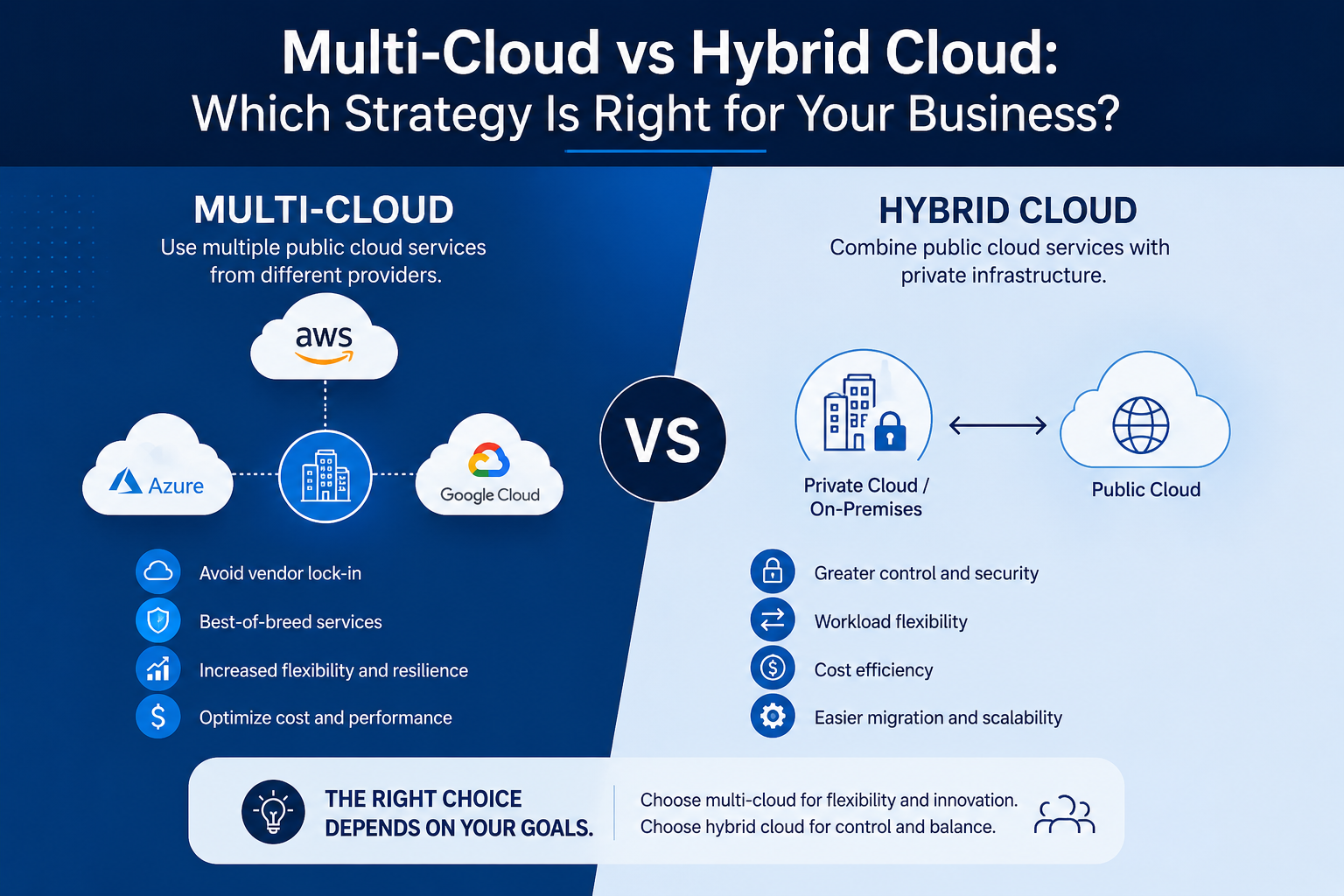
In the rapidly evolving landscape of cloud computing, businesses in India are increasingly faced with the decision of choosing between multi-cloud and hybrid cloud strategies. Both models offer unique advantages and challenges, making it crucial for enterprises to understand the differences and evaluate which cloud deployment model aligns best with their operational goals. This blog will explore the nuances of multi-cloud vs hybrid cloud, delving into cloud migration strategy, cloud infrastructure management, and enterprise cloud solutions to help you make an informed decision.
Understanding Cloud Deployment Models
Before diving into the comparison, let’s clarify what multi-cloud and hybrid cloud mean.
What is Multi-Cloud?
Multi-cloud refers to the use of multiple cloud computing services from different providers within a single architecture. It allows businesses to leverage the unique offerings of various providers to optimize performance and cost-effectiveness. For instance, a company might employ AWS for its computing power, Google Cloud for data analytics, and Azure for machine learning capabilities.
What is Hybrid Cloud?
Hybrid cloud, on the other hand, combines public and private cloud infrastructures, allowing for data and applications to be shared between them. This model provides businesses the flexibility to scale their operations while maintaining control over sensitive data in a private environment. For example, an enterprise may run applications on its private cloud while utilizing a public cloud for less-critical operations.
Key Differences Between Multi-Cloud and Hybrid Cloud
Now that we have a clear understanding of both models, let’s explore the critical differences between multi-cloud and hybrid cloud strategies.
1. Cloud Infrastructure Management
In multi-cloud environments, managing various cloud services can become complex. Organizations must invest in robust cloud infrastructure management tools to integrate, monitor, and optimize their resources effectively. On the contrary, hybrid cloud solutions often come with integrated management tools, making it easier to oversee both public and private clouds. This can lead to streamlined operations and reduced overheads.
2. Cost Efficiency
Cost efficiency is a significant factor for Indian businesses. Multi-cloud strategies allow organizations to select the most cost-effective services from different providers, potentially lowering operational costs. However, managing multiple providers can lead to hidden costs, such as increased training or integration expenses. In contrast, hybrid cloud solutions can help organizations manage costs by keeping sensitive data on a private cloud while utilizing public resources for scalability.
3. Compliance and Security
For companies in regulated industries, compliance and security are paramount. Hybrid cloud solutions typically provide a higher level of control over sensitive data, which is crucial for meeting compliance requirements. Multi-cloud strategies can offer enhanced security features from various providers, but they can also introduce risks due to the complexity of managing multiple security protocols.
4. Flexibility and Scalability
Both multi-cloud and hybrid cloud models offer flexibility and scalability, but in different ways. Multi-cloud allows organizations to scale services quickly by leveraging various providers, ensuring they can meet changing demands. Hybrid cloud, however, provides the ability to scale resources while keeping critical workloads on a private cloud, giving businesses the best of both worlds.
When to Choose Multi-Cloud?
Choosing a multi-cloud strategy can be beneficial for businesses that:
- Want to avoid vendor lock-in and ensure flexibility in their cloud services.
- Require specialized solutions from different cloud providers.
- Have a diverse range of applications that can benefit from specific cloud environments.
- Can invest in robust cloud infrastructure management tools to navigate the complexities of multi-cloud.
When to Choose Hybrid Cloud?
A hybrid cloud strategy might be the right choice for businesses that:
- Need to maintain control over sensitive data while leveraging the public cloud for scalability.
- Operate in regulated industries where compliance is essential.
- Require a more straightforward management approach to reduce overhead.
- Want to gradually transition to the cloud while keeping some operations on-premises.
Cloud Migration Strategy: Making the Transition
Regardless of which strategy you choose, a well-planned cloud migration strategy is crucial. Here are some steps to consider:
1. Assess Your Current Infrastructure
Evaluate your existing IT infrastructure to identify workloads and applications that can benefit from cloud migration. This assessment will help you determine whether a multi-cloud or hybrid cloud approach is appropriate.
2. Define Your Business Objectives
Establish clear business objectives for your cloud migration. Are you looking to improve performance, enhance security, or reduce costs? Understanding your goals will help guide your cloud deployment model decision.
3. Choose the Right Cloud Providers
If you opt for a multi-cloud strategy, carefully select cloud providers that align with your business objectives. For a hybrid cloud approach, choose a provider that offers robust integration capabilities between public and private clouds.
4. Develop a Comprehensive Migration Plan
Create a detailed migration plan that outlines the steps for moving applications and data to the cloud. Ensure that you include timelines, resource allocation, and potential risks in your plan.
5. Monitor and Optimize
After migration, continuously monitor your cloud infrastructure management to optimize performance and costs. Regular audits and assessments will help you make necessary adjustments and improve your cloud deployment model.
Conclusion: Making the Right Choice for Your Business
Both multi-cloud and hybrid cloud strategies offer distinct advantages, and the right choice for your business will depend on your specific needs and objectives. By understanding the differences between these cloud deployment models, assessing your current infrastructure, and developing a robust cloud migration strategy, you can position your business for success in the digital age.
FAQs
1. What is the main difference between multi-cloud and hybrid cloud?
The main difference lies in their architecture: multi-cloud uses multiple cloud services from various providers, while hybrid cloud combines both public and private cloud infrastructures.
2. Which cloud deployment model is more cost-effective?
Multi-cloud can be more cost-effective as it allows businesses to choose the best services from different providers. However, hybrid cloud can help manage costs by keeping sensitive data on private cloud while leveraging public resources.
3. How do I decide which strategy is right for my business?
Assess your current infrastructure, define your business objectives, and consider factors like compliance, security, and management complexity to determine the best cloud deployment model for your needs.
Call to Action
Ready to take your business to the cloud? Whether you're leaning towards a multi-cloud or hybrid cloud strategy, our team of experts at [Your Company Name] is here to help you navigate your cloud migration strategy and optimize your cloud infrastructure management. Contact us today to get started!




Leave a Comment