
 Quality Management



















 IT Service Management



 Project Management



 Agile Management



 Web Development



 Cloud Computing


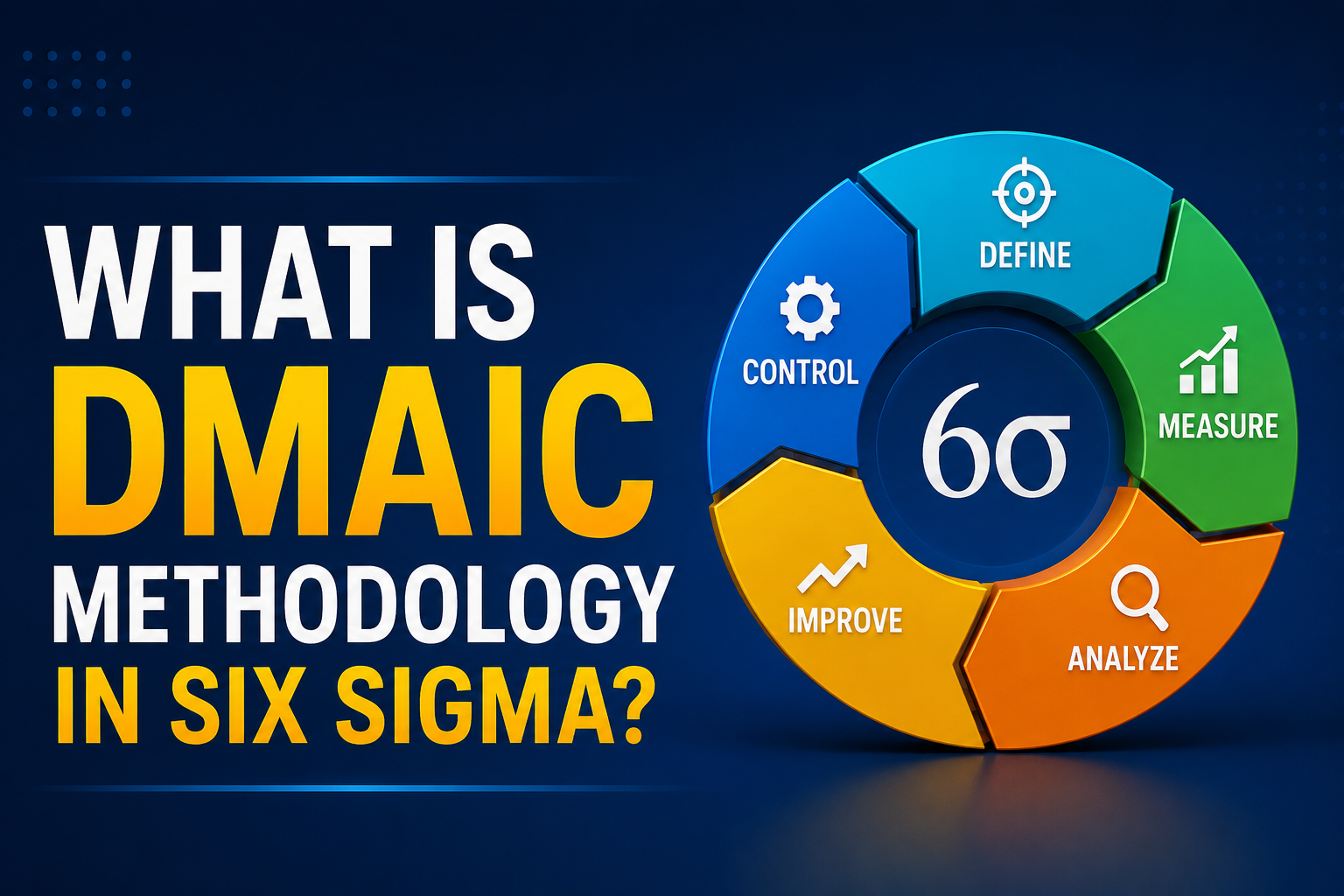
In today’s highly competitive business environment, organizations constantly look for ways to improve quality, reduce defects, optimize operations, and enhance customer satisfaction. This is where the DMAIC Methodology in Six Sigma becomes a powerful process improvement approach.
DMAIC is one of the most widely used frameworks in Lean Six Sigma and helps businesses identify problems, analyze root causes, improve processes, and maintain long-term results. Companies across manufacturing, healthcare, IT, logistics, customer service, and finance industries use the DMAIC process to increase efficiency and reduce operational waste.
Whether you are a working professional, project manager, student, quality analyst, or business owner, understanding DMAIC in Six Sigma can help you improve business processes and build a strong career in quality management.
In this article, you will learn:
- What DMAIC methodology is
- The 5 phases of DMAIC
- DMAIC tools used in each phase
- Real-life DMAIC examples
- Benefits of DMAIC
- DMAIC vs PDCA
- Best practices for implementation
What is DMAIC Methodology?
DMAIC stands for:
- Define
- Measure
- Analyze
- Improve
- Control
It is a structured, data-driven Six Sigma methodology used to solve business and process problems systematically.
The DMAIC methodology in Six Sigma helps organizations:
- Reduce process variation
- Improve quality
- Eliminate defects
- Increase productivity
- Improve customer satisfaction
- Achieve continuous improvement
DMAIC is mainly used for improving existing processes rather than creating new ones.
The framework follows a step-by-step approach that helps teams identify the root causes of issues and implement measurable improvements.
History of DMAIC in Six Sigma
The DMAIC framework was developed as part of the Six Sigma methodology introduced by Motorola in the 1980s. Later, companies like General Electric (GE) popularized Lean Six Sigma DMAIC across industries.
Over time, DMAIC became one of the most trusted process improvement methodologies because of its structured and measurable approach.
Today, DMAIC is used globally in:
- Manufacturing
- Healthcare
- IT services
- Banking
- Supply chain
- Retail
- Telecommunications
- Customer service operations
The 5 Phases of DMAIC Explained
1. Define Phase
The Define phase focuses on identifying the problem, project goals, customer expectations, and business impact.
Main Objectives
- Define the problem clearly
- Understand customer requirements
- Identify project scope
- Set improvement goals
Key Questions
- What is the problem?
- Who is affected?
- What are customer expectations?
- What is the project objective?
Tools Used in Define Phase
- Project Charter
- SIPOC Diagram
- Voice of Customer (VOC)
- Stakeholder Analysis
- Process Mapping
Example
A manufacturing company notices high product rejection rates. The Define phase identifies defective packaging as the core issue affecting customer satisfaction.
2. Measure Phase
The Measure phase focuses on collecting data and understanding current process performance.
Main Objectives
- Measure existing process performance
- Collect reliable data
- Identify process variations
- Establish baseline metrics
Key Metrics
- Defect rates
- Cycle time
- Process capability
- Customer complaints
DMAIC Tools Used
- Data Collection Plan
- Pareto Chart
- Check Sheets
- Histograms
- Process Capability Analysis
Example
The packaging company measures defect percentages across production lines to identify which machines generate maximum defects.
3. Analyze Phase
The Analyze phase identifies the root causes of defects and inefficiencies.
Main Objectives
- Identify root causes
- Validate data findings
- Analyze process gaps
- Understand why problems occur
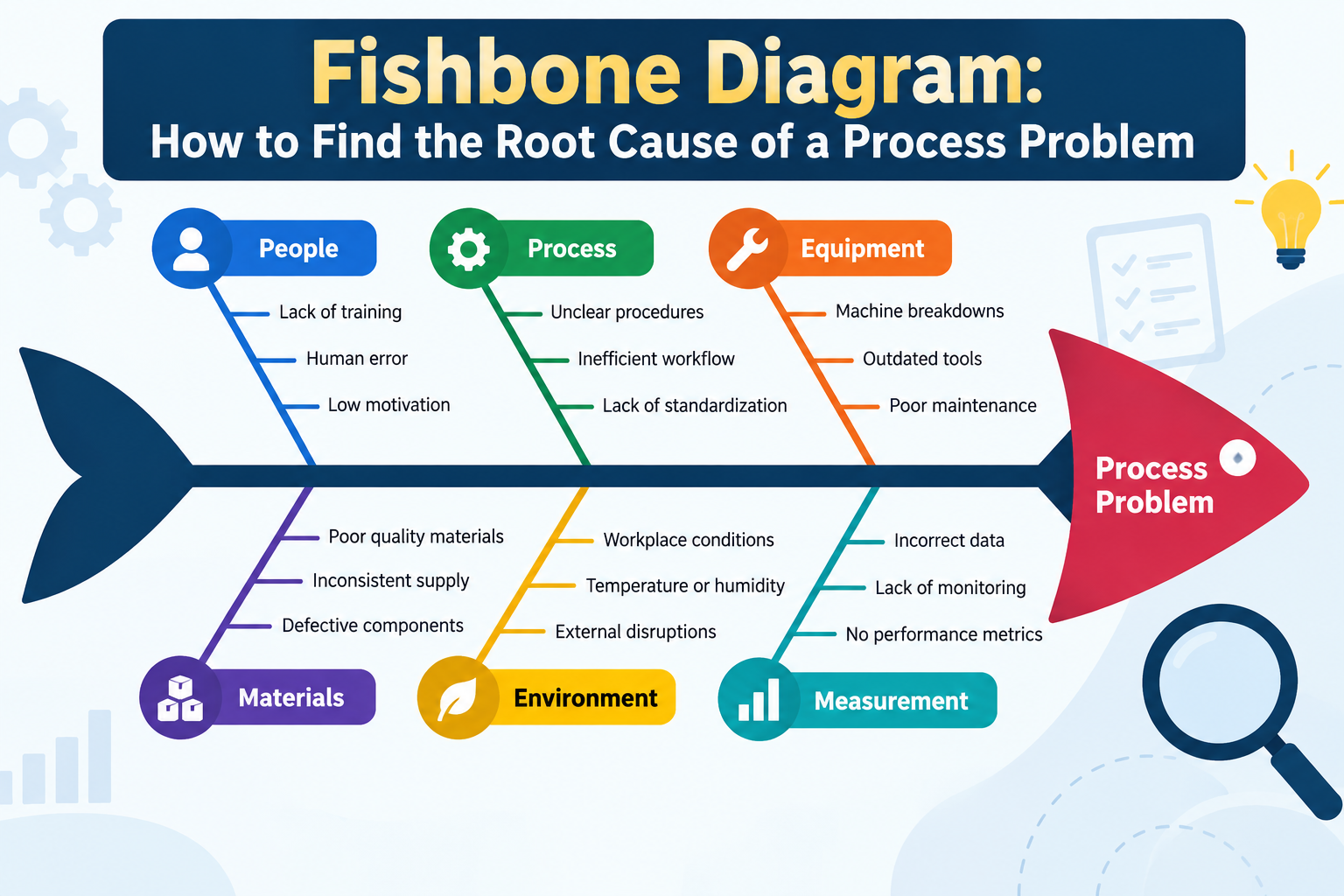
Common Root Cause Analysis Tools
- Fishbone Diagram
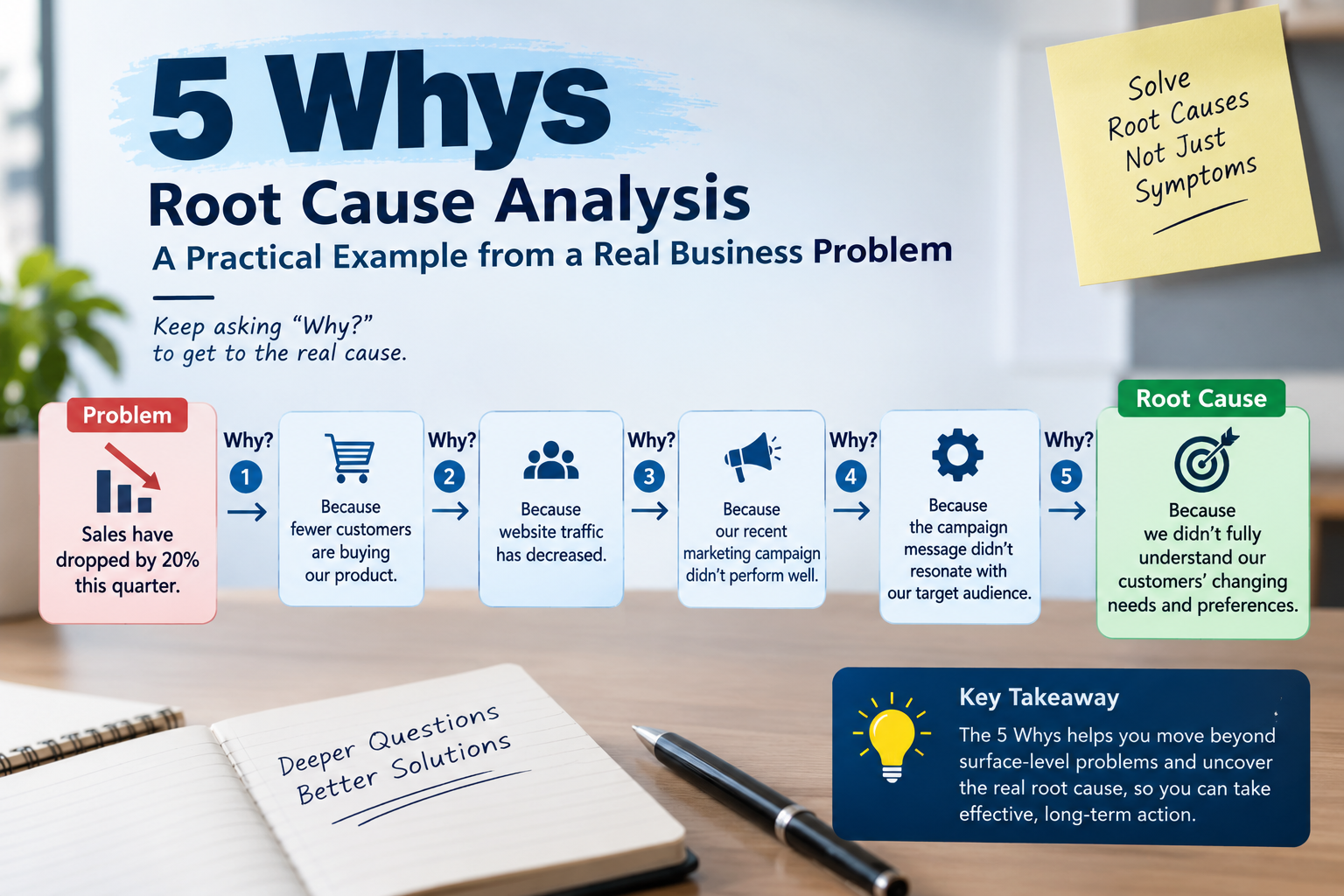
- 5 Whys Analysis
- Scatter Plot
- Failure Mode and Effects Analysis (FMEA)
- Regression Analysis
Example
After analysis, the company discovers that incorrect machine calibration causes most packaging defects.
4. Improve Phase
The Improve phase develops and implements solutions to eliminate root causes.
Main Objectives
- Develop improvement strategies
- Test solutions
- Reduce defects
- Optimize performance
Improvement Techniques
- Kaizen
- Automation
- SOP Development
- Lean Management Techniques
- Process Redesign
DMAIC Tools Used
- Brainstorming
- Pilot Testing
- Design of Experiments (DOE)
- Risk Assessment
Example
The company recalibrates machines and trains operators, reducing packaging defects by 60%.
5. Control Phase
The Control phase ensures improvements are maintained long-term.
Main Objectives
- Sustain improvements
- Monitor process performance
- Prevent recurring issues
- Standardize processes
Control Tools
- Control Charts
- SOPs
- KPI Monitoring
- Audit Checklists
- Visual Management
Example
The company implements weekly quality audits and automated monitoring systems to maintain defect reduction.
Real-Life DMAIC Examples
DMAIC in Manufacturing
A car manufacturing company uses DMAIC to reduce paint defects on vehicle bodies.
Results
- 40% defect reduction
- Faster production
- Lower rework costs
DMAIC in Healthcare
A hospital uses DMAIC methodology to reduce patient waiting times.
Results
- Improved patient satisfaction
- Reduced waiting time by 35%
- Better workflow efficiency
DMAIC in IT Industry
An IT company applies DMAIC to reduce software bugs and improve deployment quality.
Results
- Fewer production issues
- Faster release cycles
- Improved customer experience
DMAIC in Customer Service
A call center uses DMAIC to reduce customer complaint resolution time.
Results
- Faster issue resolution
- Improved customer retention
- Better employee productivity
Benefits of DMAIC Methodology in Six Sigma
The DMAIC process offers several advantages to businesses.
1. Improves Process Quality
DMAIC helps eliminate errors and defects systematically.
2. Enhances Customer Satisfaction
Improved quality directly increases customer trust and loyalty.
3. Reduces Operational Costs
Organizations reduce waste, rework, and inefficiencies.
4. Data-Driven Decision Making
DMAIC uses measurable data instead of assumptions.
5. Supports Continuous Improvement
It creates a culture of ongoing process optimization.
6. Increases Productivity
Efficient workflows improve team performance.
Why DMAIC is Important in Lean Six Sigma
DMAIC is the backbone of Lean Six Sigma process improvement.
It combines:
- Lean principles for waste reduction
- Six Sigma techniques for defect reduction
This powerful combination helps organizations achieve operational excellence.
The DMAIC methodology is especially useful because it:
- Provides structured problem solving
- Improves decision-making
- Supports measurable improvements
- Enhances process consistency
Industries Using DMAIC
DMAIC methodology examples can be found in almost every industry.
Major Industries
- Manufacturing
- Healthcare
- Banking
- Logistics
- IT & Software
- Retail
- Telecommunications
- Hospitality
- Education
- Customer Support
Organizations use DMAIC to improve efficiency, reduce defects, and optimize operations.
Common Challenges in DMAIC Projects
Although DMAIC is highly effective, businesses may face challenges.
Common Problems
- Poor data collection
- Resistance to change
- Lack of leadership support
- Inadequate training
- Incorrect root cause identification
- Weak process monitoring
Proper planning and leadership involvement can overcome these challenges.
Best Practices for DMAIC Success
1. Define Clear Objectives
Always establish measurable project goals.
2. Use Accurate Data
Reliable data improves analysis accuracy.
3. Involve Cross-Functional Teams
Collaboration improves solution quality.
4. Focus on Root Causes
Avoid solving symptoms only.
5. Monitor Results Continuously
Use KPIs and control charts regularly.
6. Train Employees
Lean Six Sigma training improves implementation success.
Frequently Asked Questions (FAQs)
What are the 5 phases of DMAIC?
The five phases are Define, Measure, Analyze, Improve, and Control.
What is DMAIC used for?
DMAIC is used for process improvement, defect reduction, and operational efficiency enhancement.
Is DMAIC part of Six Sigma?
Yes, DMAIC is a core methodology used in Lean Six Sigma projects.
What are DMAIC tools?
DMAIC tools include SIPOC, Pareto Charts, Fishbone Diagrams, FMEA, and Control Charts.
What is the difference between DMAIC and Lean?
Lean focuses on waste reduction, while DMAIC focuses on defect reduction and process improvement.
Which industries use DMAIC?
Manufacturing, healthcare, IT, logistics, banking, and customer service industries widely use DMAIC.
The DMAIC Methodology in Six Sigma is one of the most effective frameworks for business process improvement and quality management. By following the five structured phases — Define, Measure, Analyze, Improve, and Control — organizations can identify root causes, reduce defects, improve efficiency, and enhance customer satisfaction.
From manufacturing plants to IT companies and healthcare institutions, DMAIC continues to help organizations achieve operational excellence through data-driven decision-making and continuous improvement.
If you want to build a career in quality management, process optimization, or Lean Six Sigma, understanding DMAIC is essential. Whether you are a beginner or a professional, mastering DMAIC tools and techniques can significantly improve your problem-solving and leadership skills.
Start implementing DMAIC today to transform your business processes and achieve long-term operational success.


Leave a Comment