
 Quality Management



















 IT Service Management



 Project Management



 Agile Management



 Web Development



 Cloud Computing


If you’ve ever explored process improvement or quality management, you’ve probably come across two terms again and again—Lean and Six Sigma.
And the confusion is real.
Are they the same?
Which one is better?
Do you need to learn both?
For freshers, professionals, and even business owners, understanding the difference between Lean and Six Sigma is important because both approaches help companies improve efficiency—but in different ways.
Let’s break it down in the simplest way possible.
What is Lean? (Simple Explanation)
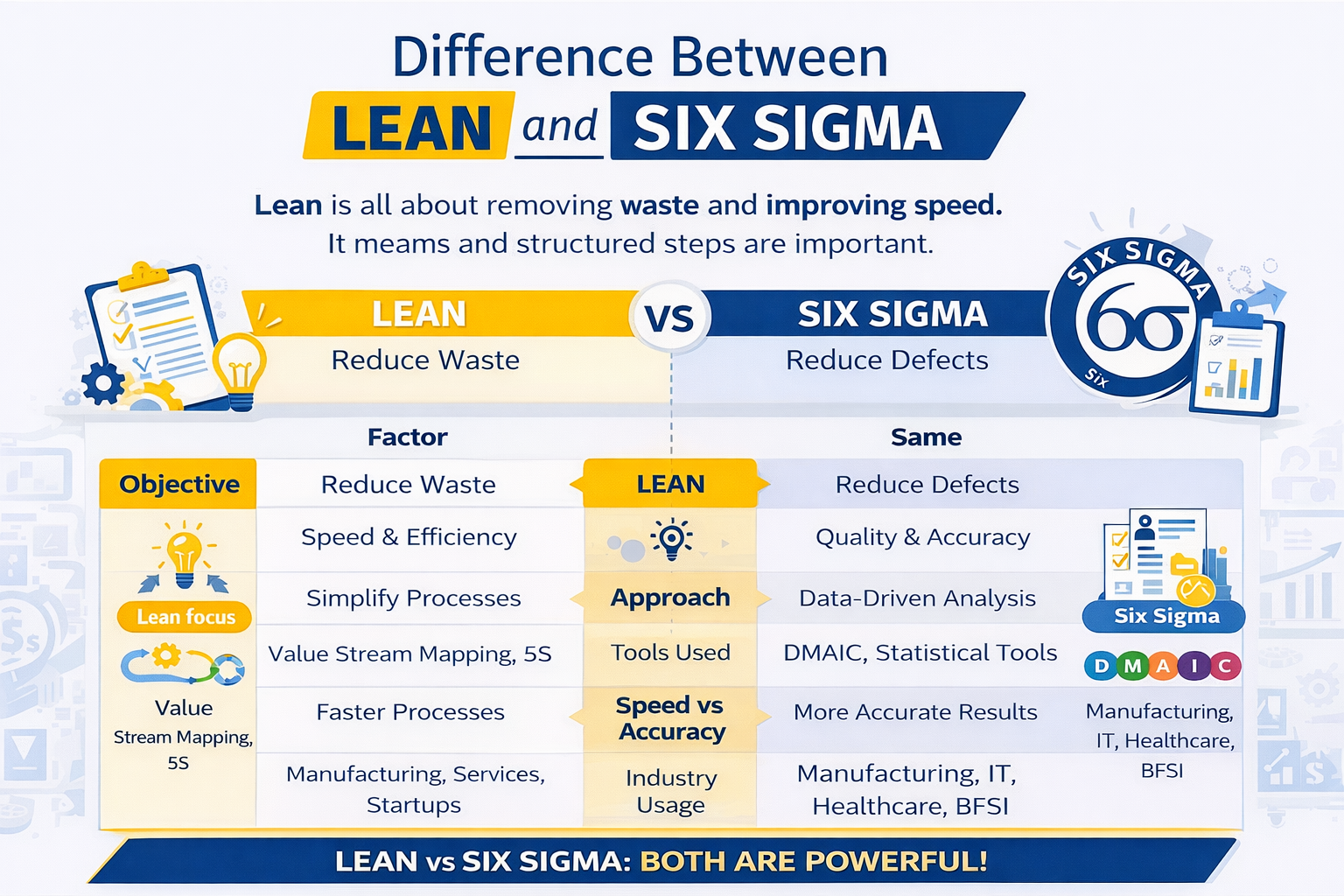
Lean is all about removing waste and improving speed.
In simple terms, Lean focuses on eliminating anything that does not add value to the customer.
Example (Indian Context):
Imagine you go to a restaurant and wait 20 minutes just to place an order.
That waiting time = waste.
Lean helps businesses:
- Reduce waiting time
- Remove unnecessary steps
- Deliver faster service
Lean Focus:
- Speed
- Efficiency
- Waste reduction
What is Six Sigma? (Simple Explanation)
Six Sigma focuses on reducing errors and improving quality.
Instead of speed, it focuses on doing things right the first time.
It uses a structured method called DMAIC:
- Define – Identify the problem
- Measure – Collect data
- Analyze – Find root cause
- Improve – Fix the issue
- Control – Maintain results
Example:
If a company is delivering defective products, Six Sigma helps identify:
- Why defects are happening
- How to reduce them
- How to maintain quality
Six Sigma Focus:
- Accuracy
- Quality
- Data-driven decisions
Key Difference Between Lean and Six Sigma
Here’s a clear comparison to understand Lean vs Six Sigma:
Factor Lean Six Sigma Objective Eliminate waste Reduce defects Focus Area Speed & efficiency Quality & accuracy Approach Simplify processes Data-driven analysis Tools Used Value Stream Mapping, 5SDMAIC, Statistical tools Speed vs Accuracy Faster processes More accurate results Industry Usage Manufacturing, services, startups Manufacturing, IT, healthcare, BFSI
Lean vs Six Sigma: Which is Better?
This is the most common question.
The answer is simple: Neither is better—they solve different problems.
Use Lean When:
- Processes are slow
- There is too much waiting time
- Workflow is inefficient
Use Six Sigma When:
- There are quality issues
- Errors or defects are high
- Decisions need data analysis
The smartest approach is knowing when to use what.
What is Lean Six Sigma?
Lean Six Sigma is a combination of both methodologies.
It combines:
- Lean’s speed and efficiency
- Six Sigma’s accuracy and quality
Why Companies Prefer Lean Six Sigma:
- Faster processes + fewer errors
- Better customer satisfaction
- Reduced costs
- Improved performance
This is why most organizations today prefer professionals with Lean Six Sigma Certification in India.
Real-Life Example: Lean vs Six Sigma in Action
Let’s take a simple example of an e-commerce company:
Problem 1: Late Deliveries
- Orders are delayed due to the slow packaging process
- 👉 Solution: Lean
- Remove unnecessary steps
- Improve workflow
Problem 2: Wrong Products Delivered
- Customers receive incorrect items
- 👉 Solution: Six Sigma
- Analyze root cause
- Improve accuracy in order processing
Final Outcome:
When both are applied → Faster delivery + correct orders
That’s the power of combining Lean and Six Sigma.
Career Opportunities in Lean and Six Sigma
Learning these skills opens doors to multiple career paths.
Popular Job Roles:
- Process Improvement Executive
- Quality Analyst
- Operations Manager
- Business Analyst
- Continuous Improvement Manager
Industries Hiring:
- Manufacturing
- IT & Software
- Healthcare
- Banking & Finance (BFSI)
- Logistics & E-commerce
- Startups
With growing demand, Six Sigma vs Lean Manufacturing is no longer a debate—companies want professionals who understand both.
Conclusion: Learn Both for Maximum Growth
Understanding the difference between Lean and Six Sigma is important—but mastering both is powerful.
Lean helps you:
- Work faster
- Eliminate waste
Six Sigma helps you:
- Improve quality
- Reduce errors
Together, they make you a complete professional.
In today’s competitive market, skills matter more than degrees—and Lean Six Sigma is one of the most valuable skills you can have.
Call to Action
If you want to stand out in your career and become job-ready:
👉 Start learning Lean Six Sigma today
👉 Build practical, industry-relevant skills
👉 Open doors to better job opportunities
Enroll in a Lean Six Sigma certification program and future-proof your career.
FAQs
1. What is the main difference between Lean and Six Sigma?
Lean focuses on removing waste and improving speed, while Six Sigma focuses on reducing defects and improving quality.
2. Which is better: Lean or Six Sigma?
Both are useful. Lean improves efficiency, while Six Sigma improves accuracy. The best approach is to combine both.
3. What is Lean Six Sigma?
Lean Six Sigma is a combination of Lean and Six Sigma that focuses on both speed and quality improvement.
4. Is Lean Six Sigma good for freshers?
Yes, it helps freshers gain practical skills and improves job opportunities.
5. Which certification should I start with?
Beginners can start with the Yellow Belt and then move to the Green Belt for advanced knowledge.



Leave a Comment