
 Quality Management



















 IT Service Management



 Project Management



 Agile Management




 Web Development



 Cloud Computing


Every year, lakhs of students graduate with degrees like B.Tech, BBA, MBA, and B.Com. But the reality hits hard during placements, companies are not just looking for degrees, they want skills.
Most freshers struggle with:
- “You don’t have practical experience”
- “We need someone who understands processes”
- “You lack problem-solving exposure”
This is where a Six Sigma Course for Freshers becomes a game-changer.
It bridges the gap between theoretical knowledge and practical industry skills, giving you a strong edge in interviews and your first job.
What is Six Sigma? (Simple Explanation)
In simple terms, Six Sigma is a method used by companies to improve processes and reduce errors.

Think of it like this:
If a company is facing delays, customer complaints, or inefficiencies, Six Sigma helps fix those problems using data and structured steps.
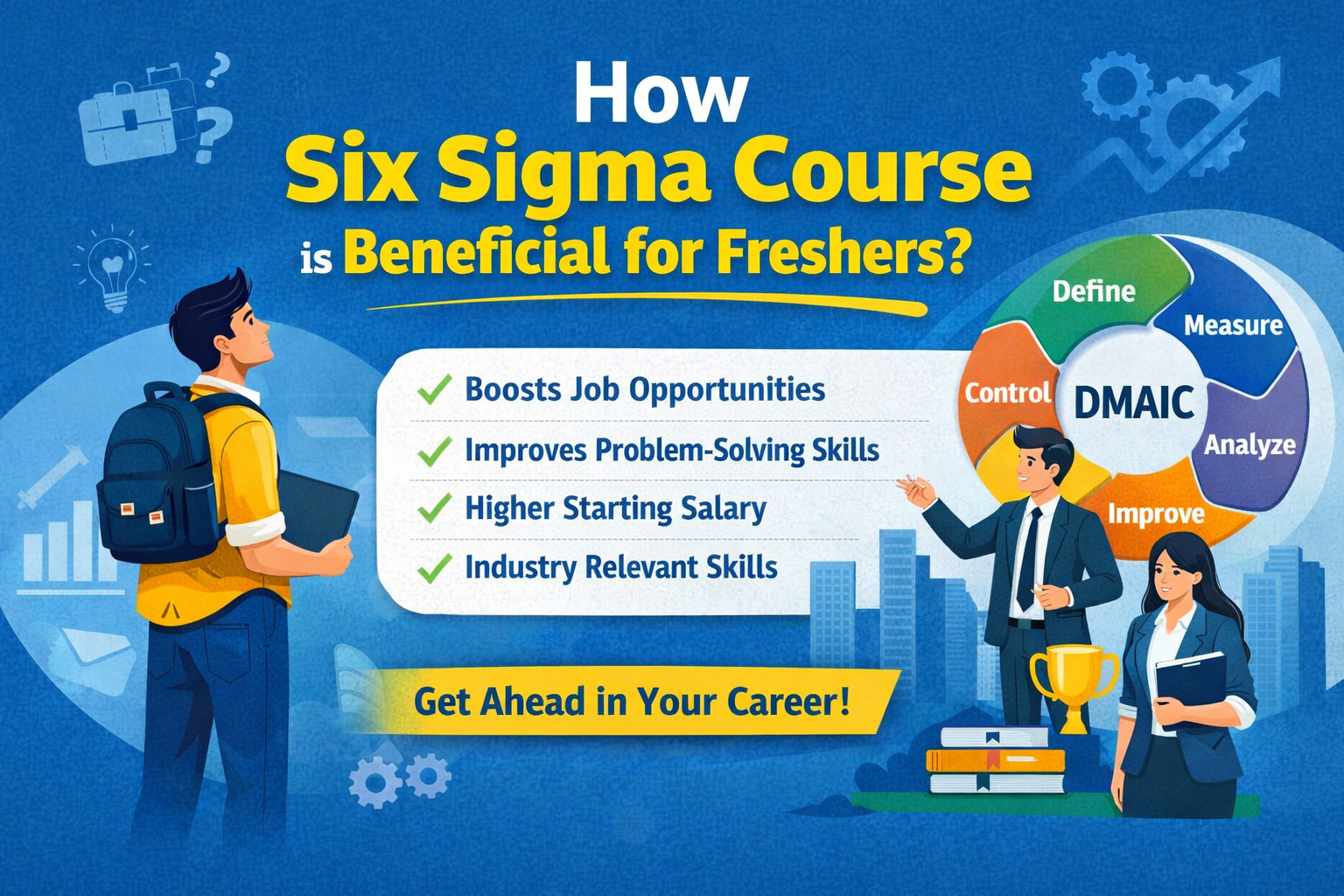
The core approach is called DMAIC:
- Define – Identify the problem
- Measure – Collect data
- Analyze – Find the root cause
- Improve – Fix the issue
- Control – Maintain results
You don’t need to be a math expert. A Six Sigma Certification for Beginners teaches everything step-by-step in a practical way.
Why Freshers Struggle in Jobs
Let’s be honest, most freshers face similar challenges:
1. Lack of Practical Skills
Colleges focus more on theory, but companies expect real-world application.
2. No Process Understanding
Freshers don’t understand how businesses actually operate—workflow, efficiency, cost-saving.
3. High Competition
With thousands of applicants for one job, standing out becomes difficult.
This is exactly where Lean Six Sigma for Freshers India provides a strong advantage.
Top Benefits of Six Sigma for Freshers
Here are the key benefits of Six Sigma for students and fresh graduates:
1. Improves Problem-Solving Skills
Six Sigma trains you to think logically and solve real business problems.
Instead of guessing, you learn:
- How to analyze data
- How to identify root causes
- How to give structured solutions
This skill is highly valued in interviews.
2. Adds Strong Value to Your Resume
A Six Sigma certification instantly makes your resume stand out.
It signals:
- You have practical knowledge
- You understand business processes
- You are job-ready
For freshers with no experience, this becomes a powerful differentiator.
3. Better Job Opportunities
Companies actively look for candidates with process improvement skills.
With a Six Sigma Course for Freshers, you can apply for roles like:
- Quality Analyst
- Process Executive
- Business Analyst (Entry-Level)
- Operations Executive
4. Higher Starting Salary Potential
Certified candidates often get better salary packages compared to non-certified peers.
Why? Because you:
- Add value from Day 1
- Require less training
- Contribute to efficiency
5. Industry Relevance Across Domains
One of the biggest advantages is flexibility.
Six Sigma is used in:
- IT & Software
- Manufacturing
- Healthcare
- Banking & Finance (BFSI)
- Logistics & E-commerce
This means your career is not limited to one industry.
6. Builds Analytical Thinking
Six Sigma helps you develop a data-driven mindset.
Instead of assumptions, you learn to:
- Work with numbers
- Interpret data
- Make informed decisions
This is a critical skill in today’s job market.
Real-Life Example: How a Fresher Got an Edge
Rahul, a B.Tech graduate, was struggling during campus placements.
He had good academic scores but kept getting rejected due to a lack of practical exposure.
He then completed a Six Sigma Certification for Beginners (Yellow Belt).
In his next interview:
- He explained a process improvement case
- Demonstrated problem-solving using DMAIC
- Showed understanding of the business efficiency result?
He got selected as a Process Executive in an MNC.
The difference wasn’t the degree—it was the skillset.
Career Opportunities After Six Sigma
After completing a Six Sigma course, freshers can explore multiple career paths.
Popular Job Roles:
- Quality Analyst
- Process Executive
- Operations Analyst
- Business Analyst (Entry-Level)
- Continuous Improvement Executive
Industries Hiring Six Sigma Professionals:
- IT & ITES
- Manufacturing & Production
- Healthcare & Hospitals
- BFSI (Banking, Financial Services, Insurance)
- E-commerce & Startups
This makes Six Sigma career opportunities highly versatile and future-proof.
Why Companies Prefer Six Sigma Certified Candidates
Companies today focus on efficiency, cost-saving, and performance.
Here’s why they prefer Six Sigma-certified freshers:
1. Focus on Efficiency & Cost Reduction
You are trained to:
- Reduce errors
- Improve productivity
- Optimize processes
2. Data-Driven Decision Making
Companies love candidates who:
- Use data instead of assumptions
- Make logical decisions
- Provide measurable results
This makes you more valuable than a regular fresher.
Which Six Sigma Certification is Best for Freshers
If you’re just starting, here’s what you should choose:
Yellow Belt (Recommended for Beginners)
- Basic understanding of Six Sigma
- Ideal for freshers
- Easy to learn and apply
Green Belt (Next Level)
- Deeper knowledge of tools and techniques
- Suitable after some basic exposure
- Helps in better career growth
For most freshers, starting with Yellow Belt is the best option.
Conclusion: Skill Matters More Than Degree
In today’s competitive job market, having a degree is not enough.
What truly matters is:
- Practical knowledge
- Problem-solving ability
- Industry-relevant skills
A Six Sigma Course for Freshers gives you all three.
It not only improves your chances of getting a job but also helps you grow faster in your career.
Call to Action
If you are a fresher struggling with placements or unsure about your career path, this is the right time to upgrade your skills.
Enroll in a Six Sigma training program today and make yourself job-ready.
Don’t just compete—stand out.
FAQs
1. Is Six Sigma useful for freshers with no experience?
Yes, Six Sigma is highly useful as it provides practical skills that freshers usually lack, making them more employable.
2. Which Six Sigma certification is best for beginners?
Yellow Belt is the best starting point for freshers. It covers basic concepts in an easy-to-understand way.
3. Can Six Sigma help in getting a job?
Yes, it improves your resume, interview performance, and increases your chances of getting hired.
4. What is the salary after Six Sigma certification for freshers?
Salary varies, but certified freshers often get better packages compared to non-certified candidates.
5. Is Six Sigma only for engineers?
No, it is useful for students from all backgrounds including BBA, B.Com, MBA, and more.



Leave a Comment