
 Quality Management



















 IT Service Management



 Project Management



 Agile Management




 Web Development



 Cloud Computing


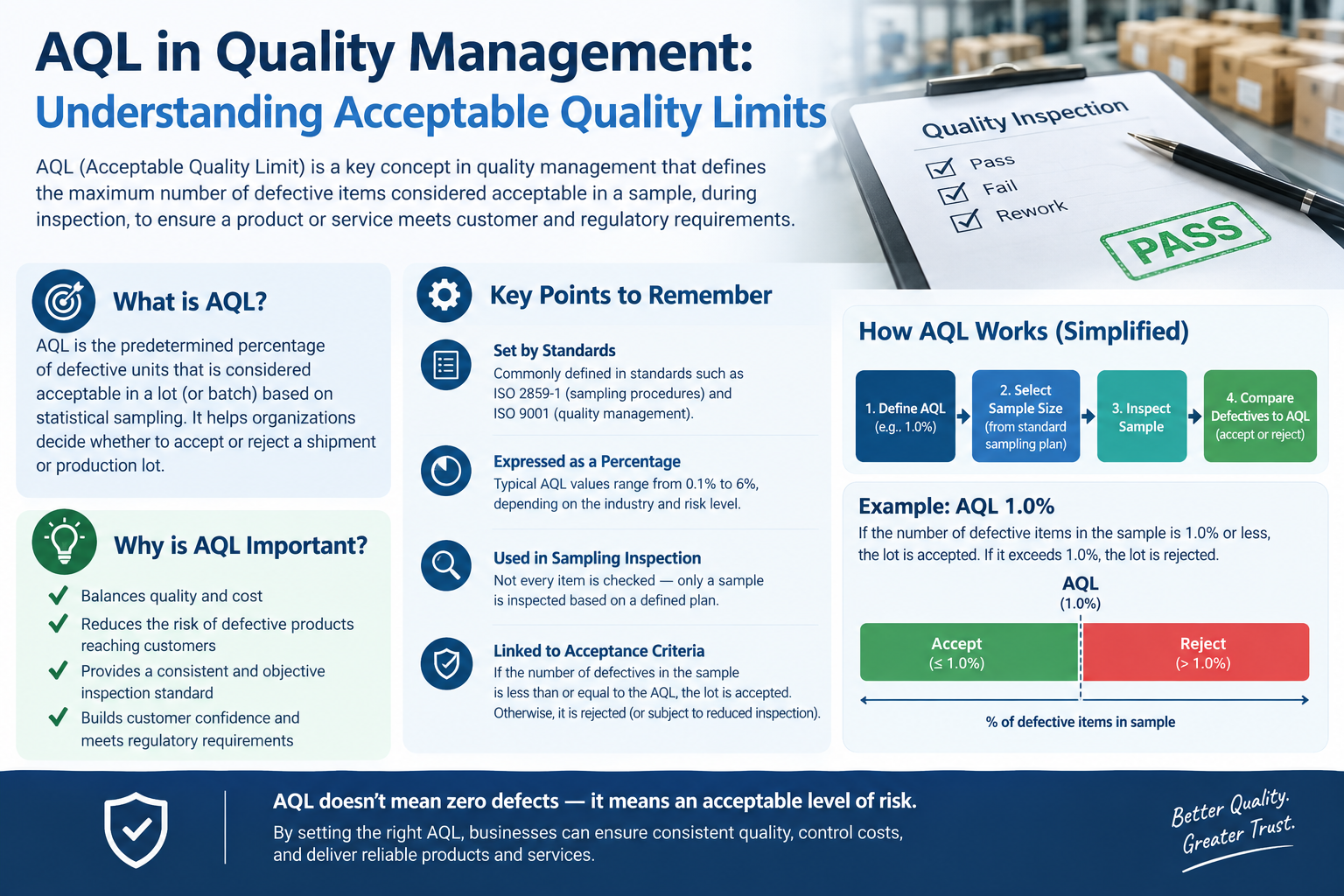
In today’s competitive manufacturing landscape, ensuring product quality is more crucial than ever. Companies in India and around the world need to meet customer expectations while maintaining cost-effectiveness. One of the fundamental concepts in quality management that helps achieve this balance is Acceptable Quality Limit (AQL). In this blog, we’ll dive deep into AQL, its significance, and how AQL sampling and inspection play a vital role in quality control.
What is Acceptable Quality Limit (AQL)?
The Acceptable Quality Limit, or AQL, is a statistical measurement used in quality control to determine the maximum number of defective items that can be considered acceptable in a sample batch. AQL is crucial for manufacturers and suppliers, as it defines the threshold of defects permissible in a production lot, ensuring that the products meet quality standards without excessive waste or rework.
Why is AQL Important?
AQL provides a structured approach to quality control sampling, enabling businesses to:
- Minimize Risk: By establishing an acceptable level of defects, companies can reduce the risk of delivering substandard products to customers.
- Enhance Efficiency: AQL helps streamline inspection processes, allowing for faster decision-making regarding product acceptance or rejection.
- Build Customer Trust: Consistently meeting AQL standards reinforces customer confidence in a brand’s commitment to quality.
Understanding AQL Sampling
AQL sampling involves selecting a representative sample from a batch of products to evaluate their quality. This method is essential for large production lots where inspecting every item may be impractical. By using statistical methods, businesses can make informed decisions based on the quality of the sample rather than the entire batch.
How to Determine AQL Levels
AQL levels can vary based on industry standards and customer requirements. Typically, AQL levels are expressed as percentages. For example, an AQL of 1% means that in a sample of 100 units, one defective item is acceptable. Here’s a breakdown of common AQL levels:
- 1.0% AQL: Often used in the electronics and medical industries, indicating a very high-quality requirement.
- 2.5% AQL: Common in textiles and consumer goods, balancing cost and quality.
- 4.0% AQL: Frequently used in less critical applications where cost efficiency is prioritized.
AQL Inspection Methods
AQL inspection is the process through which sampled items are evaluated for defects. There are two primary methods of inspection: attribute sampling and variables sampling.
Attribute Sampling
In attribute sampling, products are evaluated based on specific attributes such as pass/fail criteria. This method is straightforward and works well when the quality characteristics are binary (defective or non-defective). It’s commonly used in industries like textiles and packaging.
Variables Sampling
Variables sampling, on the other hand, involves measuring and evaluating continuous data (e.g., dimensions, weight). This method provides more detailed insights into the quality of a batch, allowing for better decision-making. It’s often employed in industries such as automotive and electronics, where precise specifications are critical.
Implementing AQL in Quality Control
To effectively implement AQL in quality control, businesses should follow these steps:
- Define Quality Standards: Establish clear AQL criteria based on customer expectations and industry standards.
- Select Sample Size: Determine the appropriate sample size for inspection based on the total lot size and desired confidence level.
- Conduct Inspections: Perform inspections using the selected method, ensuring accurate documentation of findings.
- Analyze Results: Evaluate the inspection results against the established AQL to determine whether to accept or reject the batch.
- Continuous Improvement: Use inspection data to identify trends and areas for improvement in the manufacturing process.
Challenges in AQL Sampling and Inspection
While AQL is a powerful tool for quality management, there are challenges associated with its implementation:
- Misinterpretation of AQL Levels: Different industries may have varying interpretations of AQL levels, leading to confusion and inconsistencies.
- Sampling Errors: Poor selection of samples can lead to inaccurate conclusions about the quality of a batch.
- Cost Constraints: Striking a balance between quality control and cost efficiency can be challenging for many businesses.
FAQs About AQL and Quality Management
What is the difference between AQL and LTPD?
AQL (Acceptable Quality Limit) refers to the maximum percentage of defects that are considered acceptable in a sample, while LTPD (Lot Tolerance Percent Defective) indicates the maximum percentage of defects that would lead to rejecting a lot. AQL is focused on acceptance, whereas LTPD is concerned with rejection thresholds.
How is sample size determined for AQL inspections?
The sample size for AQL inspections is typically determined based on the total lot size and the desired confidence level. Various statistical tables and formulas can be used to calculate the appropriate sample size.
Can AQL be used in service industries?
Yes, AQL can be adapted for use in service industries by defining quality attributes relevant to service delivery. For example, in customer service, AQL could be applied to the acceptable rate of service errors or customer complaints.
Conclusion
Understanding Acceptable Quality Limits (AQL) is essential for businesses striving to maintain high standards of quality while being cost-efficient. AQL sampling and inspection not only help ensure product quality but also bolster customer trust and enhance operational efficiency. By implementing AQL effectively, Indian manufacturers can navigate the complexities of quality management and stay competitive in the global market.
Are you looking to improve your quality management processes? Contact us today for expert guidance on AQL sampling and inspection tailored to your industry needs!



Leave a Comment