 Quality Management








 IT Service Management



 Project Management



 Agile Management


 Web Development


 Cloud Computing
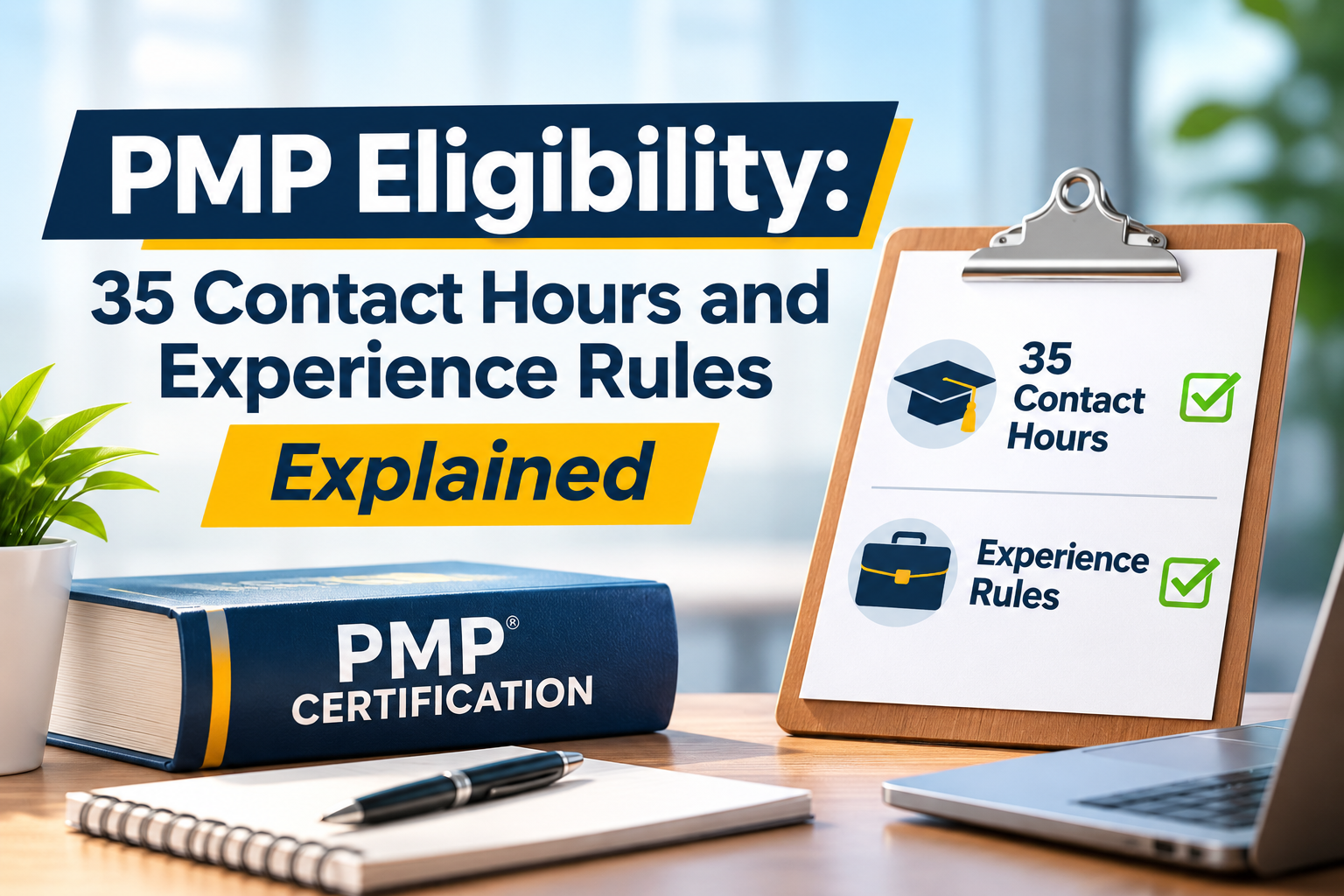
Most people who ask "Am I eligible for PMP?" are closer than they think, or further than they hope. The rules are simple on paper, but the details trip people up: which experience counts, how overlapping projects are calculated, and what qualifies as the 35 contact hours. PMI also updated its eligibility rules with the new 2026 exam, so many older articles are now out of date.
This guide explains the current PMP eligibility rules, shows how to calculate your experience correctly with worked examples, and covers how to avoid problems if your application is audited.
Quick Answer
To be eligible for the PMP, you need 35 hours of project management training (or an active CAPM) plus non-overlapping experience leading projects within the last 10 years. The experience needed depends on your education: 36 months with a bachelor's degree, 48 months with an associate-level or advanced diploma, 60 months with a higher secondary (10+2) qualification, or 24 months with a degree from a PMI GAC-accredited programme.
In this guide
PMP Eligibility Rules at a Glance
Under PMI's 2026 PMP Examination Content Outline, you need to meet one education-and-experience path, plus the training requirement. All experience must be non-overlapping, gained in a professional setting, and fall within the last 10 years before you apply.
| Your highest education | Experience leading projects | Training |
|---|---|---|
| Upper-secondary / secondary school (e.g. high school diploma) | 60 months (5 years) | 35 hours of project management training, or an active CAPM |
| Associate-level, higher-certificate or advanced technical/vocational programme | 48 months (4 years) | |
| Bachelor's degree or higher | 36 months (3 years) | |
| Bachelor's or postgraduate degree from a PMI GAC-accredited programme | 24 months (2 years) |
Source: PMI PMP Examination Content Outline (2026). Checked 18 November 2026.
What changed in 2026: older PMI rules, still repeated on many websites, looked back only 8 years and had just two main paths (60 months with a secondary qualification, 36 months with a four-year degree). The 2026 rules widen the window to 10 years and add a 48-month path for associate-level and advanced vocational qualifications. Always check PMI's current handbook before applying.
How Indian Qualifications Map to PMI's Categories
PMI describes education levels in international terms. Here is how common Indian qualifications usually fit. If your case is unusual, describe your qualification accurately in the application and let PMI assess it.
| Indian qualification | Likely PMI category | Experience needed |
|---|---|---|
| Class 12 (10+2) | Upper-secondary | 60 months |
| Polytechnic diploma or advanced vocational programme | Possibly associate-level / advanced vocational | 48 months (confirm with PMI) |
| B.Tech, B.E., B.Com, B.Sc, BA, BBA, BCA | Bachelor's degree | 36 months |
| MBA, M.Tech, MCA and other master's degrees | Bachelor's degree or higher | 36 months (24 only if from a GAC-accredited programme) |
Note that a master's degree does not reduce the requirement below 36 months unless the programme itself is accredited by PMI's Global Accreditation Center (GAC). You can check accredited programmes on PMI's website.
What Counts as "Leading Projects"?
This is where most confusion lies. You do not need the job title "Project Manager". PMI looks at what you did, not what you were called. Experience counts when you led or directed work on a project: a temporary effort with a defined goal, start and end.
| Usually counts | Usually does not count |
|---|---|
| Leading a software release or a module delivery as tech lead or scrum master | Day-to-day coding with no planning or coordination responsibility |
| Running a plant expansion, line installation or construction package as engineer-in-charge | Routine production or maintenance shifts |
| Coordinating a process improvement or Lean Six Sigma project | Ongoing operational work with no defined end |
| Managing a client implementation, migration, launch or event | Internships or academic projects done as a student |
When you describe each project, show the full project life cycle in your own words: how you started it, planned it, led the team through delivery, tracked progress and risks, and closed it. Mention real activities such as building the schedule (see the critical path method), managing risks, coordinating stakeholders and handling change requests.
How to Count Non-Overlapping Months
"Non-overlapping" means each calendar month counts only once, however many projects you ran in that month. Running three projects at the same time for a year gives you 12 months, not 36.
Example: a candidate lists three projects. Project 1 ran January to December 2021. Project 2 ran July 2021 to June 2022, overlapping Project 1 for six months. Project 3 ran September 2022 to August 2024.
- January 2021 to June 2022: 18 unique months (Projects 1 and 2 together, overlap counted once)
- July and August 2022: no project, so 0 months
- September 2022 to August 2024: 24 months
- Total: 42 months. With a bachelor's degree (36 months needed), this candidate is eligible.
PMI's online application calculates the unique months for you as you enter projects, but it helps to work it out first so there are no surprises.
The 35 Contact Hours Explained
Every PMP applicant needs 35 hours of project management education, completed before applying. Key points:
- What counts: structured project management training aligned to the PMP exam content. One hour of instruction equals one contact hour.
- What does not count: reading books or taking practice exams on your own.
- CAPM shortcut: an active CAPM certification counts as the 35 hours, so you do not need to document training.
- GAC degrees: coursework from a GAC-accredited degree programme can count toward the 35 hours.
- No expiry: the hours do not need to be recent, but keep your certificate and course details in case of audit.
Upcoming change from late Q4 2026
PMI has announced that, from a date in late Q4 2026, live-class hours will count only if the course is delivered by a PMI Authorized Training Partner (ATP), a China Registered Education Provider, or an eligible accredited academic programme. Training completed before the start date remains eligible. PMI will publish the exact date in advance, so check PMI's new PMP exam page before you enrol.
Haworth Solutions' PMP certification training provides 35 contact hours through live online classes, with a certificate you can submit with your application.
Three Example Candidates: Eligible or Not?
These are illustrative profiles to show how the rules apply.
| Candidate | Education and experience | Verdict |
|---|---|---|
| Ananya, software engineer, Bengaluru | B.Tech. Four years at work, but she has led sprint and release delivery for only the last 30 months. | Not yet. Needs 36 months. She can take CAPM now, or apply for PMP after 6 more months of leading projects. |
| Rahul, operations lead, Noida | B.Com. Three projects with overlap, as in the timeline above, totalling 42 unique months. | Eligible once he completes 35 contact hours. |
| Suresh, site supervisor, Pune | Class 12. Six years leading residential construction packages, all within the last 10 years. | Eligible. 72 months exceeds the 60 months needed. Needs 35 contact hours. |
Preparing for a PMI Audit
PMI randomly selects some applications for audit. If yours is chosen, you will be asked to provide proof of what you entered, typically copies of your education certificate, your 35-hour training certificate, and confirmation of your project experience from supervisors or managers who can vouch for it.
To make an audit painless:
- Write project descriptions honestly, in your own words, and only claim what you actually did
- Speak to the people who will verify each project before you submit
- Keep your training certificate and degree certificate ready as scanned copies
- Make sure project dates match what your verifiers will confirm
Once your application is approved, you pay the exam fee and book your exam. Our guide to PMP certification cost in India breaks down the exam fee, membership and renewal.
Not Eligible Yet? Your Options
- Take CAPM first. The CAPM certification is PMI's entry-level credential. It also counts as the 35 hours when you later apply for PMP.
- Ask for project responsibility at work. Volunteer to lead a release, rollout, process improvement or client implementation to build qualifying months.
- Consider PRINCE2. PRINCE2 Foundation has no experience requirement and is valued by many employers.
- Build practical skills. Learning scheduling tools such as Microsoft Project or Primavera P6 helps you take on project roles sooner.
- Add process improvement skills. A Lean Six Sigma Green Belt project can itself become qualifying project experience. See Lean Six Sigma career opportunities.
Already a PMP with several years of programme or portfolio experience? Look at PgMP or PfMP.
Complete your 35 contact hours
Our live online PMP training covers the 2026 exam content, includes mock tests, and helps you describe your project experience correctly in the PMI application.
View the PMP Course Not eligible yet? See CAPMFrequently Asked Questions
What are the PMP eligibility requirements?
You need 35 hours of project management training (or an active CAPM) and non-overlapping experience leading projects within the last 10 years: 36 months with a bachelor's degree, 48 months with an associate-level qualification, 60 months with a secondary qualification, or 24 months with a GAC-accredited degree.
Can a fresher apply for PMP?
No. PMP requires at least 24 to 60 months of experience leading projects, depending on education. Freshers can take the CAPM, which has no experience requirement and counts as the 35 hours later.
Do I need the job title "Project Manager" to apply?
No. PMI looks at the work you did. Leading or directing project work as a team lead, engineer-in-charge, scrum master or coordinator can count.
Do the 35 contact hours expire?
No. They can be completed at any time before you apply. Keep your training certificate in case your application is audited.
Does an MBA reduce the PMP experience requirement?
Not on its own. A master's degree falls under "bachelor's degree or higher", which needs 36 months. Only a degree from a PMI GAC-accredited programme reduces it to 24 months.
How far back can my project experience go?
Under PMI's 2026 rules, experience must fall within the last 10 years before you apply. Older articles that mention an 8-year window describe the previous rules.

Leave a Comment