 Quality Management









 IT Service Management



 Project Management


 Agile Management


 Web Development


 Cloud Computing
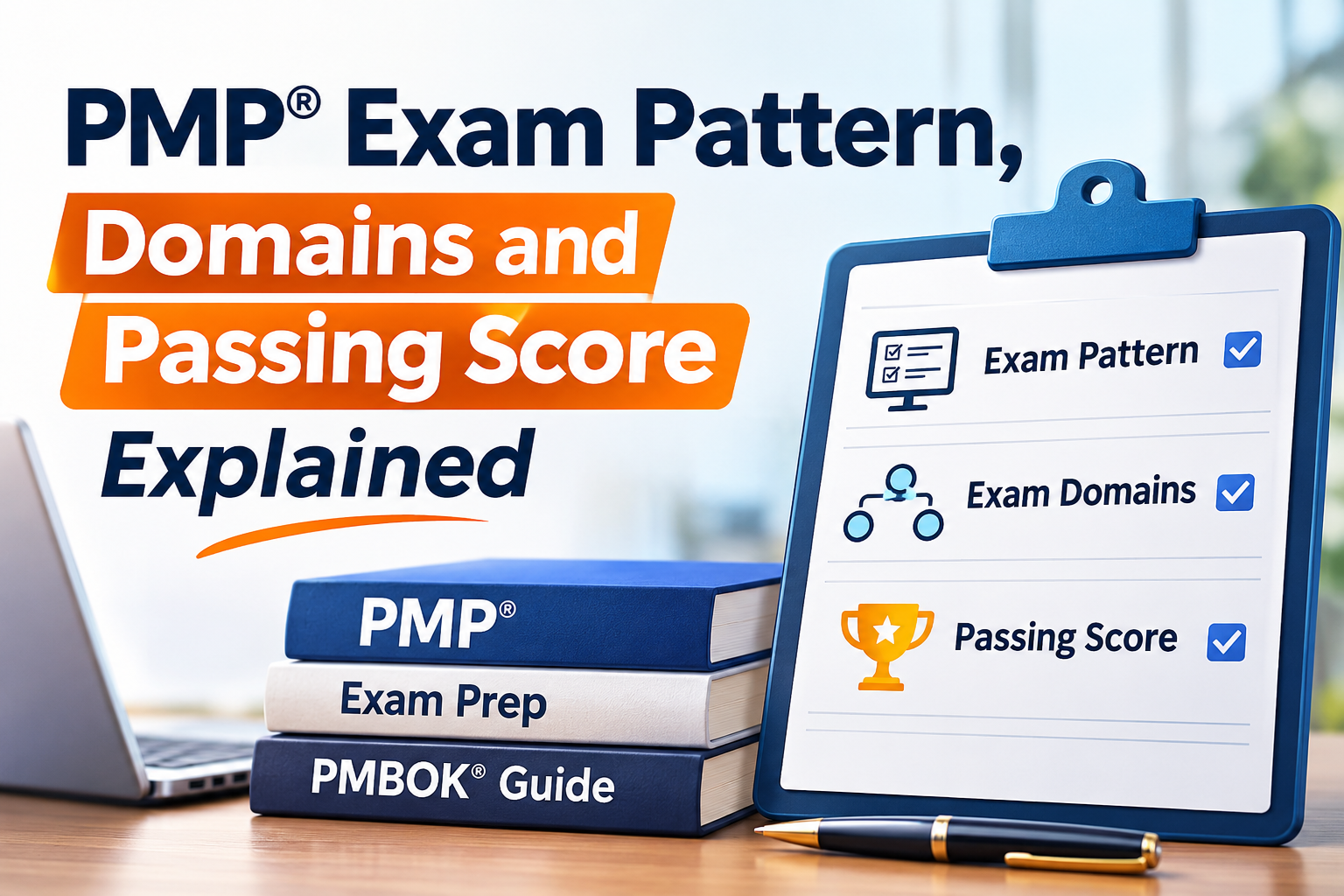
PMI updated the PMP exam in July 2026, and the changes are bigger than they look. The number of questions is the same, but the balance between domains has shifted sharply, case studies and graphic-based questions are new, and the exam now leans heavily on agile and hybrid scenarios. If you are preparing from older material, you could be studying for the wrong exam.
This guide explains the current PMP exam pattern, what each domain covers, the question types you will see, how the exam is timed, and how PMI decides whether you pass.
Quick Answer
The PMP exam has 180 questions (170 scored and 10 unscored pretest questions) to be answered in 240 minutes, with two 10-minute breaks. Questions cover three domains: People (33%), Process (41%) and Business Environment (26%). About 40% of the exam reflects predictive project approaches and 60% agile or hybrid. PMI does not publish a numeric passing score; results are reported as Above Target, Target, Below Target or Needs Improvement for each domain.
In this guide
PMP Exam Pattern at a Glance
| Total questions | 180 (170 scored + 10 unscored pretest) |
| Duration | 240 minutes (tutorial and survey not included) |
| Breaks | Two 10-minute breaks |
| Domains | People 33% · Process 41% · Business Environment 26% |
| Approach mix | About 40% predictive, 60% agile and hybrid |
| Question types | Case/scenario, graphic-based, multiple choice, multiple response, and (on computer) matching, point-and-click and pull-down |
| Delivery | Test centre or online proctored from home |
| Passing score | Not published; rated by domain |
Source: PMI PMP Examination Content Outline (2026). Checked 20 November 2026.
What Changed in the 2026 Exam
| Previous exam (2021 outline) | Current exam (2026 outline) | |
|---|---|---|
| People | 42% | 33% |
| Process | 50% | 41% |
| Business Environment | 8% | 26% (more than three times larger) |
| Duration | 230 minutes | 240 minutes |
| New question types | — | Case/scenario sets and graphic-based questions |
| New themes | — | AI, sustainability, value and business impact, stakeholder engagement |
The big message: the PMP now tests whether you can connect projects to business value, governance, compliance and organisational change, not just run schedules and budgets. Study materials written for the 2021 outline will under-prepare you for Business Environment questions.
The Three Domains and Their Tasks
With 170 scored questions, those weights work out to roughly 70 Process, 56 People, and 44 Business Environment questions. PMI does not publish exact counts, so treat these as estimates.
Domain I: People (33%)
Leading and working with people. The 8 tasks:
- Develop a common vision
- Manage conflicts
- Lead the project team
- Engage stakeholders
- Align stakeholder expectations
- Manage stakeholder expectations
- Help ensure knowledge transfer
- Plan and manage communication
Domain II: Process (41%)
Planning and delivering the work. The 10 tasks:
- Develop an integrated project management plan and plan delivery
- Develop and manage project scope
- Help ensure value-based delivery
- Plan and manage resources
- Plan and manage procurement
- Plan and manage finance
- Plan and optimise quality of products/deliverables
- Plan and manage schedule
- Evaluate project status
- Manage project closure
Scheduling questions often draw on techniques like the critical path method, and quality questions overlap with Lean Six Sigma ideas for project managers.
Domain III: Business Environment (26%)
Connecting the project to the organisation and the world around it. The 8 tasks:
- Define and establish project governance
- Plan and manage project compliance
- Manage and control changes
- Remove impediments and manage issues
- Plan and manage risk
- Continuous improvement
- Support organisational change
- Evaluate external business environment changes
Note that risk, change control and issue management now sit here. Our guides on risk management strategies, FMEA risk analysis and building a continuous improvement culture are useful background.
Predictive, Agile and Hybrid Mix
About 40% of questions reflect predictive (traditional, plan-driven) approaches. The other 60% is split between agile/adaptive and hybrid approaches. These are spread across all three domains rather than tied to any one.
In practice, this means many questions start by describing the project environment, such as "a team using two-week sprints" or "a fixed-scope construction contract", and the right answer depends on that context. Learn to spot which approach a scenario uses before choosing an answer.
Question Types, With a Sample Question
| Question type | What it looks like |
|---|---|
| Case or scenario (new) | A longer project situation followed by several linked questions |
| Graphic-based (new) | Read a chart, burndown, schedule or diagram to answer |
| Multiple choice | One correct answer from four options |
| Multiple response | Select two or more correct answers |
| Matching / enhanced matching | Pair items, such as tools with their purpose |
| Point and click (hotspot) | Click the correct area of an image |
| Pull-down list | Choose answers from drop-down menus within a passage |
Matching, point-and-click and pull-down questions appear only in the computer-based exam.
Sample scenario question (written for practice, not from PMI)
You are leading a hybrid project to roll out a new billing system. Development runs in two-week sprints, while data migration follows a fixed plan agreed with finance. In the sprint review, the finance head asks for a new report that was not in the original scope. The product owner agrees it is valuable. What should you do first?
A. Add the report to the current sprint so finance is satisfied
B. Ask the product owner to add the report to the product backlog and prioritise it
C. Raise a formal change request and wait for the change control board
D. Tell finance the scope is fixed and the report cannot be added
Best answer: B. The report affects the agile part of the project, where new requests go into the backlog for the product owner to prioritise. Option A disrupts the sprint, C applies predictive change control to adaptive work, and D ignores stakeholder value.
Exam Structure, Breaks and Time Management
The exam begins with the case-study section. The first 10-minute break comes after it, and the second comes roughly halfway through the independent questions. Once you start a break, you cannot go back to earlier sections, so review any flagged questions before each break.
With 240 minutes for 180 questions, you have about 80 seconds per question on average. A simple pacing plan:
- Read the last line of a long question first, so you know what is being asked
- Flag anything that takes more than two minutes and move on
- Check the clock after every 20–30 questions
- Keep 10 minutes before each break to review flagged questions in that section
- Take both breaks, even if you feel fine
If you take the exam online, make sure your computer passes the system check, your room is clear, and your ID matches your PMI profile exactly.
How the PMP Passing Score Works
PMI does not publish a passing percentage or number of correct answers. The passing standard is set through psychometric analysis, and any website quoting a fixed figure such as "61%" or "65%" is guessing or using very old information. The 10 pretest questions do not count toward your result, and you will not know which ones they are.
You see "Pass" or "Fail" overall, plus a performance rating for each domain:
| Rating | What it means |
|---|---|
| Above Target | Performance exceeds the minimum standard |
| Target | Performance meets the minimum standard |
| Below Target | Slightly below the standard; more preparation recommended |
| Needs Improvement | Well below the standard; significant preparation needed |
The pass decision is based on your overall performance, not on each domain separately. Candidates sometimes pass with one Below Target domain if they are strong elsewhere, but the safe goal is Target or above in all three. In practice mock tests, aim to score consistently above 70% before booking the real exam.
If you do not pass, you can retake the exam within your one-year eligibility period, up to three attempts in total. The PMP cost guide explains exam and retake fees.
How to Prepare for This Pattern
- Check your study material is aligned to the 2026 outline. Look specifically for coverage of governance, compliance, organisational change, AI, and sustainability.
- Learn agile and hybrid thoroughly. With 60% of the exam in these approaches, Scrum roles, backlogs, iterations, and hybrid decision-making are essential.
- Practise case studies and graphics. Work through multi-question scenarios and questions based on burndown charts, schedules and dashboards.
- Take full-length timed mocks. At least two or three under real conditions, including the no-going-back rule at breaks.
- Review every wrong answer. Understand why the best answer is best in that context, not just which one it was.
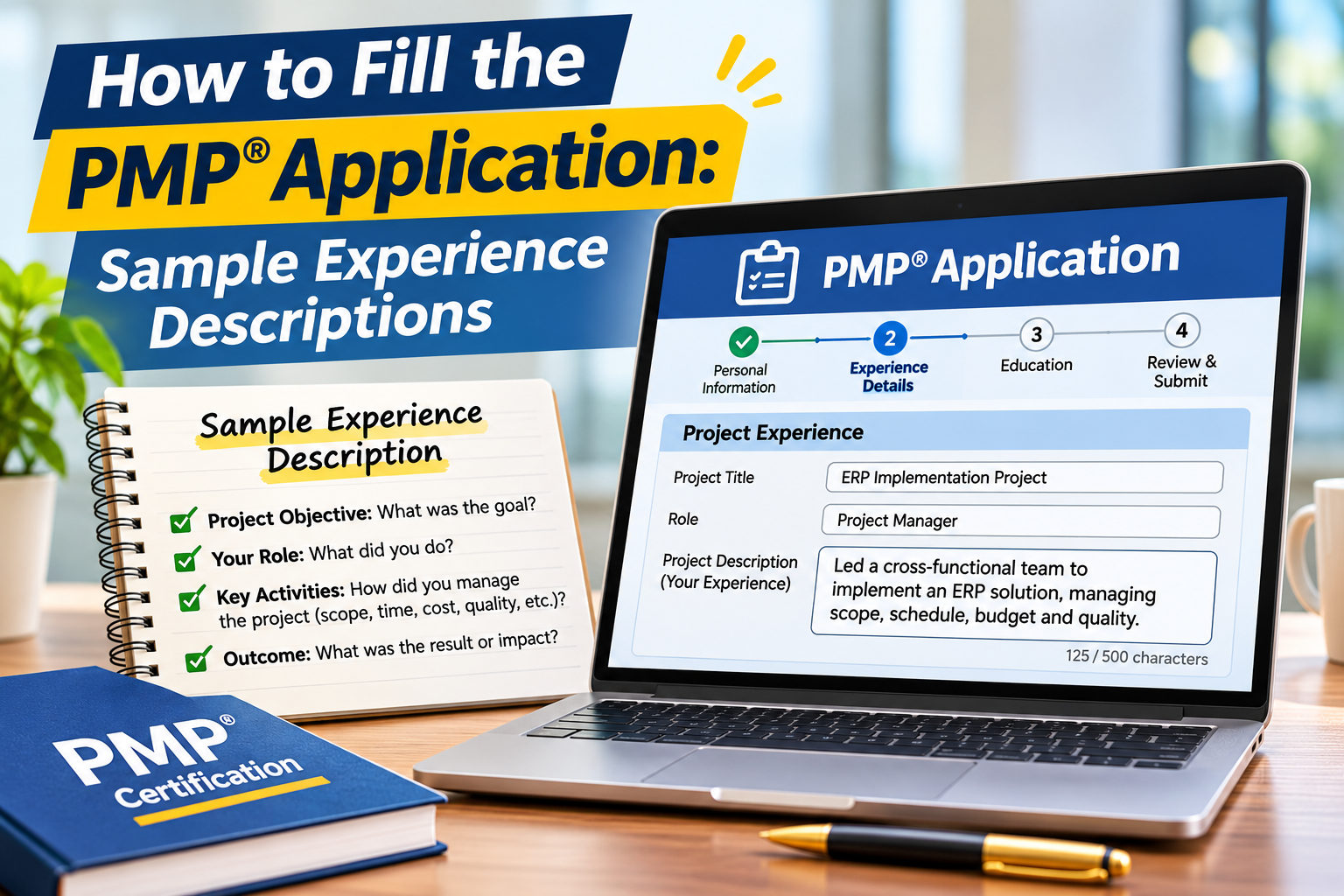
Before you start studying, confirm you meet the PMP eligibility requirements, and see our guide on how to fill out the PMP application.
Prepare for the 2026 PMP exam
Our live online PMP training covers all three domains of the 2026 outline, agile and hybrid scenarios, and full-length mock tests, and provides the 35 contact hours you need to apply.
View the PMP CourseNot eligible yet? Start with CAPM. Want hands-on scheduling practice? Try Microsoft Project or Primavera P6.
Frequently Asked Questions
How many questions are in the PMP exam?
180 questions: 170 are scored, and 10 are unscored pretest questions mixed in randomly.
How long is the PMP exam?
240 minutes of exam time, plus two 10-minute breaks. The optional tutorial and survey are not counted in the 240 minutes.
What is the passing score for the PMP exam?
PMI does not publish one. The pass standard is set through psychometric analysis, and results are reported as Above Target, Target, Below Target or Needs Improvement for each domain.
What are the three PMP exam domains?
People (33%), Process (41%) and Business Environment (26%), under PMI's 2026 Examination Content Outline.
How much of the PMP exam is agile?
About 60% of the exam covers agile/adaptive and hybrid approaches combined, and about 40% covers predictive approaches.
Can I go back to earlier questions after a break?
No. Once you start a break, you cannot return to the questions before it, so review flagged questions before each break.


Leave a Comment