
 Quality Management



















 IT Service Management



 Project Management



 Agile Management



 Web Development



 Cloud Computing


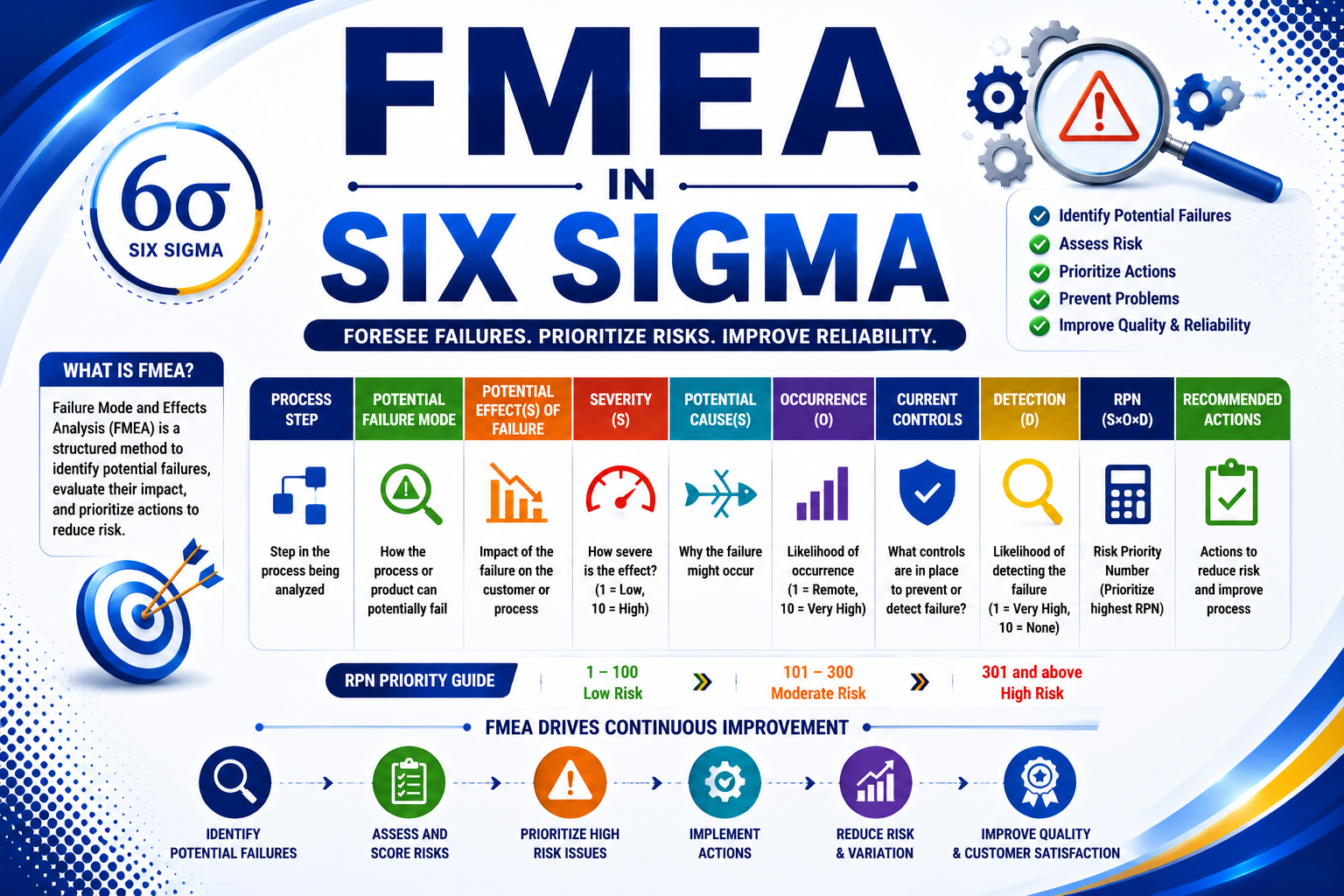
In the world of quality management and process improvement, Failure Mode and Effects Analysis (FMEA) stands out as a critical tool, especially when integrated into Six Sigma methodologies. This detailed blog will explore the intricacies of FMEA analysis, its significance in risk assessment in Six Sigma, and provide practical examples to help you understand its application better. Whether you're a quality manager, a Six Sigma practitioner, or simply curious about process improvement, this guide aims to equip you with the knowledge you need.
What is FMEA?
Failure Mode and Effects Analysis is a systematic approach to identifying potential failure modes in a product or process and assessing the risks associated with those failures. It is a proactive method used to improve the reliability and safety of products and processes by addressing potential issues before they occur.
The Importance of FMEA in Six Sigma
Integrating FMEA into the Six Sigma framework enhances the overall effectiveness of quality improvement initiatives. Here’s why:
1. Proactive Risk Management
FMEA allows organizations to identify and prioritize risks associated with various processes. By doing so, businesses can implement preventive measures, reducing the likelihood of failures and defects.
2. Enhanced Customer Satisfaction
By addressing potential failures before they affect the end user, companies can significantly improve product quality, leading to higher customer satisfaction levels.
3. Cost Reduction
By identifying failure modes early in the process, organizations can save costs related to recalls, repairs, and warranty claims, ultimately enhancing profitability.
How FMEA Works: Steps Involved
Conducting an FMEA involves several structured steps:
Step 1: Identify the Scope
Clearly define the process, product, or system to be analyzed. This includes understanding its purpose and how it fits into the larger organizational structure.
Step 2: Assemble a Cross-Functional Team
Gather a team of experts from various departments to ensure diverse perspectives on potential failure modes.
Step 3: Identify Potential Failure Modes
List all the possible ways the process or product could fail. This step is crucial as it sets the stage for the analysis.
Step 4: Determine Effects of Each Failure
For each identified failure mode, evaluate the potential effects on the customer, operations, and other stakeholders.
Step 5: Assess the Severity, Occurrence, and Detection
Rate each failure mode based on:
- Severity: The impact of the failure on the customer or process.
- Occurrence: The likelihood of the failure occurring.
- Detection: The ability to detect the failure before it reaches the customer.
Step 6: Calculate the Risk Priority Number (RPN)
Multiply the severity, occurrence, and detection ratings to obtain the RPN, which helps prioritize which failure modes need immediate attention.
Step 7: Develop Action Plans
For the highest RPNs, create action plans to mitigate the risks. This may involve redesigning processes, increasing quality checks, or providing additional training.
Step 8: Review and Reassess
Continuously monitor the effectiveness of the action plans and reassess the FMEA as necessary to adapt to any changes in processes or products.
FMEA Example: A Practical Application
To illustrate how FMEA works in a real-world scenario, let’s consider an example from the manufacturing sector.
Example: Manufacturing a Mobile Phone
Imagine a company that manufactures mobile phones. The FMEA process might look like this:
1. Identify the Scope
The scope covers the mobile phone assembly process, from component sourcing to final quality checks.
2. Assemble a Cross-Functional Team
The team includes members from engineering, production, quality assurance, and customer service.
3. Identify Potential Failure Modes
Potential failures could include:
- Battery overheating
- Screen malfunction
- Poor audio quality
4. Determine Effects of Each Failure
Effects might range from customer dissatisfaction to safety hazards.
5. Assess Severity, Occurrence, and Detection
Each failure is rated. For instance, battery overheating might have high severity, moderate occurrence, and low detection.
6. Calculate RPN
Using the ratings, the RPN is computed, allowing the team to prioritize which failures to address first.
7. Develop Action Plans
For the battery issue, the action plan may involve sourcing better components and enhancing testing protocols.
8. Review and Reassess
The team continuously monitors the implementation of the action plans and updates the FMEA as necessary.
Integrating FMEA with Six Sigma Tools
FMEA can be effectively integrated with other Six Sigma tools and techniques, such as:
1. DMAIC
The Define, Measure, Analyze, Improve, and Control (DMAIC) framework complements FMEA by providing a structured approach to problem-solving and quality improvement.
2. Control Charts
Control charts help monitor process performance over time, allowing teams to identify trends and make data-driven decisions based on FMEA findings.
3. Root Cause Analysis
FMEA can be used alongside root cause analysis tools to dig deeper into failure modes and implement more effective corrective actions.
FAQs about FMEA in Six Sigma
What is the main purpose of FMEA?
The main purpose of FMEA is to identify potential failure modes in a process or product, assess their impact, and prioritize them for corrective action to enhance quality and reliability.
How does FMEA contribute to risk assessment in Six Sigma?
FMEA contributes to risk assessment by systematically analyzing potential failure modes and their effects, allowing teams to prioritize risks and implement preventive measures in the Six Sigma framework.
Can you give a simple FMEA example?
A simple FMEA example could involve analyzing the assembly of a bicycle, identifying potential failure modes like brake failure, and assessing the severity, occurrence, and detection ratings to prioritize corrective actions.
Is FMEA only applicable in manufacturing?
No, FMEA can be applied across various industries, including healthcare, software development, and service industries, to improve processes and reduce risks.
Conclusion
Incorporating FMEA analysis into your Six Sigma practices is a powerful strategy for enhancing product quality and operational efficiency. By identifying potential failures and addressing them proactively, your organization can not only improve customer satisfaction but also reduce costs associated with defects and failures. Embrace FMEA as a vital part of your Six Sigma risk assessment efforts, and watch your processes transform.
Call to Action
If you are looking to implement FMEA in your organization or need assistance with Six Sigma methodologies, contact us today. Our team of experts is here to help you achieve excellence in quality management!




Leave a Comment