
 Quality Management



















 IT Service Management



 Project Management



 Agile Management




 Web Development


 Cloud Computing


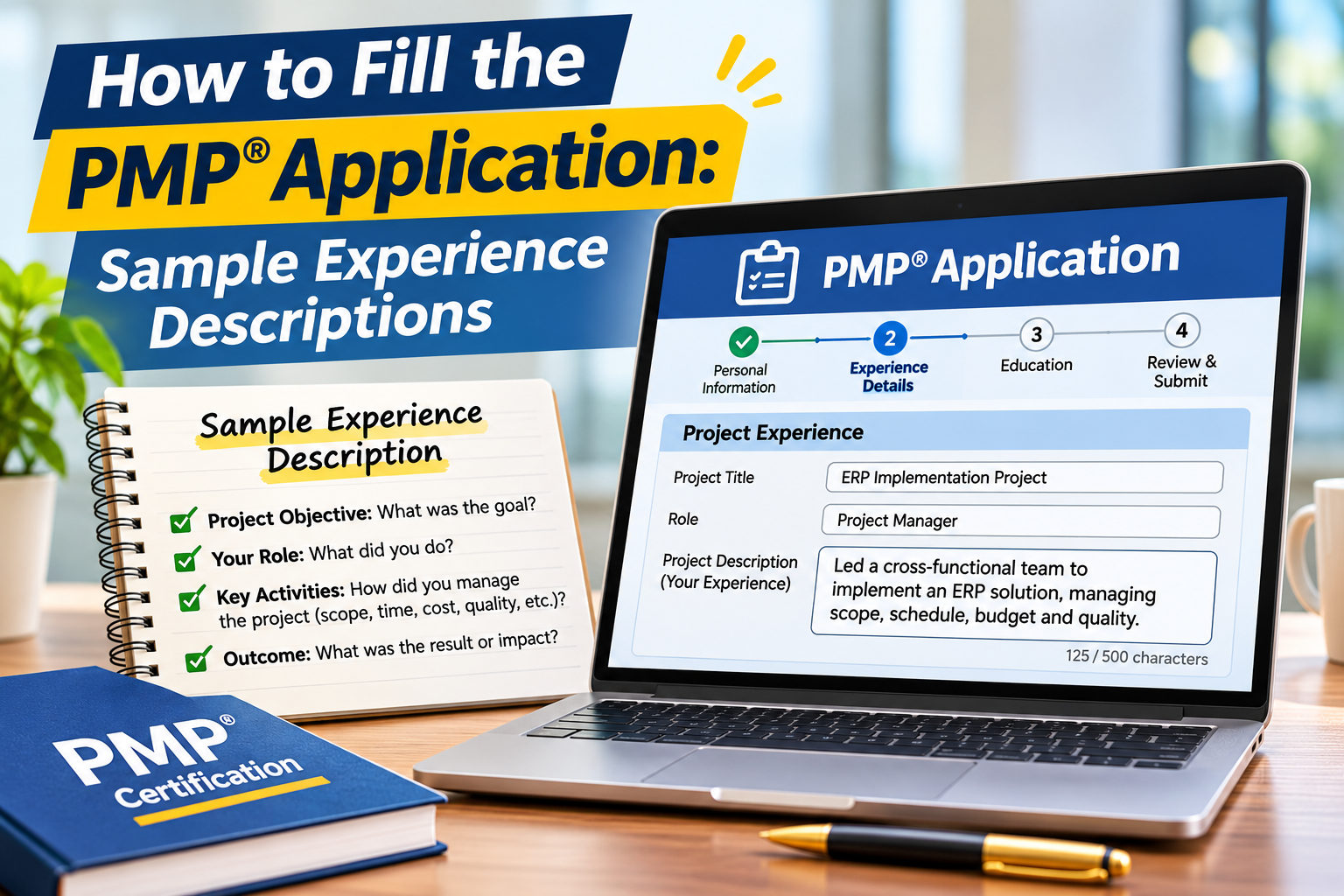
For most candidates, the hardest part of the PMP application is not the education section or the training details. It is the experience section: turning years of real work into short descriptions that clearly show you led projects, not just worked on them.
This guide walks through the application step by step, gives you a simple structure for every experience description, and shows three sample descriptions from IT, manufacturing and operations that you can use as a model for writing your own.
Quick Answer
The PMP application is completed online at pmi.org and must be submitted within 90 days of starting it. In the experience section, you enter each role with its organisation, job title and dates, plus a summary (commonly 200–500 words) covering the project objective, your leadership role, your responsibilities across the project life cycle, the deliverables and the outcome. Write in the first person, use plain project management language, include real numbers, and make sure your supervisors can confirm everything if you are audited.
In this guide
Before You Start: Check Eligibility
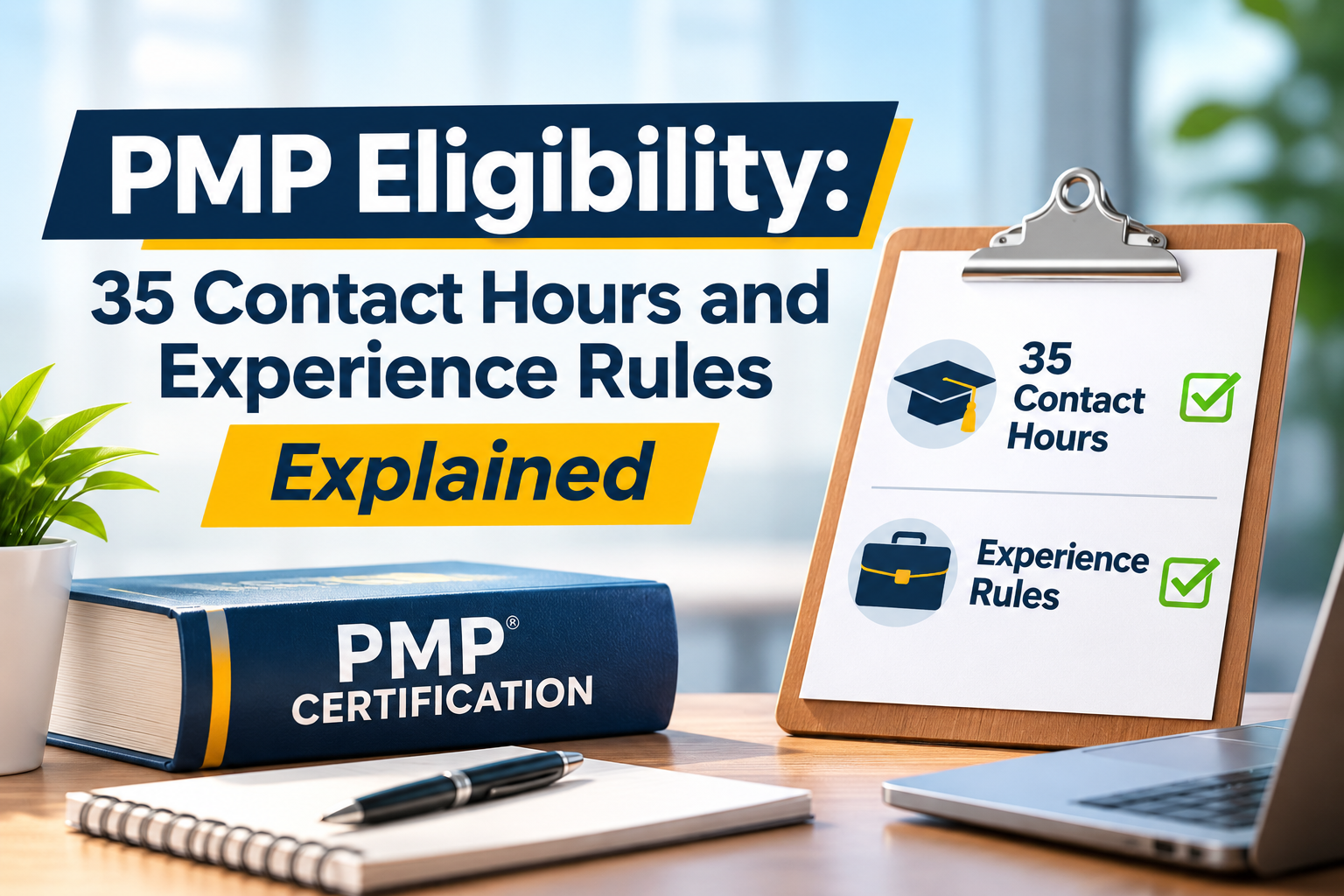
Make sure you meet PMI's requirements before you open the application. You need 35 hours of project management training (or an active CAPM) and enough non-overlapping months of experience leading projects for your education level. Our guide to PMP eligibility explains the current rules and how to count your months correctly.
Gather these before you begin:
- Your degree or diploma details (institution, qualification, year)
- Your 35-hour training certificate (provider, course name, dates, hours)
- A list of your roles and projects with start and end months
- Names and contact details of supervisors or managers who can confirm each role
- Rough figures for each project: team size, budget, duration, results
The Application, Section by Section
- Create or log in to your PMI account at pmi.org and start the PMP application. You have 90 days to complete and submit it once started. You can save and return.
- Personal and contact details. Enter your name exactly as it appears on the ID you will show at the exam.
- Education. Select your highest qualification and add the institution and year.
- Professional experience. For each role, enter the organisation, job title, start and end dates, and a written summary. This is the section that needs the most care, and the rest of this guide focuses on it.
- Project management education. Enter your training provider, course title, dates and number of hours (at least 35), or your CAPM details.
- Review and submit. Check dates, spelling and totals, then agree to PMI's terms and submit.
PMI updates the form from time to time. If the field names or word limits you see differ from this guide, follow what the form shows.
How to Structure Each Experience Description
PMI wants to see that you led and directed project work. A clear structure makes that obvious to the reviewer. Write your summary in this order:
| Part | What to include | Approx. length |
|---|---|---|
| 1. Objective | Why the project existed, its goal, and key constraints (budget, deadline, scope) | 1–2 sentences |
| 2. Your role | Your position, who you reported to, team size you led | 1–2 sentences |
| 3. Responsibilities | What you did across the life cycle: starting, planning, executing, monitoring and closing | The main body |
| 4. Deliverables | The documents and products you produced (charter, schedule, risk register, reports) | 1 sentence |
| 5. Outcome | The result, ideally with numbers: on time, on budget, savings, quality, adoption | 1–2 sentences |
A simple template:
The objective of the project was to [goal] within [time] and [budget]. As [your role], I led a team of [number] and reported to [sponsor/manager]. I initiated the project by [charter, stakeholders, kick-off]. I planned [scope, schedule, budget, risks, communication]. During execution I [led the team, managed vendors, held reviews]. I monitored progress through [status reports, metrics, change control] and handled [a key issue or risk]. I closed the project by [handover, sign-off, lessons learned]. Key deliverables included [list]. The project [outcome with numbers].
Three Sample Experience Descriptions
Use these as models, not text to copy. Your description must describe your own work in your own words. Copied or templated text is easy to spot and creates problems if your application is audited.
Sample 1: IT — mobile banking feature release
Role: Technical Lead, IT services company. About 260 words.
The objective of the project was to add UPI AutoPay mandate management to a private bank's mobile app within six months and a budget of ₹1.2 crore, to reduce customer calls about failed recurring payments.
As Technical Lead, I led a team of 9 developers and testers and reported to the delivery manager, with the bank's product head as sponsor. I initiated the project by facilitating requirement workshops with the bank's product and compliance teams and drafting the project charter. I planned the work by breaking scope into a work breakdown structure, building a release schedule with sprint milestones, estimating effort and budget, and setting up a risk register covering regulatory and integration risks.
During execution, I ran sprint planning and daily stand-ups, coordinated with the bank's payment gateway vendor, and resolved resource conflicts with other teams. I monitored progress with weekly status reports, a burn-down chart and defect metrics, and managed four change requests through the bank's change control board. When integration testing slipped by two weeks, I re-sequenced the remaining work and added a parallel test cycle to protect the go-live date.
I closed the project by securing user acceptance sign-off, handing over to the support team with run books, and leading a lessons-learned session.
Deliverables included the charter, release plan, risk register, status reports and closure report. The feature went live on schedule and within 4% of budget, and the bank reported fewer customer calls about recurring payments in the following quarter.
Sample 2: Manufacturing — new assembly line installation
Role: Production Engineer, auto component manufacturer. About 240 words.
The objective of the project was to install and commission a new brake-component assembly line within eight months and ₹3.5 crore, to meet a new OEM order without adding overtime.
As Production Engineer in charge of the project, I led a cross-functional team of 12 from production, maintenance, quality and purchase, reporting to the plant head. I initiated the project by defining scope and capacity targets with the plant head and preparing the project charter. I planned the line layout, equipment procurement schedule, installation sequence, budget and quality plan, and identified key risks such as delayed machine delivery.
During execution, I coordinated three equipment vendors and the civil contractor, held weekly site reviews, and arranged operator training. I tracked progress against the schedule and budget, and when one machine was delayed by three weeks, I rearranged installation so other stations could be commissioned first. I managed trial runs and worked with quality to complete the customer's approval process.
I closed the project with formal handover to production, completion documents, and a lessons-learned report.
Deliverables included the charter, layout plan, project schedule, budget tracker and handover report. The line was commissioned one week late but 3% under budget, and met the rated capacity within the first month of production.
Sample 3: Operations — process improvement in a shared services centre
Role: Process Excellence Lead, global shared services centre. About 230 words.
The objective of the project was to reduce invoice processing time in the accounts payable team from an average of nine days to five days within five months, to avoid late payment penalties and improve supplier satisfaction.
As Process Excellence Lead, I led a team of 7 analysts and team leaders and reported to the finance operations director. I initiated the project by agreeing scope and targets with the director and stakeholders in procurement and IT. I planned the work by mapping the current process, collecting baseline data, and preparing a schedule, communication plan and risk log.
During execution, I led workshops to remove duplicate approval steps, worked with IT to automate invoice matching, and trained 40 processors on the new process. I monitored progress through weekly dashboards on cycle time and error rates, managed resistance from two approving teams through stakeholder meetings, and controlled scope when additional requests came in.
I closed the project by documenting the new standard process, handing over the dashboard to the operations team and running a lessons-learned review.
Deliverables included the project plan, process maps, training material and closure report. Average processing time fell to under five days, and late payment penalties dropped significantly in the following two quarters.
Sample 3 shows how improvement work can count as project experience. If you have led Lean Six Sigma projects, our guides to value stream mapping and Lean Six Sigma for project managers can help you describe that work in project management terms.
Words That Show Leadership
| Instead of | Write |
|---|---|
| I was part of the team that… | I led a team of 8 to… |
| I helped with planning | I developed the schedule and budget and identified key risks |
| I coded the payment module | I assigned work, tracked progress and resolved blockers for the payment module |
| The project went well | The project went live on schedule and 4% under budget |
Useful verbs: initiated, defined, planned, estimated, scheduled, led, coordinated, negotiated, monitored, controlled, escalated, resolved, closed, handed over. Mention real project tools where they apply, such as the critical path method for scheduling or a risk register for risk management.
Mistakes That Cause Delays or Audit Problems
- Describing your job, not projects. Routine operations or ongoing support do not count. Focus on temporary efforts with a clear start and end.
- Showing only technical work. "Designed the database" shows skill, not project leadership.
- Missing phases. Cover how you started, planned, delivered, tracked and closed the work.
- Overlapping dates counted twice. Your total must be based on unique months.
- Copying samples from the internet. Write every description yourself.
- Claims your supervisor cannot confirm. Discuss your entries with them before submitting.
- Confidential details. You can describe the project without naming sensitive clients or sharing confidential figures; use approximate values if needed.
After You Submit: Review, Audit and Payment
- PMI reviews your application, usually within a few business days. If something is unclear, PMI may ask you to revise a description.
- PMI selects a small share of applications for audit. If yours is chosen, you will need copies of your education certificate and training certificate, plus confirmation of your experience from supervisors. The audit is random, so prepare for it regardless.
- Pay the exam fee once approved. Our guide to PMP certification cost in India explains member and non-member fees and how to save.
- Schedule your exam within your one-year eligibility period, online or at a test centre.
Get help with your PMP application
Our live online PMP training provides the 35 contact hours, covers the current exam content, and includes guidance on describing your experience in the PMI application.
View the PMP CourseNot enough experience yet? The CAPM certification is PMI's entry-level option. Building scheduling skills with Microsoft Project or Primavera P6 can also help you take on project roles sooner.
Frequently Asked Questions
How long should each PMP experience description be?
Most guidance recommends 200 to 500 words per entry. The form shows the exact limits, so follow those. Clear and specific matters more than long.
How long do I have to complete the PMP application?
You have 90 days from when you start the online application to complete and submit it. You can save your progress and return.
Do I need to use PMI terms like "initiating" and "closing"?
It helps to show the full project life cycle, but you do not need to force jargon. Plain descriptions of how you started, planned, delivered, tracked and closed the work are enough.
Can I include projects from a previous employer?
Yes, as long as the experience falls within PMI's time window and someone from that employer can confirm it if you are audited.
What happens if my application is audited?
You will be asked to send copies of your education and training certificates and confirmation of your experience from supervisors. Once PMI verifies them, you can pay the fee and book the exam.
Can I use agile project experience?
Yes. Leading sprints, releases or agile delivery counts. Describe how you planned, coordinated, tracked and delivered the work, as in Sample 1 above.



Leave a Comment