
 Quality Management



















 IT Service Management



 Project Management



 Agile Management




 Web Development



 Cloud Computing


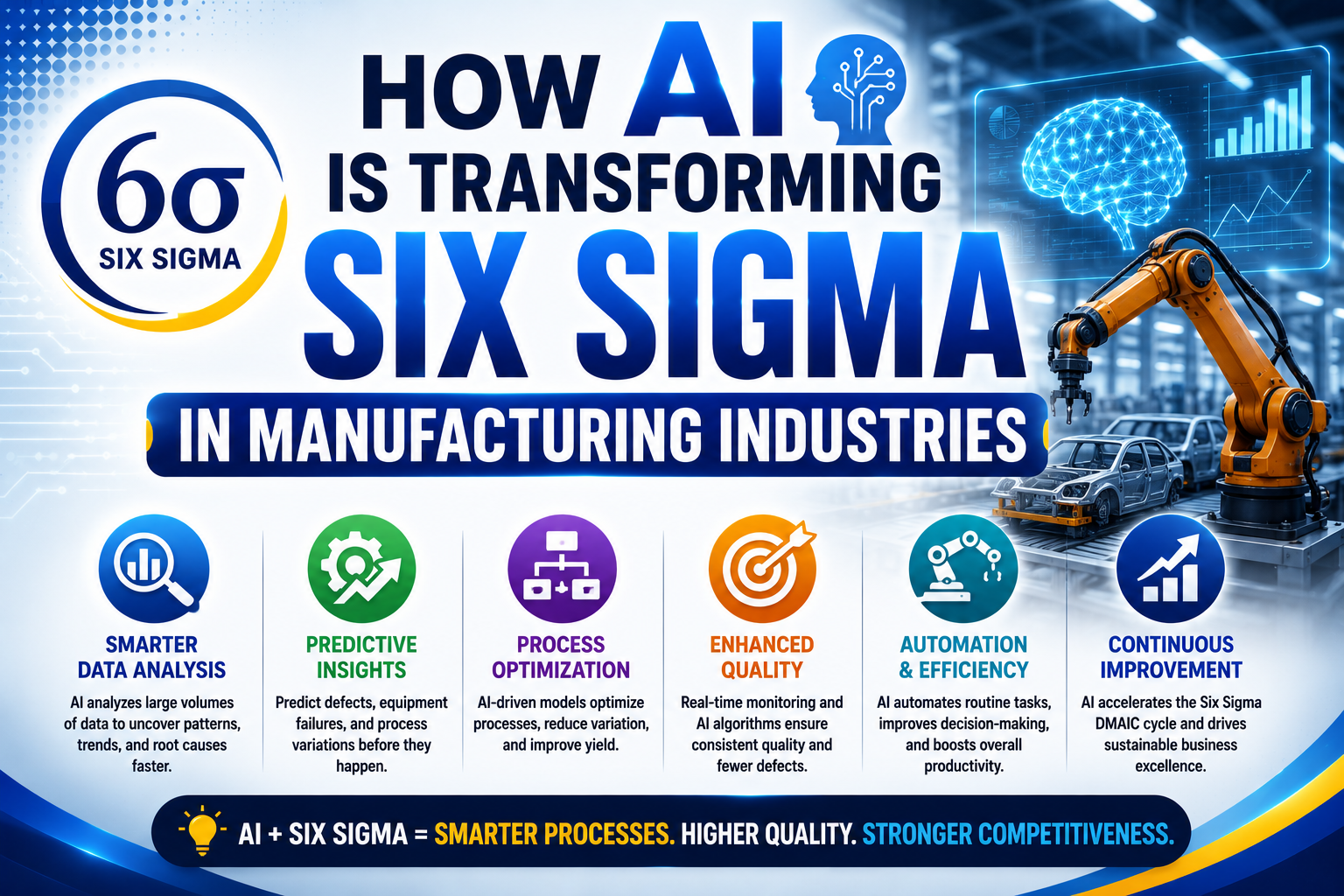
The manufacturing industry has always been focused on quality and efficiency. With the advent of Artificial Intelligence (AI), this focus is evolving into a more dynamic and effective approach. In particular, the integration of AI in Six Sigma methodologies is revolutionizing how businesses approach quality control and process improvement. In this blog, we will explore how AI is transforming Six Sigma practices in manufacturing industries, especially in India.
Understanding Six Sigma and Its Importance in Manufacturing
Six Sigma is a set of techniques and tools for process improvement, primarily aimed at reducing defects and enhancing quality. It uses statistical methods to measure and improve operational performance, and its principles are widely adapted in manufacturing industries worldwide. In India, where manufacturing is a key component of the economy, Six Sigma plays a crucial role in ensuring that products meet quality standards and customer expectations.
The Traditional Approach to Six Sigma
Traditionally, Six Sigma relies on data collection and analysis to identify defects and inefficiencies in manufacturing processes. Teams utilize methodologies such as DMAIC (Define, Measure, Analyze, Improve, Control) to drive improvements. While this process has proven effective, it can be time-consuming and reliant on historical data, which may not always reflect current conditions.
The Role of AI in Enhancing Six Sigma
AI in Six Sigma is transforming manufacturing by introducing advanced data analytics, predictive modeling, and automation. Here are some key ways AI is enhancing the Six Sigma framework:
1. Predictive Analytics for Proactive Quality Control
One of the most significant contributions of AI in Six Sigma is predictive analytics. By analyzing vast amounts of data, AI algorithms can forecast potential defects before they occur. This proactive approach allows manufacturers to take corrective actions before issues escalate, thereby reducing waste and improving overall quality. For instance, AI can analyze machine performance data to predict when a machine is likely to fail or require maintenance, ensuring that production processes remain uninterrupted.
2. Real-time Data Processing
AI enables real-time data processing, which is essential for effective quality control. Traditional Six Sigma methods might rely on periodic data analysis, but AI can continuously monitor production processes and quality metrics. This real-time capability allows manufacturers to react swiftly to deviations from quality standards, ensuring that products are consistently manufactured to specification.
3. Enhanced Root Cause Analysis
Identifying the root cause of defects is a critical aspect of Six Sigma. AI tools can analyze complex datasets to uncover hidden patterns and correlations that might not be visible through traditional analysis methods. By utilizing machine learning algorithms, manufacturers can gain insights into the underlying causes of defects, leading to more effective solutions and improvements.
4. Automation of Quality Control Processes
AI-driven automation is revolutionizing quality control processes in manufacturing. Automated inspection systems equipped with AI can analyze products at high speeds and accuracy, significantly reducing the likelihood of human error. This not only enhances quality control but also frees up human resources to focus on more strategic tasks within the production process.
5. Continuous Improvement through Machine Learning
Machine learning, a subset of AI, allows systems to learn and improve over time. In the context of Six Sigma, this means that quality control processes can continuously evolve based on new data and insights. As manufacturing processes change, AI can adapt and optimize quality control measures accordingly, fostering a culture of continuous improvement.
Case Studies: AI in Six Sigma Implementation
Several Indian manufacturing companies are already reaping the benefits of integrating AI with Six Sigma. Here are a couple of noteworthy examples:
1. Tata Motors
Tata Motors has implemented AI in Six Sigma to enhance its manufacturing processes. By utilizing predictive analytics, the company has significantly reduced defects in its vehicle assembly line. AI tools analyze data from various stages of production, enabling managers to identify potential quality issues early and implement corrective measures effectively.
2. Infosys
Infosys, a leading IT services company, has adopted AI-driven quality control measures within its manufacturing sector. By automating inspection processes and leveraging machine learning, Infosys has improved the accuracy of its quality assessments, resulting in higher customer satisfaction and reduced operational costs.
Challenges and Considerations
While the potential of AI in Six Sigma is immense, there are challenges to consider. Implementing AI technologies requires significant investment in infrastructure and training. Additionally, there may be resistance to change from employees accustomed to traditional methods. It’s essential for organizations to foster a culture of innovation and continuous learning to successfully integrate AI into their Six Sigma practices.
Conclusion
The integration of AI into Six Sigma practices is transforming the manufacturing landscape in India. With enhanced predictive analytics, real-time data processing, and automation, manufacturers can achieve unprecedented levels of quality and efficiency. As the industry continues to evolve, embracing AI in Six Sigma will be crucial for staying competitive and meeting the demands of a rapidly changing market.
FAQs
Q1: What is Six Sigma?
A1: Six Sigma is a set of techniques and tools for process improvement, primarily aimed at reducing defects and enhancing quality in manufacturing and other industries.
Q2: How does AI enhance quality control in manufacturing?
A2: AI enhances quality control by providing predictive analytics, real-time data processing, automation of inspection processes, and improved root cause analysis.
Q3: Can small manufacturers benefit from AI in Six Sigma?
A3: Yes, small manufacturers can benefit from AI in Six Sigma by improving their quality control processes, reducing waste, and increasing efficiency, even with limited resources.
Q4: What are the challenges of implementing AI in Six Sigma?
A4: Challenges include the high initial investment, the need for employee training, and potential resistance to change from existing personnel.
Call to Action
If you’re a manufacturer looking to enhance your quality control processes, consider integrating AI with Six Sigma methodologies. The benefits are significant, and the future of manufacturing is undoubtedly leaning towards intelligent automation and data-driven decision-making. Reach out to us today for a consultation on how you can start this transformative journey!





Leave a Comment