
 Quality Management



















 IT Service Management



 Project Management



 Agile Management



 Web Development



 Cloud Computing


In the dynamic world of IT, managing your resources efficiently is crucial for success. Two foundational practices that often come up in discussions about optimizing IT operations are IT Asset Management and Configuration Management. Though they may sound similar, they serve different purposes and contribute uniquely to the overall management of IT infrastructure. In this blog post, we will delve into the distinctions between IT Asset Management and Configuration Management, focusing on their roles, methodologies, and the importance of a Configuration Management Database (CMDB) within the framework of ITIL asset management.
Understanding IT Asset Management
IT Asset Management (ITAM) refers to the process of managing an organization's IT assets throughout their lifecycle. This includes planning, acquiring, deploying, managing, and disposing of hardware and software assets. The primary goal of ITAM is to ensure that the organization's IT resources are utilized effectively and efficiently, reducing costs and risks associated with asset ownership.
Key Components of IT Asset Management
- Inventory Management: Keeping a detailed and up-to-date record of all IT assets, including hardware and software.
- License Management: Ensuring compliance with software licensing agreements and optimizing software usage.
- Cost Management: Tracking costs associated with IT assets to identify opportunities for savings.
- Lifecycle Management: Managing assets from acquisition to disposal, ensuring they remain functional and compliant throughout their lifecycle.
Benefits of IT Asset Management
Implementing ITAM provides numerous benefits for organizations, including:
- Enhanced visibility into IT assets
- Improved compliance and reduced risk
- Optimized resource utilization
- Better financial management and cost savings
Understanding Configuration Management
Configuration Management (CM) is a process that involves maintaining and managing the configurations of IT systems and services. This means tracking and controlling the configuration of hardware, software, and documentation to ensure that systems are consistent and reliable. Configuration Management is integral to ITIL (Information Technology Infrastructure Library) practices and is often supported by a Configuration Management Database (CMDB).
Key Components of Configuration Management
- Configuration Identification: Defining and documenting the components and their relationships within the IT infrastructure.
- Configuration Control: Managing changes to configurations, ensuring that any modifications are documented and approved.
- Configuration Status Accounting: Keeping track of the status and history of configuration items.
- Configuration Audit: Regularly reviewing configurations to ensure they meet the required standards and compliance.
Benefits of Configuration Management
Effective Configuration Management leads to several advantages, including:
- Improved service delivery and reliability
- Reduced downtime and faster incident resolution
- Enhanced change management and control
- Better alignment of IT services with business needs
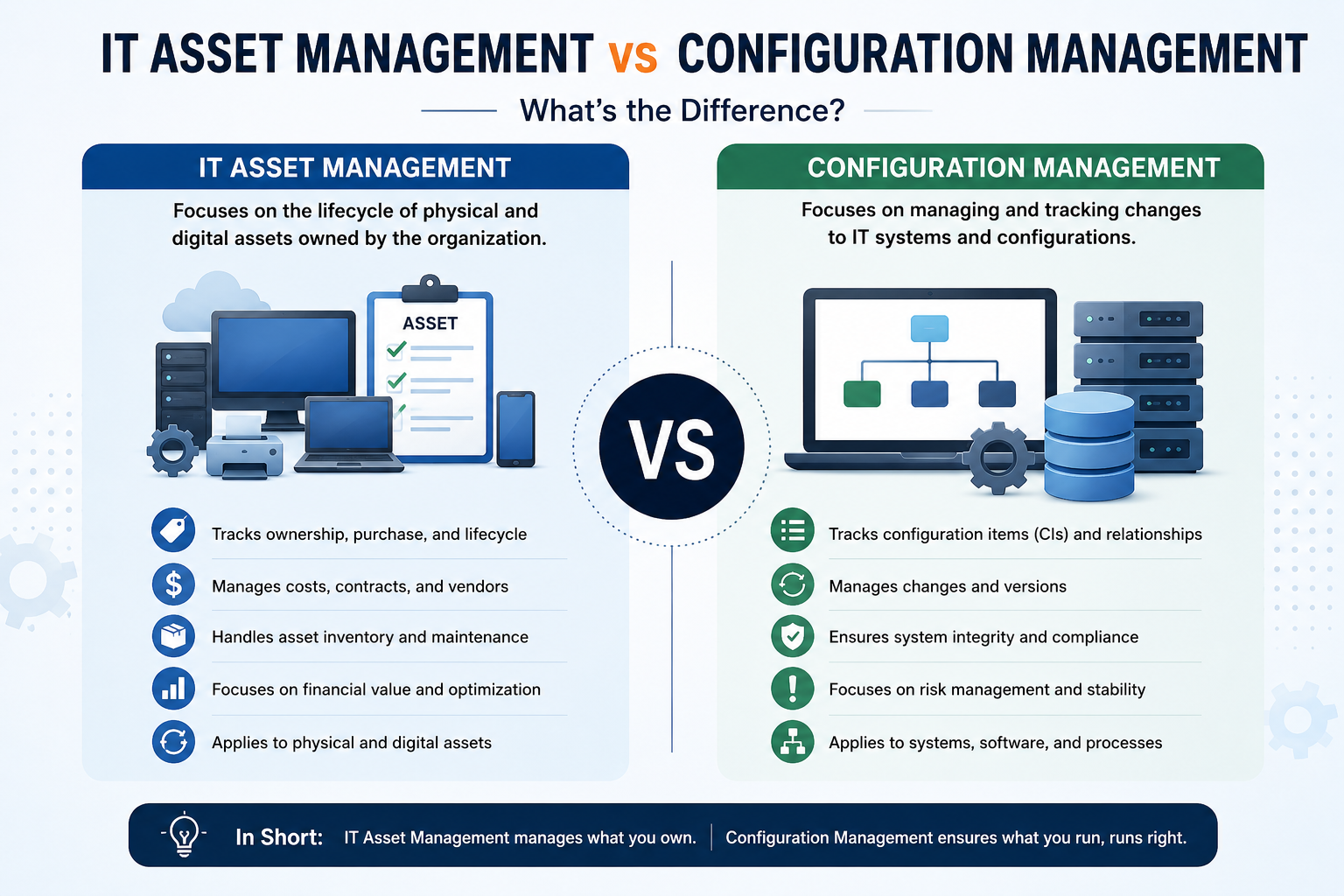
IT Asset Management vs Configuration Management: The Key Differences
While IT Asset Management and Configuration Management share a common goal of optimizing IT resources, they focus on different aspects of IT operations:
Scope
ITAM primarily deals with the procurement, management, and lifecycle of physical and virtual assets. In contrast, Configuration Management is concerned with the relationships and configurations of these assets, ensuring that systems function cohesively.
Focus
IT Asset Management focuses on financial aspects, compliance, and asset optimization. Configuration Management, on the other hand, emphasizes maintaining system integrity, controlling changes, and ensuring that configurations are consistent with organizational policies.
Tools and Processes
ITAM utilizes tools for inventory management, license tracking, and financial reporting. Configuration Management relies on a CMDB to document configurations, track changes, and facilitate audits.
Outcome
The end goal of IT Asset Management is to optimize asset utilization and minimize costs, whereas Configuration Management aims to ensure system stability, reliability, and compliance with IT policies.
The Role of CMDB in ITIL Asset Management
A Configuration Management Database (CMDB) is a repository that stores information about the components of an organization's IT infrastructure, including their configurations and relationships. The CMDB plays a vital role in both ITAM and Configuration Management:
Benefits of CMDB
- Centralized Information: Provides a single source of truth for configuration items, making it easier to manage and track assets.
- Change Impact Analysis: Helps in assessing potential impacts of changes on the IT environment.
- Incident and Problem Management: Facilitates quicker resolution of incidents by providing context about configurations and dependencies.
Conclusion
In conclusion, while IT Asset Management and Configuration Management are distinct practices within the realm of IT, they are both essential for ensuring an organization's IT infrastructure is well-managed, efficient, and compliant. Understanding the differences between them allows organizations to implement effective strategies that align with their business objectives.
If you're looking to enhance your IT operations through effective asset and configuration management, now is the time to act. Start by evaluating the current state of your IT infrastructure and consider implementing best practices from both ITAM and Configuration Management.
FAQs
1. What is the primary purpose of IT Asset Management?
The primary purpose of IT Asset Management is to manage an organization's IT assets throughout their lifecycle, ensuring efficiency, compliance, and cost-effectiveness.
2. How does Configuration Management support ITIL practices?
Configuration Management supports ITIL practices by maintaining accurate records of IT configurations, which helps in managing changes, incidents, and ensuring service delivery aligns with business needs.
3. What is a CMDB and why is it important?
A CMDB is a centralized repository that stores information about configuration items in an IT environment. It is important because it helps organizations manage configurations, understand dependencies, and streamline change management processes.
4. Can IT Asset Management and Configuration Management work together?
Yes, IT Asset Management and Configuration Management can work together to provide a comprehensive approach to managing IT resources, enhancing visibility, control, and operational efficiency.
Call to Action
Are you ready to transform your IT asset and configuration management strategies? Contact us today to learn more about how we can help you optimize your IT infrastructure for better performance and compliance. Let’s work together to drive efficiency in your organization!



Leave a Comment