
 Quality Management



















 IT Service Management



 Project Management



 Agile Management




 Web Development



 Cloud Computing


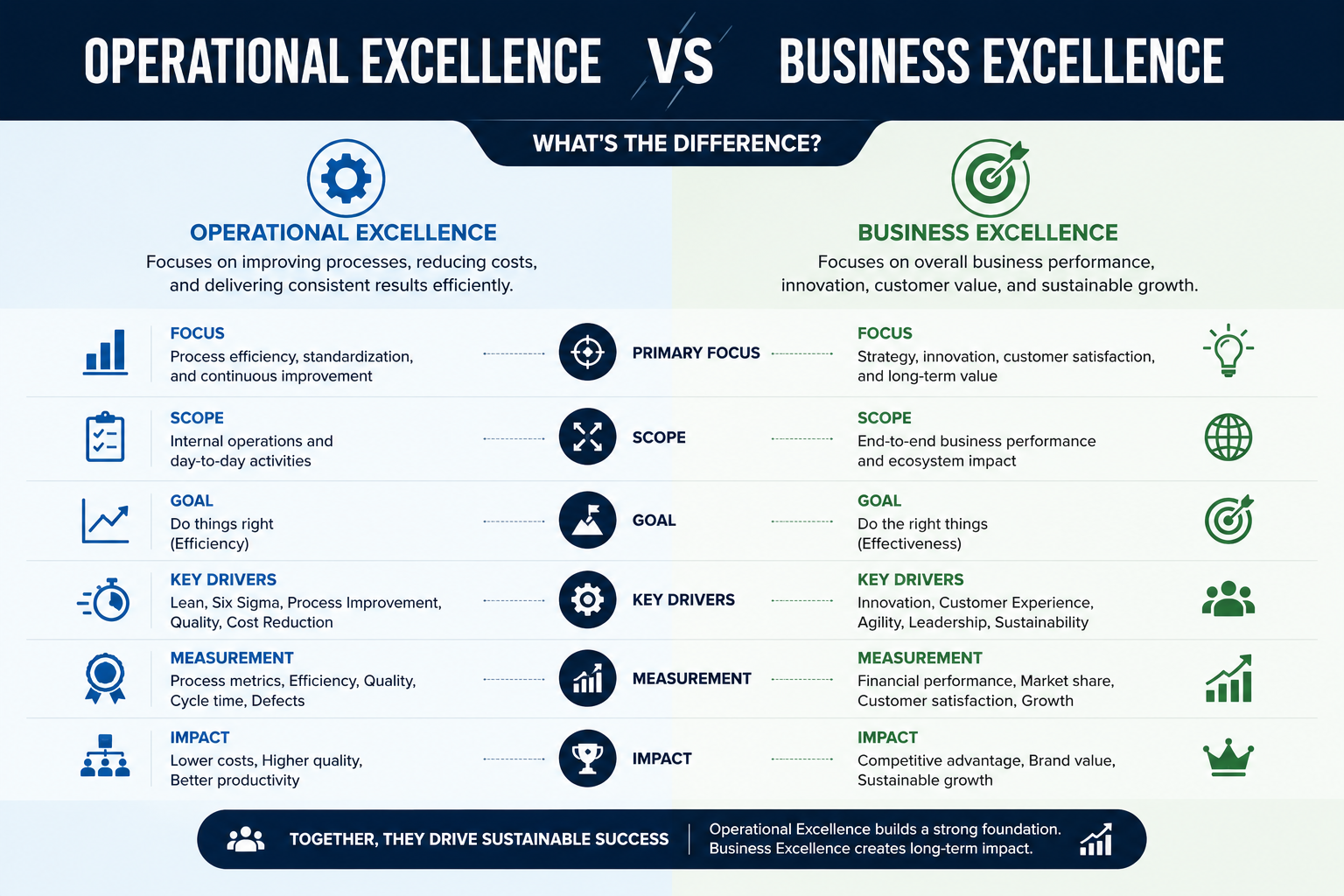
In today’s highly competitive market, organizations are constantly on the lookout for ways to improve their performance. Two terms that frequently come up in discussions about enhancing organizational performance are operational excellence and business excellence. While they might seem similar at first glance, they represent different concepts and approaches. In this blog, we will delve into the differences between operational excellence and business excellence, their significance, and how they contribute to overall performance improvement.
Understanding Operational Excellence
Operational excellence is a philosophy that focuses on the continuous improvement of an organization’s operations. It aims to enhance efficiency, reduce waste, and improve quality. The ultimate goal is to create a streamlined process that delivers maximum value to customers while minimizing costs. In India, where businesses are striving to become more competitive on a global scale, the principles of operational excellence are paramount.
Key Principles of Operational Excellence
- Customer Focus: Everything begins and ends with the customer. Understanding customer needs helps organizations deliver better products and services.
- Process Improvement: Utilizing methodologies such as Lean and Six Sigma, organizations can identify inefficiencies and streamline processes.
- Employee Engagement: Employees at all levels must be involved in the continuous improvement process. Their insights can lead to innovative solutions.
- Data-Driven Decisions: Utilizing data analytics to track performance metrics helps organizations make informed decisions.
Exploring Business Excellence
Business excellence, on the other hand, is a broader concept that encompasses various aspects of an organization’s performance. It is not limited to operational processes but includes leadership, strategy, customer results, and employee engagement. Business excellence frameworks such as the Baldrige Criteria for Performance Excellence and the EFQM Model provide organizations with a comprehensive approach to assessing and improving their overall performance.
Core Elements of Business Excellence
- Leadership: Strong leadership is crucial for setting the vision and culture of the organization.
- Strategy: A well-defined strategy that aligns with the organization’s goals is essential for long-term success.
- Results Orientation: Business excellence focuses on achieving sustainable results that benefit all stakeholders.
- Innovation: Encouraging innovation and adaptability is vital for staying ahead in a rapidly changing market.
Comparing Operational Excellence and Business Excellence
While both operational excellence and business excellence aim to improve performance, they do so from different angles. Here’s a comparison to highlight their differences:
| Operational Excellence | Business Excellence |
|---|---|
| Focuses primarily on operations and process improvement. | Encompasses all areas of the organization, including leadership and strategy. |
| Utilizes methodologies like Lean and Six Sigma. | Involves frameworks like Baldrige and EFQM. |
| Emphasizes efficiency and cost reduction. | Stresses sustainable results and stakeholder satisfaction. |
| Short-term goals of reducing waste and increasing productivity. | Long-term goals of overall organizational improvement and sustainability. |
The Importance of Performance Improvement
In the Indian context, businesses are increasingly recognizing the importance of both operational and business excellence. With a growing economy and stiff competition, organizations are focusing on performance improvement as a means to not only survive but thrive. Implementing principles of operational excellence can lead to immediate gains in efficiency and cost savings. On the other hand, embracing business excellence ensures that the organization is well-positioned for sustainable growth.
Strategies for Achieving Excellence
To achieve operational and business excellence, organizations can adopt the following strategies:
- Adopt a Continuous Improvement Culture: Foster an environment where employees are encouraged to suggest improvements and innovate.
- Invest in Training and Development: Equip employees with the skills and knowledge needed to excel in their roles.
- Use Technology Wisely: Leverage technology and data analytics to enhance decision-making processes.
- Engage Stakeholders: Regularly communicate with all stakeholders, including customers, suppliers, and employees, to gather feedback and insights.
Conclusion
Both operational excellence and business excellence play critical roles in enhancing an organization’s performance. While operational excellence focuses on optimizing processes, business excellence takes a more holistic approach to encompass leadership, strategy, and stakeholder satisfaction. By understanding and implementing both concepts, organizations in India can ensure they not only meet the current demands of the market but also prepare for future challenges.
FAQs
What is the primary goal of operational excellence?
The primary goal of operational excellence is to enhance efficiency, reduce waste, and improve quality in organizational processes while delivering maximum value to customers.
How does business excellence differ from operational excellence?
Business excellence encompasses a broader scope that includes not just operations but also leadership, strategy, and overall organizational performance, while operational excellence is more focused on improving specific processes.
Why is continuous improvement essential for organizations?
Continuous improvement is essential for organizations as it promotes a culture of innovation, efficiency, and responsiveness to market changes, allowing them to stay competitive.
What are some frameworks for achieving business excellence?
Some well-known frameworks for achieving business excellence include the Baldrige Criteria for Performance Excellence and the European Foundation for Quality Management (EFQM) Model.
Call to Action
Are you ready to take your organization to the next level of excellence? Whether you’re aiming for operational efficiency or striving for comprehensive business improvement, understanding these concepts is crucial. Start your journey towards organizational excellence today. Contact us for expert guidance on implementing effective strategies for performance improvement!


Leave a Comment