
 Quality Management



















 IT Service Management



 Project Management



 Agile Management




 Web Development



 Cloud Computing


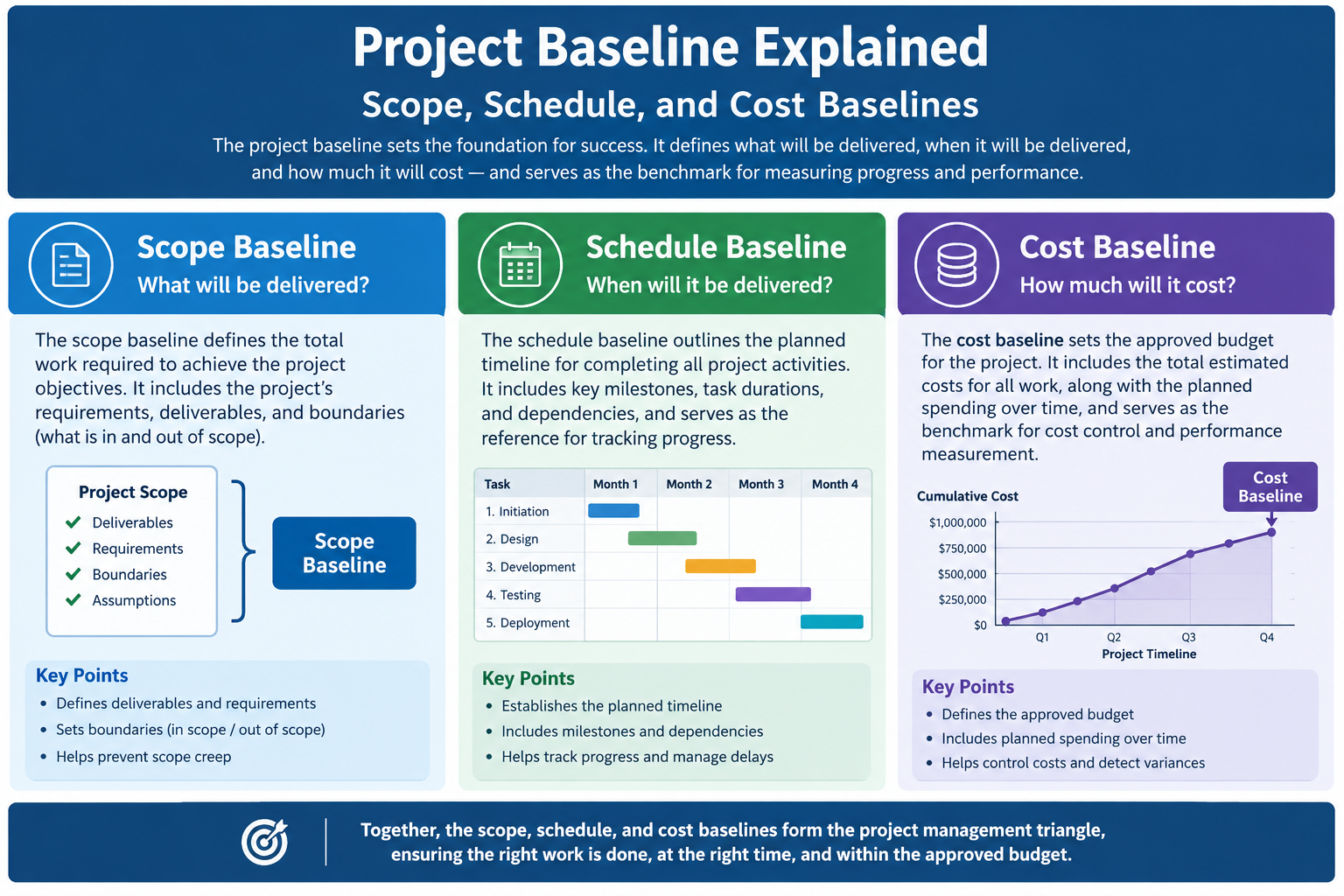
In the realm of project management, understanding the concept of a project baseline is crucial for ensuring the successful delivery of projects. Whether you're in India or elsewhere, grasping the nuances of the scope baseline, schedule baseline, and cost baseline can significantly enhance your project control measures. This comprehensive guide will walk you through each component of a project baseline, how they interconnect, and their importance in project management.
What is a Project Baseline?
A project baseline serves as a reference point against which the progress of a project can be measured. It establishes what was initially planned and provides a framework for measuring performance and progress. In project management, baselines are typically defined in terms of three key components: scope, schedule, and cost. Together, these elements form the foundation for effective project control.
The Importance of Project Baselines
Project baselines are essential for several reasons:
- Performance Measurement: They allow project managers to assess how well the project is adhering to its original plan.
- Change Control: They provide a basis for evaluating the impact of changes in scope, schedule, or cost.
- Stakeholder Communication: They serve as a tool for communicating project status and performance to stakeholders.
- Risk Management: They help identify deviations that might indicate potential risks or issues.
Understanding the Three Components of Project Baselines
1. Scope Baseline
The scope baseline refers to the approved version of the project scope statement, work breakdown structure (WBS), and its associated WBS dictionary. It delineates what is included in the project and what is not, thereby establishing clear boundaries for project deliverables.
Key elements of the scope baseline include:
- Project Scope Statement: A detailed description of the project and its deliverables.
- Work Breakdown Structure (WBS): A hierarchical decomposition of the total scope of work to accomplish the project objectives.
- WBS Dictionary: An accompanying document that provides detailed descriptions of each component in the WBS.
2. Schedule Baseline
The schedule baseline is the approved version of the project schedule, which includes the planned start and finish dates for each project activity. It serves as a benchmark for measuring project performance in terms of time.
Components of the schedule baseline consist of:
- Activity List: A detailed list of all project activities.
- Activity Sequencing: The logical order in which activities are to be performed.
- Duration Estimates: The estimated time required to complete each activity.
- Milestones: Significant points in the project timeline that represent key achievements.
3. Cost Baseline
The cost baseline is the approved version of the project budget, outlining the planned expenditure for each project phase. It provides a basis for measuring project costs and serves as a control mechanism to manage project finances.
Important components of the cost baseline include:
- Cost Estimates: The estimated costs for each project activity.
- Budget Allocation: The distribution of the total budget across different project phases and activities.
- Contingency Reserves: Additional funds set aside to address unforeseen costs.
How to Establish a Project Baseline
Establishing a project baseline involves several key steps:
- Define Project Objectives: Clearly outline what the project aims to achieve.
- Develop the Scope Statement: Document the project scope, including deliverables and exclusions.
- Create the WBS: Break down the project into manageable components.
- Develop the Schedule: Identify activities, sequence them, and estimate durations.
- Prepare the Budget: Estimate costs and allocate the budget accordingly.
- Obtain Approval: Ensure all stakeholders approve the baselines before proceeding.
Monitoring and Controlling Project Baselines
Once the project baselines are established, monitoring and controlling them is essential for project success. This involves regularly comparing actual performance against the baselines to identify variances. Here are some strategies to effectively monitor and control project baselines:
- Regular Status Meetings: Conduct regular meetings to review progress and discuss any discrepancies.
- Performance Metrics: Utilize key performance indicators (KPIs) to track progress against the baselines.
- Change Management Processes: Implement a formal process for managing changes to the baselines.
- Reporting Tools: Use project management software to generate reports and dashboards for real-time visibility.
Common Challenges in Managing Project Baselines
While managing project baselines, several challenges may arise. These include:
- Scope Creep: Uncontrolled changes or continuous growth in project scope can lead to deviations from the baseline.
- Inaccurate Estimates: Poor estimation of costs or durations can undermine the baseline's effectiveness.
- Stakeholder Misalignment: Lack of consensus among stakeholders can lead to conflicting expectations.
- Change Resistance: Resistance to change can complicate the process of adjusting baselines when necessary.
Frequently Asked Questions (FAQs)
What is the difference between scope, schedule, and cost baselines?
The scope baseline defines what is included in the project, the schedule baseline outlines the planned timeline for project activities, and the cost baseline details the approved budget for the project. Together, they form a complete project baseline for effective management.
How often should project baselines be reviewed?
Project baselines should be reviewed regularly, ideally during status meetings or at key project milestones. Continuous monitoring helps identify variances early and allows for timely corrective actions.
Can project baselines be changed?
Yes, project baselines can be changed, but it requires a formal change management process. Any changes must be documented, and all stakeholders should agree to the revisions.
What tools can help manage project baselines?
Project management software like Microsoft Project, Trello, Asana, or specialized tools such as Primavera P6 can help in managing project baselines effectively. These tools provide features for tracking progress, managing changes, and generating reports.
Conclusion
Understanding and implementing project baselines is a cornerstone of successful project management. By clearly defining the scope baseline, schedule baseline, and cost baseline, you can significantly improve your project control efforts. This knowledge is particularly vital for project managers in India, where diverse challenges and opportunities exist in the project management landscape.
Are you ready to take your project management skills to the next level? Start incorporating effective baseline management into your projects today! For more insights, tips, and resources on project management, subscribe to our newsletter and stay updated!




Leave a Comment