
 Quality Management



















 IT Service Management



 Project Management



 Agile Management



 Web Development



 Cloud Computing


In the realm of project management, understanding project dependencies is crucial for successful execution and completion. Whether you are a seasoned project manager or a novice, grasping the types of task dependencies and effective dependency management strategies can enhance your project scheduling and overall project success. In this blog, we’ll delve into the various project dependency types, their significance, and how to manage them effectively.
What Are Project Dependencies?
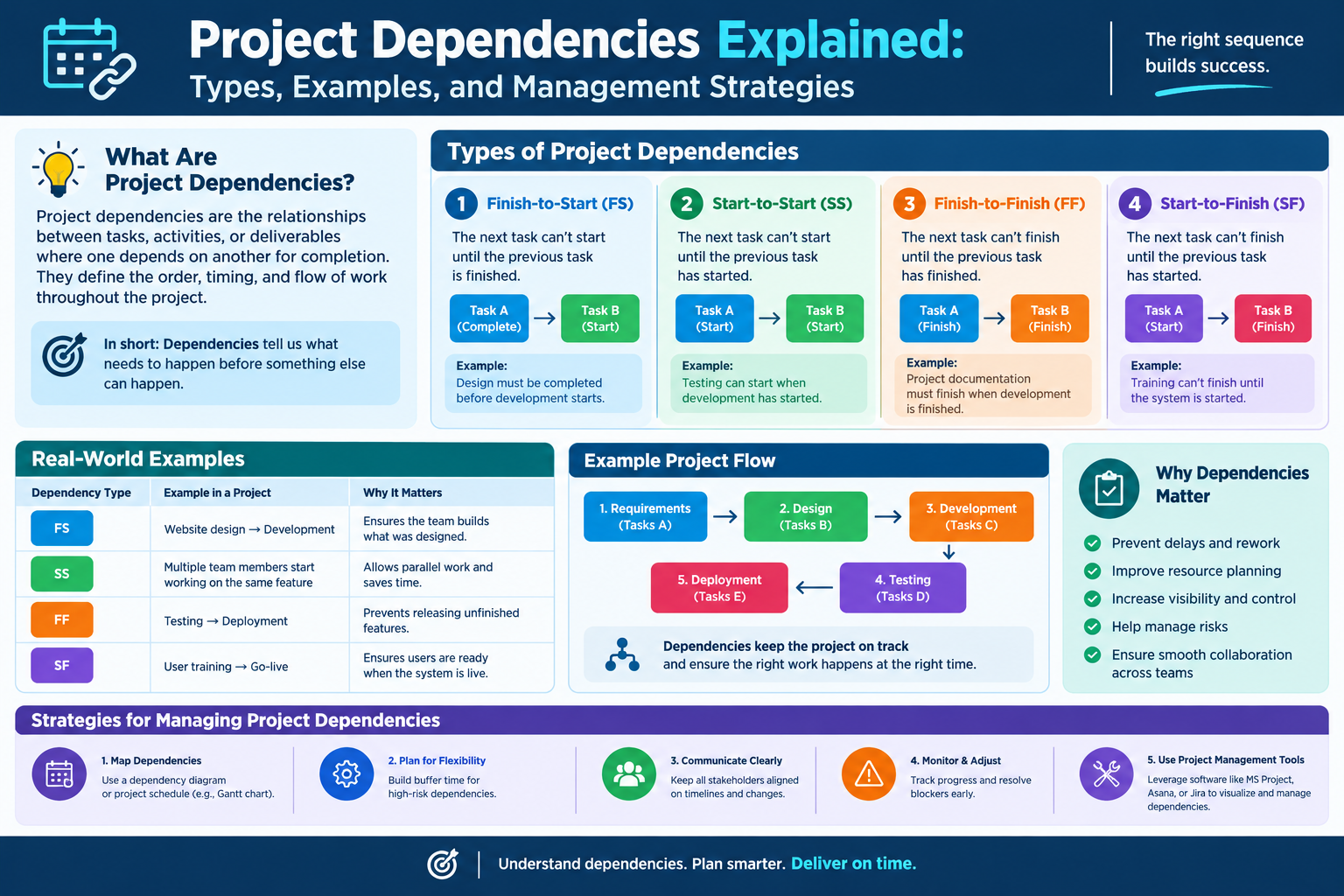
Project dependencies refer to the relationships between tasks in a project. They dictate the order in which tasks must be completed, and understanding these relationships is vital for creating a realistic and achievable project schedule. In essence, a project dependency indicates that one task relies on the completion of another before it can begin or finish.
Importance of Managing Project Dependencies
Managing task dependencies is essential for several reasons:
- Enhanced Clarity: Understanding dependencies helps clarify task sequences, reducing confusion among team members.
- Improved Scheduling: By identifying dependencies, project managers can create a more accurate project timeline.
- Risk Mitigation: Recognizing dependencies allows for better risk assessment and management, minimizing potential delays.
- Resource Allocation: Proper management of dependencies ensures that resources are allocated efficiently across tasks.
Types of Project Dependency Types
Project dependencies can be categorized into four primary types. Understanding these types is crucial for effective dependency management.
1. Finish-to-Start (FS)
The most common type of dependency is the Finish-to-Start (FS) relationship. In this scenario, Task A must be completed before Task B can begin. For example, in a construction project, the foundation (Task A) must be laid before the walls (Task B) can be erected.
2. Start-to-Start (SS)
In a Start-to-Start (SS) dependency, Task A must start before Task B can also start. This type often occurs in projects where tasks can be executed concurrently but require coordination. For instance, in software development, coding (Task A) can start simultaneously while testing (Task B) is initiated.
3. Finish-to-Finish (FF)
A Finish-to-Finish (FF) dependency means that Task A must be completed before Task B can finish. This type of dependency is common in projects where the outcome of one task directly affects the completion of another. For example, editing (Task A) must be completed before the final review (Task B) can be finalized.
4. Start-to-Finish (SF)
The Start-to-Finish (SF) dependency is less common and occurs when Task A must start before Task B can finish. An example would be in a scenario where a new system (Task A) must be implemented before the old system (Task B) can be decommissioned.
Examples of Project Dependencies
Let’s look at some real-world scenarios to better understand how these dependencies play out in practice:
Example 1: In a wedding planning project, the booking of a venue (Task A) must be completed before sending out invitations (Task B). This is a Finish-to-Start dependency.
Example 2: In a product launch, market research (Task A) should begin before product development (Task B) starts. This represents a Start-to-Start dependency.
Example 3: In a film production project, editing (Task A) must be completed to finalize the release (Task B). This is a Finish-to-Finish dependency.
Example 4: In an IT system upgrade, the new software installation (Task A) must start before the old software can be officially retired (Task B). This illustrates a Start-to-Finish dependency.
Strategies for Effective Dependency Management
To manage project dependencies effectively, consider the following strategies:
1. Use Project Management Tools
Leverage project management software like Microsoft Project, Trello, or Asana. These tools help visualize dependencies and create Gantt charts, making it easier to plan and adjust timelines.
2. Regularly Review Dependencies
Dependencies can change as projects progress. Regularly review and update your dependency map to reflect any changes in task completion or project scope.
3. Communicate with Your Team
Ensure that all team members are aware of the dependencies and their implications. Open communication fosters collaboration and helps mitigate risks associated with delays.
4. Prioritize Tasks Wisely
Prioritize tasks based on their dependencies. Focus on completing critical tasks first to avoid bottlenecks that can derail the entire project.
5. Utilize the Critical Path Method (CPM)
The Critical Path Method can help identify the longest stretch of dependent tasks and measure the time required to complete them. This method aids in determining which tasks are essential for project success.
FAQs About Project Dependencies
What happens if a dependency is delayed?
If a dependency is delayed, it can have a domino effect on subsequent tasks, leading to overall project delays. It’s essential to identify critical tasks and implement strategies to mitigate such risks.
Can dependencies change during a project?
Yes, dependencies can change as the project evolves. Regular review and communication with the team are vital to keep everyone informed and adjust the project plan accordingly.
How do I identify project dependencies?
To identify project dependencies, conduct a thorough analysis of all tasks, understanding their relationships and prerequisites. Tools like flowcharts or project management software can help visualize these connections.
Is it possible to have overlapping tasks?
Yes, overlapping tasks are possible, especially in Start-to-Start and Finish-to-Finish dependencies. However, it’s crucial to manage overlaps carefully to avoid resource conflicts.
Conclusion
Understanding project dependencies is a fundamental aspect of successful project management. By recognizing the various project dependency types and implementing effective dependency management strategies, you can enhance your project scheduling and ensure that your projects are completed on time and within budget.
Ready to take your project management skills to the next level? Start implementing these strategies today and watch your projects flourish!
Call to Action
If you found this blog helpful, share it with your colleagues and friends. For more insights on project management strategies, subscribe to our newsletter and stay updated with the latest trends and tips!



Leave a Comment