
 Quality Management



















 IT Service Management



 Project Management



 Agile Management




 Web Development



 Cloud Computing


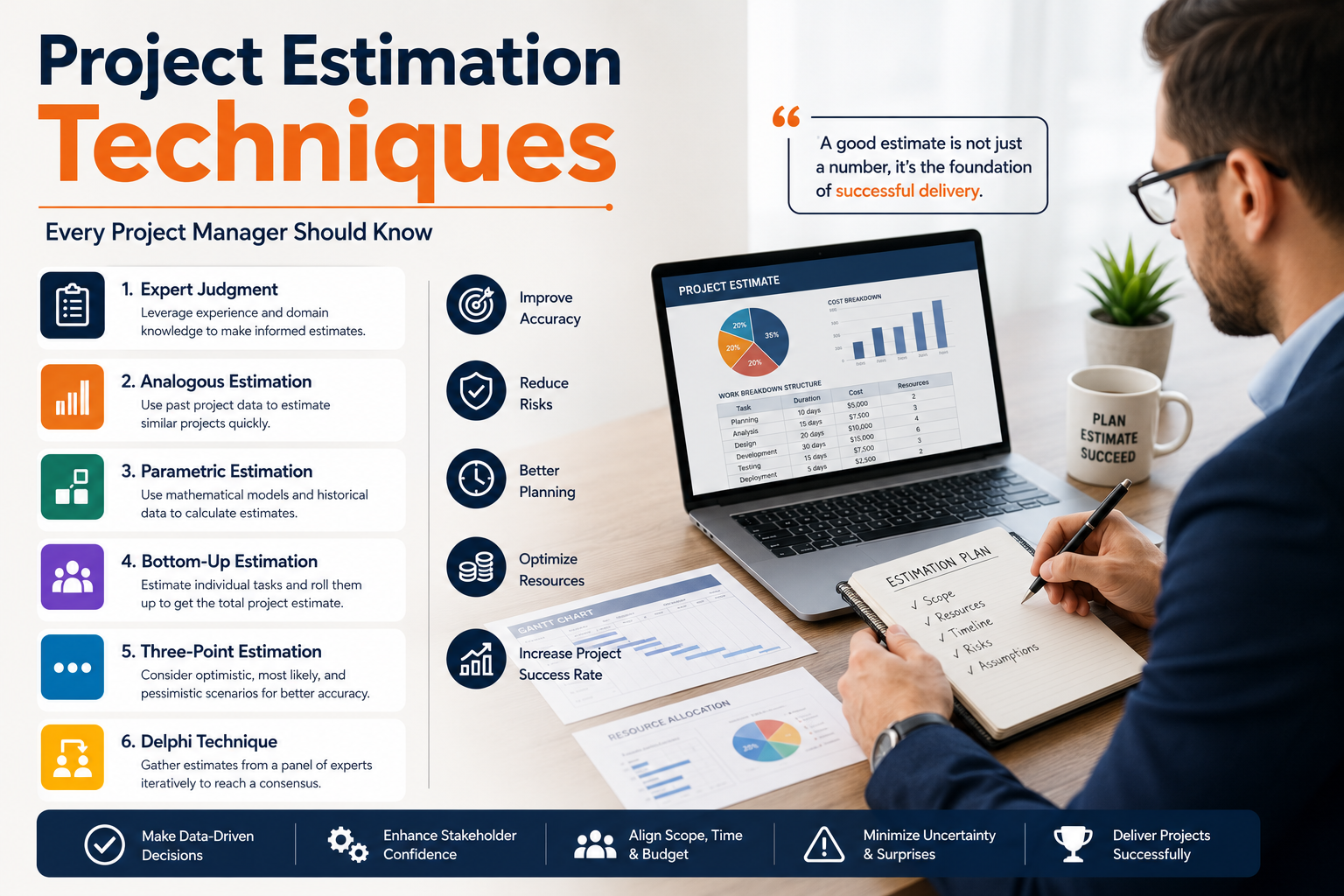
In the realm of project management, precise planning is the cornerstone of success. Among the various aspects of project planning, project estimation techniques hold particular significance. They not only help in determining the time and cost required for a project but also guide decision-making throughout the project lifecycle. In this blog, we will explore essential effort estimation, project cost estimation, and effective estimation methods that every project manager should be familiar with, especially in the context of the Indian market.
Understanding Project Estimation Techniques
Project estimation refers to the process of predicting the resources, time, and costs necessary to complete a project. Accurate estimations are crucial as they influence budgeting, scheduling, and resource allocation. In India, where businesses are rapidly evolving, mastering these techniques can provide a competitive edge.
The Importance of Accurate Estimation
Accurate project estimation is vital for several reasons:
- Budget Control: Helps in managing finances effectively.
- Resource Allocation: Ensures that the right resources are available at the right time.
- Stakeholder Confidence: Builds trust with stakeholders through reliable forecasts.
- Risk Management: Identifies potential risks and prepares for contingencies.
Key Techniques for Project Estimation
There are various project estimation techniques that project managers can use. Here are some of the most effective:
1. Expert Judgment
One of the simplest yet most effective techniques is relying on the expertise of seasoned professionals. This method involves gathering estimations from individuals who have relevant experience in similar projects. While this technique is quick and often reliable, it can be subjective and may not always yield consistent results.
2. Analogous Estimation
Analogous estimation involves using historical data from previous projects to forecast future project requirements. By comparing the current project to similar past projects, managers can derive estimates based on actual outcomes. This method is particularly useful when there are limited resources or time constraints.
3. Parametric Estimation
This technique uses statistical relationship between historical data and other variables to calculate estimates. For instance, if a project typically requires a certain number of hours per unit of work, this can be multiplied by the expected number of units to derive the total effort estimation. Parametric estimation is effective in large projects where historical data is abundant.
4. Bottom-Up Estimation
Bottom-up estimation involves breaking down the project into smaller components or tasks and estimating the resources and time required for each. Once all individual estimates are compiled, they are aggregated to form a comprehensive project estimate. This technique is time-consuming but often results in highly accurate estimates.
5. Three-Point Estimation
This technique uses three different estimates for each task: optimistic (best-case scenario), pessimistic (worst-case scenario), and most likely. By calculating a weighted average of these three estimates, project managers can derive a more balanced and realistic estimate. This method is particularly useful for risk management, as it considers uncertainty.
Project Cost Estimation Techniques
Cost estimation is a critical component of project planning. Here are some effective techniques:
1. Fixed Price Estimation
In this approach, the project cost is predetermined and fixed. This method is often used in contracts where the scope of work is clearly defined. While it provides financial certainty, it may lead to compromises in quality if the estimate is too low.
2. Time and Materials Estimation
This method involves estimating costs based on the time spent and materials used. It is suitable for projects with uncertain scopes, as it allows for flexibility. However, it may lead to budget overruns if not monitored closely.
3. Value Engineering
Value engineering focuses on improving the value of a project while minimizing costs. This technique involves analyzing project functions and identifying ways to achieve the same results at a lower cost. It requires creativity and collaboration among team members.
Tips for Effective Project Planning
As project managers implement these estimation methods, they should consider the following tips to enhance their project planning:
- Involve Stakeholders: Engage stakeholders early in the estimation process to gather insights and achieve buy-in.
- Document Everything: Keep detailed records of all estimates and assumptions to facilitate future reference and adjustments.
- Review and Adjust: Regularly review estimates as the project progresses and adjust them based on new information.
- Utilize Software Tools: Leverage project management software to streamline the estimation process and improve accuracy.
FAQs about Project Estimation Techniques
1. What are project estimation techniques?
Project estimation techniques are methods used by project managers to predict the resources, time, and costs required for a project. They include expert judgment, analogous estimation, parametric estimation, bottom-up estimation, and three-point estimation.
2. Why is project cost estimation important?
Project cost estimation is crucial for budgeting and financial planning. Accurate cost estimates help in resource allocation, managing stakeholder expectations, and mitigating financial risks.
3. How can I improve my project estimation skills?
To improve your project estimation skills, familiarize yourself with various estimation techniques, seek feedback from experienced colleagues, and continuously learn from past project outcomes.
4. What is the best estimation method for large projects?
For large projects, bottom-up estimation and parametric estimation are often the best methods, as they provide detailed and data-driven insights into the project's requirements.
Conclusion
Mastering project estimation techniques is essential for every project manager looking to succeed in today’s competitive landscape. By understanding and implementing various effort estimation and project cost estimation methods, project managers can ensure that their projects are completed on time and within budget. As the Indian market becomes increasingly dynamic, honing these skills will not only enhance project outcomes but also foster greater stakeholder trust and satisfaction.
If you're looking to improve your project management skills and implement effective estimation techniques, consider joining our workshops and training sessions. Contact us today for more information!





Leave a Comment