
 Quality Management



















 IT Service Management



 Project Management



 Agile Management




 Web Development



 Cloud Computing


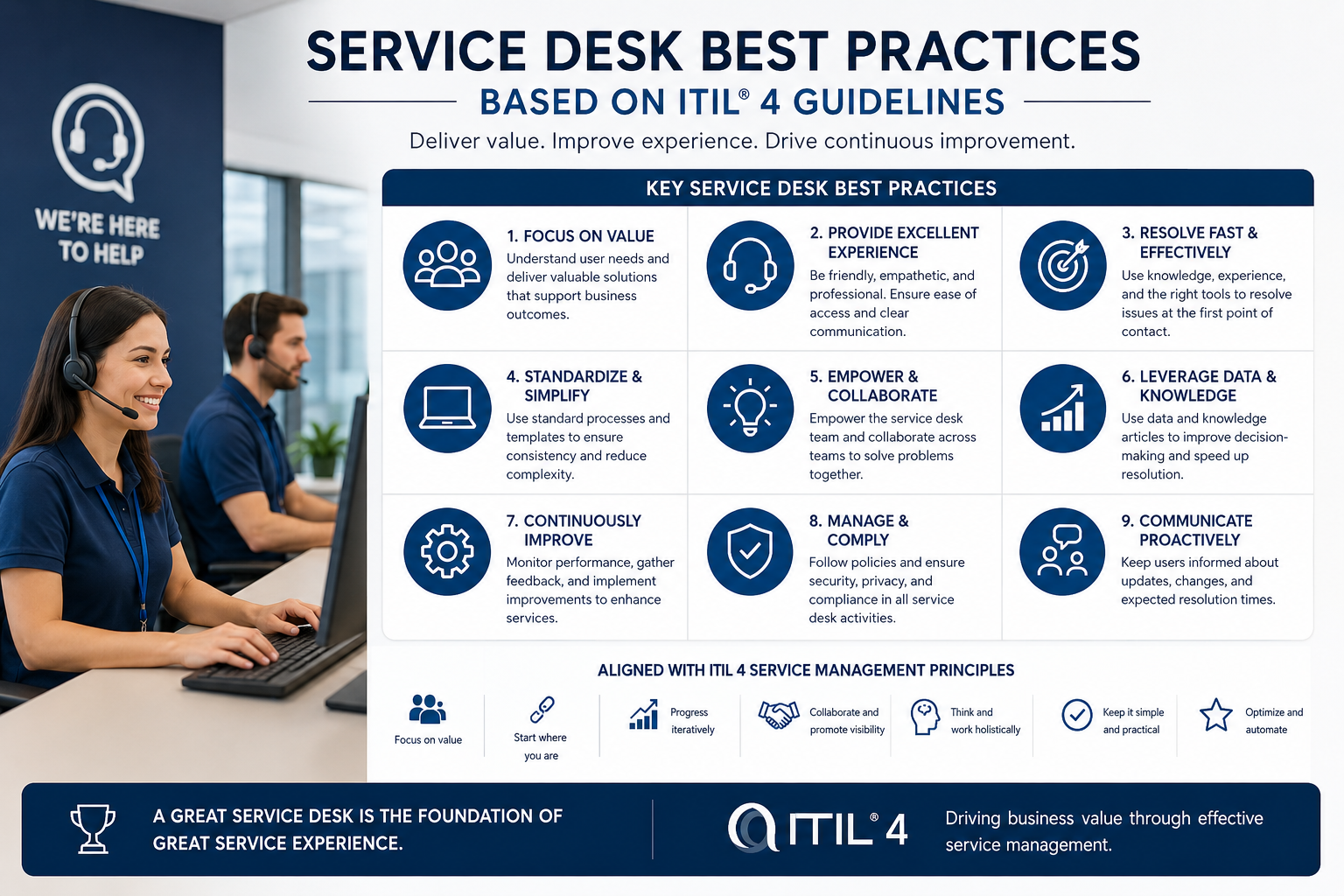
In the dynamic world of IT service management, the service desk plays a pivotal role in ensuring smooth operations and effective customer support. As organizations in India increasingly adopt ITIL 4 guidelines, understanding and implementing service desk best practices becomes essential for maintaining high-quality customer support management and achieving optimal help desk optimization. In this blog, we will explore the best practices for service desks that align with ITIL 4, emphasizing the importance of these practices for enhancing service delivery and customer satisfaction.
Understanding ITIL 4 and Its Relevance to Service Desks
ITIL 4, the latest iteration of the IT Infrastructure Library, offers a comprehensive framework for IT service management (ITSM). It emphasizes a holistic approach, focusing on value co-creation through effective collaboration between service providers and customers. For Indian businesses, embracing ITIL 4 guidelines can significantly enhance their service desk operations.
Service desks are the primary point of contact for customers seeking support and assistance. By implementing ITIL 4 best practices, organizations can streamline their service desk functions, improve response times, and ultimately boost customer satisfaction. Let’s delve into some essential service desk best practices that align with ITIL 4 principles.
1. Establish Clear Objectives and Metrics
A well-defined service desk operates with clear objectives that resonate with organizational goals. Setting measurable KPIs (Key Performance Indicators) allows teams to gauge their performance and identify areas for improvement. Common metrics include:
- First Contact Resolution Rate
- Average Response Time
- Customer Satisfaction Score (CSAT)
- Ticket Resolution Time
Regularly reviewing these metrics helps in refining processes and enhancing service delivery, aligning with ITIL’s focus on continual improvement.
2. Prioritize Incident and Request Management
Effective incident and request management is crucial for a successful service desk. By categorizing and prioritizing incoming requests, service desks can allocate resources more efficiently. ITIL 4 emphasizes a structured approach to incident management, ensuring that:
- Incidents are logged accurately
- Prioritization is based on impact and urgency
- Resolved incidents are documented for future reference
This systematic approach minimizes downtime and enhances the overall customer experience, reinforcing the importance of customer support management.
3. Embrace Automation and Self-Service Options
In today's fast-paced environment, automation is key to optimizing help desks. Implementing automated ticketing systems and self-service portals can significantly reduce the workload on service desk agents. ITIL 4 encourages organizations to leverage technology for:
- Automating routine tasks
- Providing self-service options for common issues
- Integrating chatbots for immediate assistance
These practices not only improve efficiency but also empower customers to resolve issues independently, enhancing their overall experience.
4. Foster Collaboration and Communication
Effective communication among service desk staff, IT teams, and customers is vital for smooth operations. Establishing a culture of collaboration ensures that information flows freely, enabling quicker resolutions. Regular meetings and updates can help teams stay aligned and informed about:
- Ongoing incidents
- New service offerings
- Customer feedback
ITIL 4 promotes collaboration as a means to improve service delivery, ultimately leading to better customer support management.
5. Invest in Continuous Training and Development
To keep pace with evolving technologies and customer expectations, service desk personnel must receive continuous training and development. ITIL 4 highlights the importance of upskilling employees to enhance their knowledge and competencies. Organizations should:
- Provide regular training sessions
- Encourage certification in ITIL principles
- Facilitate knowledge-sharing among team members
This investment in human capital not only improves service desk efficiency but also fosters a culture of excellence and innovation.
6. Utilize Customer Feedback for Improvement
Customer feedback is a valuable resource for identifying areas of improvement within the service desk. ITIL 4 encourages organizations to actively seek feedback through:
- Post-resolution surveys
- Regular check-ins with customers
- Monitoring social media and online reviews
By analyzing this feedback, service desks can make informed decisions about process enhancements and service adjustments, ultimately leading to a more customer-centric approach.
7. Implement Knowledge Management Practices
A robust knowledge management system is essential for service desk optimization. ITIL 4 advocates for creating a centralized knowledge base that contains:
- Commonly asked questions
- Step-by-step guides for troubleshooting
- Documentation of resolved incidents
By providing easy access to this information, service desk agents can resolve issues more quickly and efficiently, which significantly enhances customer satisfaction.
FAQs
What are the main objectives of a service desk?
The main objectives of a service desk include providing efficient customer support, managing incidents and requests, ensuring service continuity, and enhancing customer satisfaction through effective communication and resolution processes.
How does ITIL 4 improve service desk operations?
ITIL 4 improves service desk operations by providing a structured framework for best practices, emphasizing continual improvement, fostering collaboration, and encouraging customer-centric approaches that enhance overall service delivery.
What role does automation play in service desk optimization?
Automation plays a crucial role in service desk optimization by streamlining repetitive tasks, reducing response times, and allowing customers to access self-service options, leading to a more efficient and satisfactory support experience.
How can organizations measure the success of their service desk?
Organizations can measure the success of their service desk by tracking key performance indicators (KPIs) such as first contact resolution rate, average response time, customer satisfaction score, and ticket resolution time.
Conclusion
Incorporating service desk best practices based on ITIL 4 guidelines is essential for organizations in India striving for excellence in customer support management. By establishing clear objectives, embracing automation, fostering collaboration, and investing in training, businesses can optimize their service desk operations and enhance customer satisfaction. As the IT landscape continues to evolve, staying updated on these best practices will ensure that service desks remain relevant and effective in meeting customer needs.
If you're looking to optimize your service desk based on ITIL 4 guidelines, connect with us today! Our team of experts is here to help you implement effective strategies that enhance your customer support management and overall service delivery.



Leave a Comment