
 Quality Management



















 IT Service Management



 Project Management



 Agile Management



 Web Development



 Cloud Computing


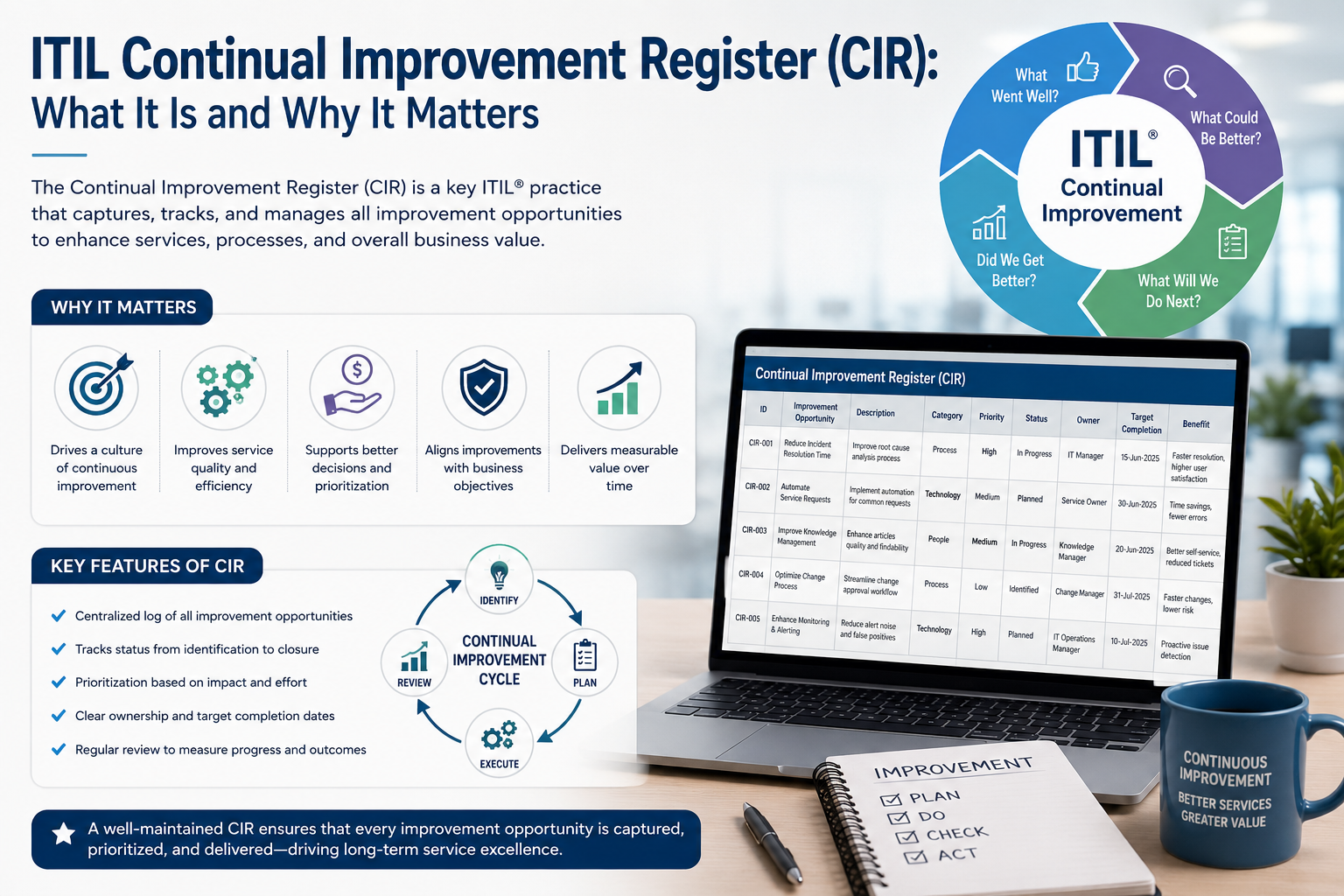
In the ever-evolving landscape of IT service management, organizations are continuously looking for ways to enhance their services and operations. One of the key frameworks that guide these improvements is ITIL (Information Technology Infrastructure Library). A critical aspect of this framework is the Continual Improvement Register (CIR). In this blog, we will delve into what the ITIL CIR is, its significance, and how it can help organizations in India adopt ITIL best practices for effective service management.
Understanding the ITIL Continual Improvement Register (CIR)
The ITIL Continual Improvement Register (CIR) is a structured tool that organizations use to document and track improvement initiatives. It acts as a central repository for all improvement ideas, projects, and activities that are aimed at enhancing the quality of IT services. The CIR aligns with the ITIL continual improvement model, which emphasizes ongoing service enhancement through systematic assessment and adjustment.
Key Components of the Continual Improvement Register
- Improvement Initiatives: Detailed descriptions of each improvement activity, including objectives, scope, and expected outcomes.
- Status Tracking: A way to monitor the current status of each initiative, whether it is in planning, execution, or completed.
- Metrics and KPIs: Relevant metrics and key performance indicators that measure the success and impact of each initiative.
- Responsible Parties: Clear identification of who is responsible for each initiative, ensuring accountability.
- Review Dates: Scheduled dates for periodic reviews to assess progress and make necessary adjustments.
Why the ITIL Continual Improvement Register Matters
The importance of the ITIL Continual Improvement Register cannot be overstated. It serves multiple purposes that significantly contribute to an organization's growth and efficiency.
1. Encourages a Culture of Continuous Improvement
By maintaining a CIR, organizations promote a culture where employees are encouraged to identify areas for improvement actively. This culture leads to innovative thinking and can result in significant service enhancements, ultimately benefiting customers and stakeholders alike.
2. Provides a Structured Approach
The CIR offers a structured methodology for tracking improvement initiatives. This structure helps in prioritizing projects based on their potential impact and feasibility, thus optimizing resource allocation.
3. Enhances Decision-Making
With documented improvement activities, decision-makers have access to real data and insights. This information aids in making informed choices about which initiatives to pursue, ensuring that resources are invested wisely.
4. Facilitates Performance Measurement
The metrics and KPIs tracked in the CIR allow organizations to measure the performance of improvement initiatives. This measurement helps in understanding what works, what doesn’t, and where further adjustments are needed.
5. Aligns with ITIL Best Practices
Using the ITIL CIR aligns an organization with recognized ITIL best practices. It ensures that improvement initiatives are not only effective but also adhere to industry standards, which is crucial for maintaining high service quality.
Implementing the ITIL Continual Improvement Register in Your Organization
Implementing a Continual Improvement Register may seem daunting, but with the right steps, organizations can do so effectively.
Step 1: Define Improvement Goals
Begin by clearly defining the goals of your improvement initiatives. What areas of service need enhancement? What are the expected outcomes? Having clear objectives will guide the entire process.
Step 2: Create the Register
Develop a template for your CIR that includes all the key components mentioned earlier. This template can be customized based on the specific needs of your organization.
Step 3: Involve Stakeholders
Engage key stakeholders in the process. Their insights can help identify potential improvement areas and foster a sense of ownership over the initiatives.
Step 4: Monitor and Update
Regularly review the CIR to ensure it is up-to-date. Track progress and make adjustments as necessary. This ongoing maintenance is crucial for the CIR's effectiveness.
Step 5: Communicate Results
Share the outcomes of improvement initiatives with the organization. Transparency helps build trust and encourages further participation in the continual improvement process.
Common Challenges in Using the ITIL Continual Improvement Register
While the CIR is a powerful tool, organizations may face several challenges in its implementation.
1. Resistance to Change
Employees may be resistant to new processes. To overcome this, it's essential to communicate the benefits of the CIR clearly and involve everyone in the process.
2. Lack of Data
Without sufficient data, it can be difficult to measure the effectiveness of improvement initiatives. Organizations should invest in collecting and analyzing relevant data to inform their decisions.
3. Overcomplication
It's easy to make the CIR overly complex. Focus on simplicity and clarity to ensure that all employees can understand and engage with the register.
FAQs about ITIL Continual Improvement Register (CIR)
What is the main purpose of the ITIL Continual Improvement Register?
The main purpose of the ITIL Continual Improvement Register is to document, track, and manage improvement initiatives within an organization, ensuring systematic enhancements to IT services.
How does the CIR align with ITIL best practices?
The CIR is designed in accordance with ITIL best practices, ensuring that improvement initiatives are effective, measurable, and aligned with industry standards.
Can small businesses benefit from the ITIL CIR?
Absolutely! Small businesses can leverage the ITIL CIR to implement structured improvement initiatives, which can lead to significant operational efficiencies and service quality enhancements.
How often should the CIR be updated?
The CIR should be reviewed and updated regularly, ideally in line with scheduled review dates or after the completion of significant initiatives.
Conclusion
The ITIL Continual Improvement Register is an invaluable tool for organizations looking to enhance their IT service management practices. By fostering a culture of continuous improvement and aligning with ITIL best practices, organizations can achieve remarkable service quality and operational efficiency. If you haven’t already implemented a CIR in your organization, now is the perfect time to start!
For more insights on ITIL best practices and how to implement effective service improvement plans, feel free to reach out to us. Let's embrace the journey of continual improvement together!
Call to Action
If you're ready to take your IT service management to the next level, contact us today for a consultation on implementing ITIL best practices tailored to your organizational needs!



Leave a Comment