
 Quality Management



















 IT Service Management



 Project Management



 Agile Management




 Web Development



 Cloud Computing


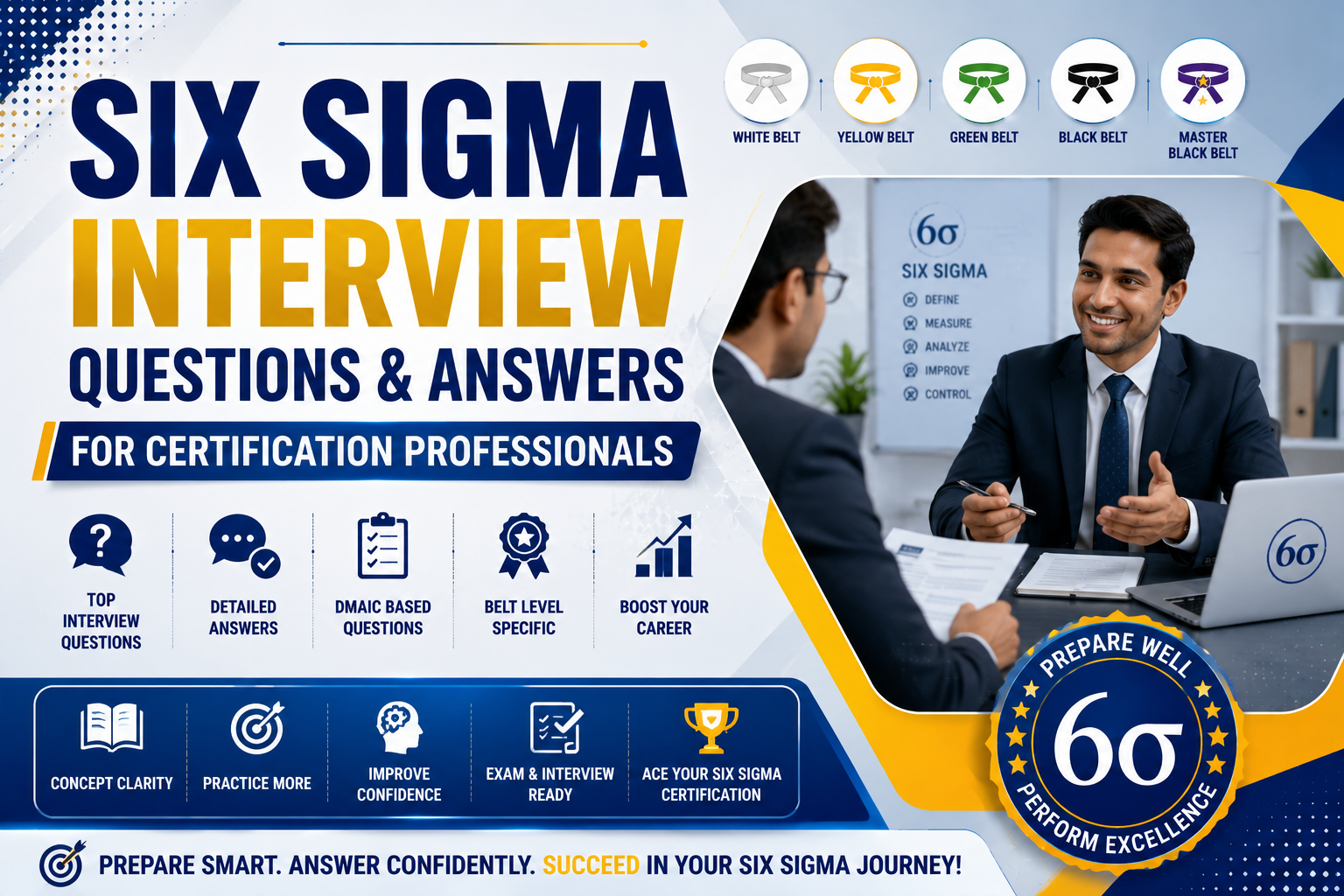
Are you preparing for a Six Sigma certification interview? Whether you are aiming for a Green Belt or Black Belt certification, understanding the common Six Sigma interview questions is crucial for your success. In this blog, we will explore a variety of Lean Six Sigma interview questions, including DMAIC-related queries and specific questions tailored for quality analysts. Let’s dive in!
Understanding Six Sigma and Its Importance
Six Sigma is a data-driven methodology that aims to improve processes by eliminating defects and variance, ultimately enhancing overall quality. In India, as more organizations recognize the importance of quality management, professionals with Six Sigma certifications are increasingly sought after. Mastering the Green Belt or Black Belt methodologies can significantly boost your career prospects in industries such as manufacturing, healthcare, and IT.
Common Six Sigma Interview Questions
1. What is Six Sigma?
This is a fundamental question that every candidate should be ready to answer. Six Sigma is a set of techniques and tools for process improvement. It was developed by Motorola in the 1980s and has since been adopted by various industries worldwide. It aims to reduce process variation and improve product quality.
2. Explain the DMAIC process.
The DMAIC process is a core component of Six Sigma. It stands for Define, Measure, Analyze, Improve, and Control. Each phase plays a crucial role in problem-solving:
- Define: Identify the problem and project goals.
- Measure: Collect data to understand current performance.
- Analyze: Identify the root causes of defects.
- Improve: Develop solutions to eliminate root causes.
- Control: Implement solutions and monitor results to sustain improvements.
3. What are the roles of a Green Belt vs. a Black Belt?
A Green Belt professional typically works on process improvement projects part-time, while a Black Belt is a full-time project leader who oversees and manages Six Sigma projects. Green Belts can lead smaller projects and assist Black Belts in larger initiatives.
4. Can you explain what a 'Defect' is in Six Sigma terms?
A defect is any instance where a product or service fails to meet customer specifications or requirements. In Six Sigma, the goal is to minimize defects to achieve higher quality standards.
5. What is a Control Chart?
A Control Chart is a graphical tool used to monitor process variability over time. It helps determine whether a process is in a state of control or if it requires intervention. Understanding how to interpret control charts is essential for quality analysts and Six Sigma professionals.
6. What is the significance of the 'Voice of the Customer' (VoC)?
The Voice of the Customer represents customer feedback and expectations. It is vital for understanding customer needs and aligning process improvements with those needs. Integrating VoC into the Six Sigma process ensures that improvements lead to higher customer satisfaction.
Lean Six Sigma Interview Questions
7. What are the principles of Lean Six Sigma?
Lean Six Sigma combines Lean manufacturing principles with Six Sigma methodologies. Its main principles include:
- Value: Define what is valuable to the customer.
- Value Stream: Identify all steps in the value stream and eliminate waste.
- Flow: Ensure smooth flow of processes without interruptions.
- Pull: Produce only what is needed when it is needed.
- Perfection: Continuously strive for perfection by eliminating defects.
8. What is Kaizen?
Kaizen is a Japanese term meaning "continuous improvement." In the context of Lean Six Sigma, it refers to the practice of ongoing improvement involving everyone in the organization, from top management to the shop floor.
Black Belt Interview Questions
9. Describe a Six Sigma project you have led.
When answering this question, focus on a specific project where you applied Six Sigma principles effectively. Discuss the problem, your role, the tools you used, and the outcomes achieved. Use metrics where possible to quantify your results.
10. How do you handle conflict in a team setting?
As a Black Belt, you will often lead teams through complex projects. Demonstrating your conflict resolution skills is essential. Discuss specific strategies you employ to facilitate open communication and maintain focus on project goals.
DMAIC Interview Questions
11. Give an example of a project where you used DMAIC.
Provide a detailed account of a project where you successfully applied the DMAIC methodology. Highlight each phase and the tools you used, such as Fishbone diagrams or Pareto charts, to analyze data.
12. What tools do you use during the Analyze phase?
Common tools used during the Analyze phase include:
- Fishbone Diagrams
- 5 Whys Analysis
- Process Mapping
- Statistical Analysis Tools
Quality Analyst Interview Questions
13. How do you ensure quality in your processes?
This question allows you to showcase your commitment to quality assurance. Discuss your approach to monitoring, measuring, and analyzing processes to maintain high standards. Emphasize the importance of metrics and KPIs in your role.
14. What is the role of a Quality Analyst in a Six Sigma project?
A Quality Analyst plays a crucial role in data collection, analysis, and ensuring that quality standards are met throughout the Six Sigma process. They are responsible for identifying defects and proposing improvements to enhance quality.
FAQs
1. What is the best way to prepare for a Six Sigma interview?
Review the key concepts, methodologies, and tools associated with Six Sigma. Practice answering common interview questions and consider participating in mock interviews to build confidence.
2. How long does it take to earn a Six Sigma certification?
The duration to earn a Six Sigma certification varies depending on the level. Generally, Green Belt certification can be achieved in a few weeks to a few months, while Black Belt certification may take several months.
3. Are online courses effective for Six Sigma certification?
Yes, many reputable organizations offer online Six Sigma courses that provide valuable knowledge and skills. Ensure the course is accredited and includes practical case studies.
4. What industries value Six Sigma certification?
Industries such as manufacturing, healthcare, finance, and IT highly value Six Sigma certification. It demonstrates a professional's commitment to quality improvement and process efficiency.
Conclusion
Preparing for a Six Sigma interview can be daunting, but understanding the key Six Sigma interview questions and practicing your answers can set you up for success. Whether you’re pursuing a Green Belt or Black Belt certification, showcasing your knowledge and experience in Six Sigma methodologies will help you stand out. Remember, continuous improvement is at the heart of Six Sigma, so keep learning and refining your skills.
If you found this blog helpful, don’t forget to share it with others preparing for their Six Sigma interviews. For more insights and tips on Six Sigma and quality management, subscribe to our newsletter!


Leave a Comment