
 Quality Management



















 IT Service Management



 Project Management



 Agile Management




 Web Development



 Cloud Computing


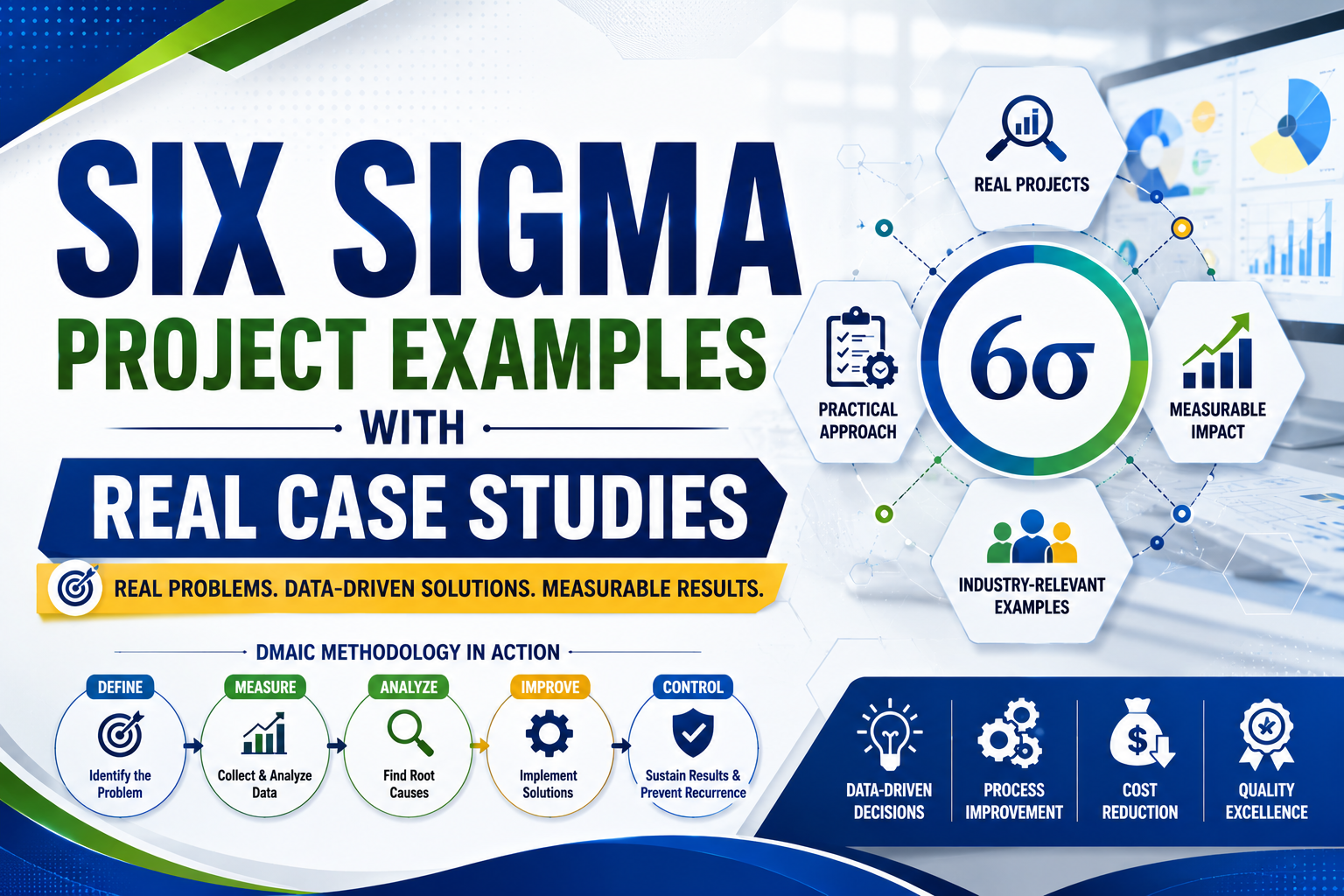
In today's competitive business landscape, organizations are continually seeking ways to enhance their processes, reduce waste, and improve overall efficiency. One of the most effective methodologies for achieving these goals is Six Sigma. In this blog, we will delve into various Six Sigma case study examples that demonstrate the practical application of Six Sigma principles through real-world scenarios. Let’s explore these Six Sigma project examples and discover how companies have successfully implemented the DMAIC framework to achieve remarkable results.
Understanding Six Sigma and DMAIC
Before we dive into specific case studies, let's briefly recap what Six Sigma is and the DMAIC framework that underpins its methodology. Six Sigma is a data-driven approach aimed at eliminating defects and ensuring quality in business processes. The DMAIC process, which stands for Define, Measure, Analyze, Improve, and Control, is a structured problem-solving framework used in Six Sigma projects.
Define
This stage involves outlining the problem, setting goals, and identifying customer requirements.
Measure
Here, data is collected to establish a baseline for current performance and identify the extent of the problem.
Analyze
This phase focuses on identifying root causes of defects and opportunities for improvement.
Improve
In the Improve phase, solutions are developed and tested to address the root causes identified.
Control
Finally, the Control phase ensures that improvements are sustained over time through monitoring and adjustments.
Six Sigma Project Examples
1. Motorola: The Pioneer of Six Sigma
One of the most notable Six Sigma case study examples comes from Motorola, where Six Sigma was first developed in the 1980s. Motorola aimed to reduce defects in its manufacturing processes, specifically in its semiconductor division. By implementing Six Sigma methodologies, they achieved a reduction in defect rates from 18,000 parts per million (PPM) to just 3.4 PPM.
This transformation not only saved the company millions of dollars but also established Motorola as a leader in quality manufacturing. The success of this project served as a catalyst for other companies to adopt Six Sigma practices.
2. GE: Streamlining Processes for Efficiency
General Electric (GE) is another prime example of a company that effectively utilized Six Sigma. Under the leadership of former CEO Jack Welch, GE implemented Six Sigma to enhance its operational efficiency. One of the process improvement case study projects involved their aircraft engine manufacturing division.
By applying the DMAIC framework, GE was able to reduce cycle times and improve product quality. They achieved a remarkable reduction in costs and time, which ultimately contributed to increased customer satisfaction and market competitiveness.
3. Ford Motor Company: Enhancing Quality Control
Ford Motor Company faced significant challenges in the early 2000s, with rising quality issues impacting its reputation. In response, Ford adopted Lean Six Sigma principles to revamp its quality control processes. One successful Six Sigma implementation project focused on the production of the Ford Explorer.
Through rigorous analysis and process improvements, Ford was able to decrease warranty claims significantly and enhance overall vehicle reliability. This successful application of Six Sigma not only improved product quality but also restored customer trust in the Ford brand.
4. Tata Steel: Improving Operational Efficiency
Tata Steel, one of India's largest steel producers, embraced Six Sigma to streamline its operations. A notable DMAIC example involved improving the efficiency of its steel manufacturing process. By identifying bottlenecks and implementing data-driven solutions, Tata Steel reduced production costs and enhanced output quality.
The results were astounding: the company reported significant savings and improved its market position in the competitive steel industry. This success story highlights the effectiveness of Six Sigma in the Indian manufacturing sector.
5. Wipro: Elevating Service Quality
Wipro, a leading IT services provider in India, implemented Six Sigma to enhance service delivery and client satisfaction. A significant process improvement case study involved their project management processes. By employing the DMAIC framework, Wipro was able to reduce project delivery times and improve overall service quality.
This initiative not only led to greater customer satisfaction but also positioned Wipro as a trusted partner in the IT industry, showcasing how Six Sigma can be effectively applied in service-oriented organizations.
6. HDFC Bank: Streamlining Customer Service
HDFC Bank, one of India's premier banking institutions, utilized Six Sigma to enhance its customer service operations. A key Six Sigma project example focused on improving the loan processing time. By analyzing existing processes and identifying inefficiencies, HDFC Bank successfully reduced the loan approval time significantly.
The outcome was a substantial increase in customer satisfaction and loyalty, demonstrating how Six Sigma can be instrumental in the service industry, particularly in banking and finance.
Key Takeaways from Six Sigma Success Stories
The above lean six sigma success stories illustrate the transformative power of Six Sigma across various industries. Here are some key takeaways:
- Data-Driven Decisions: Six Sigma emphasizes the importance of using data to inform decision-making, ensuring that improvements are based on empirical evidence.
- Customer Focus: All successful Six Sigma projects prioritize customer needs and strive to enhance satisfaction through quality improvements.
- Cross-Functional Collaboration: Effective Six Sigma implementation requires collaboration across different departments, fostering a culture of teamwork and shared goals.
- Continuous Improvement: Six Sigma is not a one-time effort; it promotes a culture of continuous improvement, encouraging organizations to regularly assess and optimize processes.
FAQs
What is Six Sigma?
Six Sigma is a data-driven methodology aimed at reducing defects and improving quality in business processes.
What is the DMAIC framework?
DMAIC stands for Define, Measure, Analyze, Improve, and Control. It is a structured problem-solving approach used in Six Sigma projects.
How can Six Sigma benefit my organization?
Six Sigma can help organizations reduce waste, improve efficiency, enhance product quality, and increase customer satisfaction, ultimately leading to higher profitability.
Are there specific industries where Six Sigma is more effective?
While Six Sigma can be applied in any industry, it has shown significant success in manufacturing, healthcare, finance, and service sectors.
Conclusion and Call to Action
The success stories highlighted in this article demonstrate the immense potential of Six Sigma in driving process improvements and fostering a culture of excellence. If you're looking to implement Six Sigma in your organization, consider starting with a focused project that addresses specific challenges. The benefits of embracing this methodology can be profound—leading to cost savings, increased efficiency, and enhanced customer satisfaction.
Ready to take the next step? Contact us today for a consultation on how to implement Six Sigma effectively in your organization and unlock your potential for continuous improvement!




Leave a Comment