
 Quality Management



















 IT Service Management



 Project Management



 Agile Management



 Web Development



 Cloud Computing


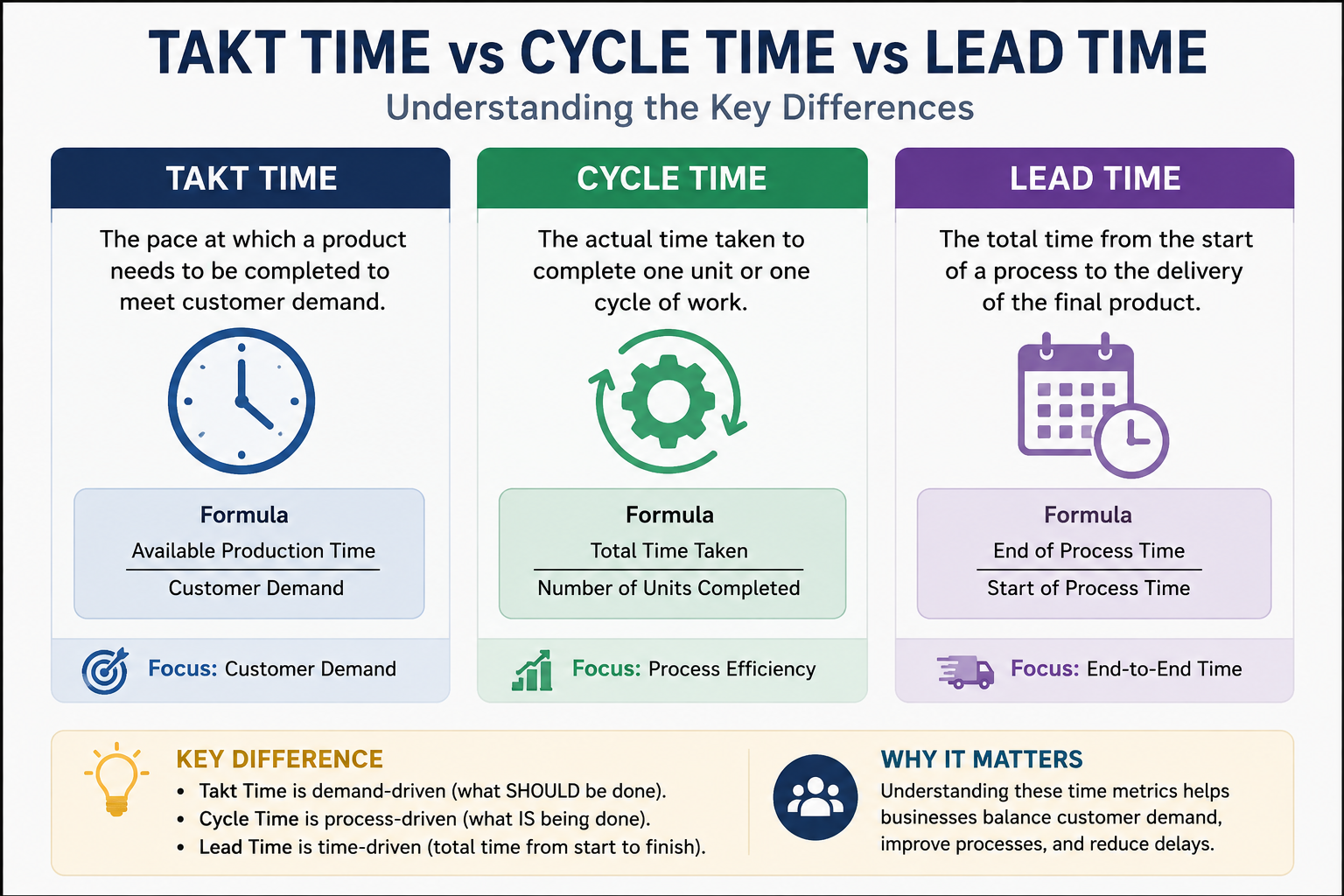
In the realm of lean manufacturing metrics, understanding the intricacies of takt time, cycle time, and lead time is crucial for optimizing production processes. In this blog, we will delve deep into these terms, exploring their definitions, differences, and implications in manufacturing environments, particularly in the Indian context.
What is Takt Time?
Takt time is a critical metric in lean manufacturing that defines the maximum allowable time to produce a product in order to meet customer demand. It is derived from the formula:
Takt Time = Available Production Time / Customer Demand
For instance, if a factory operates for 8 hours a day and has a demand for 160 units, the takt time would be:
Takt Time = 480 minutes / 160 units = 3 minutes per unit
This means that to satisfy customer demand, a product must be completed every 3 minutes. Understanding takt time helps manufacturers align their production rates with market demand, preventing overproduction and stockpiling.
What is Cycle Time?
Cycle time, on the other hand, refers to the total time taken to complete a single cycle of production. This includes every step from the start of production to the end, encompassing setup time, processing time, and any delays or waiting periods. Unlike takt time, cycle time is a reflection of the actual performance of a production line.
The formula to calculate cycle time is:
Cycle Time = Total Production Time / Number of Units Produced
For example, if a machine takes 2 hours to produce 10 units, the cycle time would be:
Cycle Time = 120 minutes / 10 units = 12 minutes per unit
What is Lead Time?
Lead time encompasses the total time from the initiation of a customer order to the fulfillment of that order. It includes not only the production time but also the time taken for order processing, material procurement, and transportation. Lead time is crucial for businesses to understand customer satisfaction levels and manage expectations.
Lead time can be broken down into several components:
- Order Processing Time
- Production Time
- Transportation Time
- Waiting Time
For instance, if a customer places an order for a product and it takes 5 days for the order to be processed, 2 days for production, and 3 days for delivery, the total lead time would be:
Lead Time = 5 days + 2 days + 3 days = 10 days
Key Differences: Takt Time vs Cycle Time vs Lead Time
While these terms are often used interchangeably, they serve distinct purposes in the manufacturing process. Here’s a breakdown of their key differences:
1. Definition
- Takt Time: The time available to produce each unit to meet customer demand.
- Cycle Time: The total time taken to produce a single unit, including all production steps.
- Lead Time: The total time from order placement to delivery of the product.
2. Purpose
- Takt Time: Ensures production aligns with customer demand.
- Cycle Time: Measures the efficiency of the production process.
- Lead Time: Assesses the overall time taken to fulfill customer orders.
3. Calculation
- Takt Time: Available production time divided by customer demand.
- Cycle Time: Total production time divided by the number of units produced.
- Lead Time: Sum of all time components from order to delivery.
4. Impact on Operations
- Takt Time: Helps in balancing workloads and scheduling.
- Cycle Time: Identifies bottlenecks and inefficiencies in production.
- Lead Time: Influences customer satisfaction and retention.
Why Understanding These Metrics Matters
For manufacturers in India and beyond, grasping the distinctions between takt time, cycle time, and lead time is essential for several reasons:
- Improved Efficiency: By analyzing cycle time, manufacturers can identify areas for improvement, reducing waste and increasing production efficiency.
- Better Resource Allocation: Takt time helps in planning resources and workforce effectively, ensuring that production meets demand without excess.
- Enhanced Customer Satisfaction: Understanding lead time allows businesses to set realistic expectations for customers, leading to improved relationships and retention.
FAQs about Takt Time, Cycle Time, and Lead Time
1. How can I calculate my company's takt time?
To calculate your company's takt time, divide the available production time by the customer demand for your product. This will give you the time you need to produce each unit to meet expectations.
2. What is a good cycle time for a manufacturing process?
A good cycle time varies by industry and product type. Benchmarking against industry standards and continuously analyzing your production processes will help determine an optimal cycle time for your operations.
3. How can lead time be reduced?
Lead time can be reduced by streamlining processes, improving communication between departments, optimizing inventory management, and utilizing efficient logistics solutions.
4. Are these metrics applicable only to manufacturing?
While these metrics are primarily used in manufacturing, they can also be applied in any industry that involves production or service delivery, such as software development and supply chain management.
Conclusion
Understanding the differences between takt time, cycle time, and lead time is vital for any business aiming for efficiency and customer satisfaction. By implementing these metrics into your production strategy, you can streamline operations, meet customer demands, and improve your overall performance.
If you’re looking to enhance your manufacturing processes or need help with analyzing your production metrics, don’t hesitate to reach out. Our team of experts is here to assist you in optimizing your operations for better results!
Contact us today to learn more about how we can help you improve your manufacturing metrics and achieve operational excellence!




Leave a Comment