
 Quality Management



















 IT Service Management



 Project Management



 Agile Management



 Web Development



 Cloud Computing


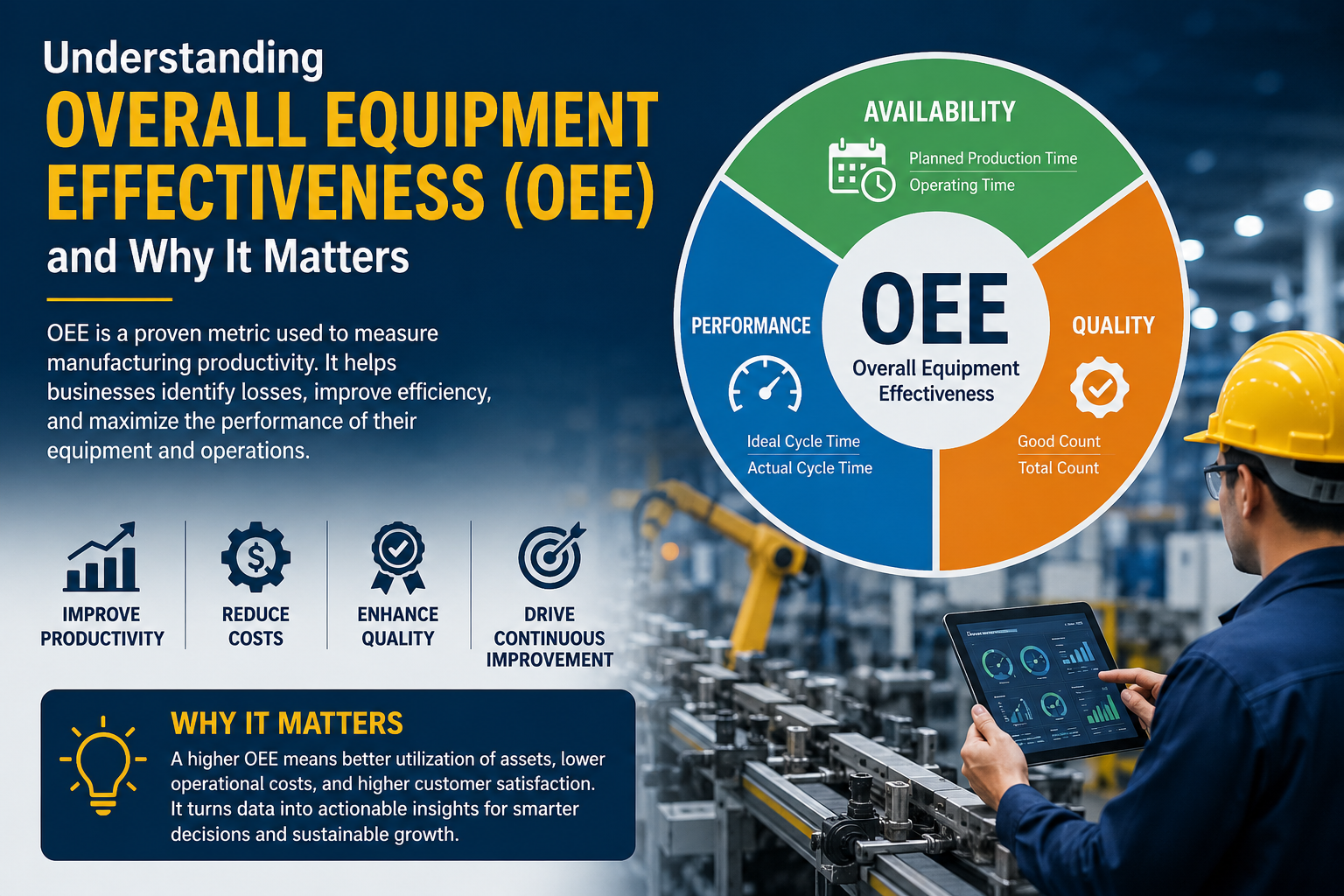
In the fast-paced world of manufacturing, efficiency is key to staying competitive. One of the most important metrics that companies use to measure their productivity is Overall Equipment Effectiveness (OEE). This blog will explore what OEE is, how to calculate it, and why it matters for manufacturing businesses in India.
What is Overall Equipment Effectiveness (OEE)?
Overall Equipment Effectiveness is a comprehensive metric that measures the effectiveness of a manufacturing operation. It combines three key elements: availability, performance, and quality. By assessing these factors, OEE provides a clear picture of how well manufacturing equipment is performing and identifies areas for improvement.
The Three Pillars of OEE
- Availability: This measures the percentage of scheduled time that the equipment is actually available for production. Factors such as machine breakdowns, maintenance, and setup times can affect this metric.
- Performance: This assesses the speed at which the equipment operates compared to its maximum potential. It considers any slowdowns or interruptions that may reduce production speed.
- Quality: This looks at the percentage of products manufactured that meet quality standards. Any defects or rework can negatively impact this aspect of OEE.
How to Calculate OEE
Calculating OEE is relatively straightforward. The formula involves multiplying the three components together:
OEE = Availability × Performance × Quality
Breaking Down the OEE Calculation
To give you a clearer understanding, let’s break down each component further:
- Availability:
Availability = (Total Production Time - Downtime) / Total Production Time
For example, if your total production time is 8 hours (480 minutes), and downtime is 30 minutes, the availability would be (480 - 30) / 480 = 0.9375 or 93.75%. - Performance:
Performance = (Actual Production Rate / Maximum Production Rate) × 100
If your actual production rate is 100 units per hour, but your maximum rate is 120 units per hour, the performance would be (100 / 120) × 100 = 83.33%. - Quality:
Quality = (Good Units Produced / Total Units Produced) × 100
If you produced 1000 units, but 50 were defective, your quality would be (950 / 1000) × 100 = 95%.
Finally, plug these values into the OEE formula. Using the examples above:
OEE = 0.9375 × 0.8333 × 0.95 = 0.733 or 73.3%
Why OEE Matters in Manufacturing
Understanding OEE is crucial for manufacturers for several reasons:
1. Identifies Areas for Improvement
By breaking down the OEE into its components, companies can pinpoint where inefficiencies lie. Whether it's downtime due to maintenance, slow performance, or quality issues, OEE highlights the specific areas that require attention.
2. Enhances Production Efficiency
With a clear understanding of OEE, manufacturers can implement strategies to enhance production efficiency. This can lead to better resource utilization, reduced waste, and increased output, ultimately contributing to higher profitability.
3. Supports Continuous Improvement Initiatives
OEE is a foundational metric for many continuous improvement initiatives, such as Lean Manufacturing and Six Sigma. By regularly monitoring OEE, companies can foster a culture of continuous improvement, encouraging teams to seek out and implement efficiency-enhancing solutions.
4. Facilitates Benchmarking
OEE provides a standard metric that can be used for benchmarking against industry standards or competitors. By comparing OEE scores, manufacturers can determine how they stack up in terms of equipment performance and operational efficiency.
5. Drives Informed Decision-Making
Data-driven decision-making is essential in today's manufacturing landscape. OEE provides quantifiable insights that help managers make informed choices about resource allocation, investment in new technologies, and operational changes.
Implementing OEE in Your Manufacturing Operation
To implement OEE effectively, follow these steps:
1. Gather Data
Start by collecting data on machine availability, performance, and quality. Ensure that your data collection methods are accurate and consistent.
2. Calculate Your OEE
Use the formula provided to calculate the OEE for each machine or production line.
3. Analyze and Identify Issues
Analyze the OEE results to identify specific issues affecting performance. Engage with your team to understand the root causes.
4. Implement Improvement Strategies
Based on your analysis, implement targeted strategies to address the identified issues. This could involve preventive maintenance, training for operators, or process adjustments.
5. Monitor and Adjust
Continuous monitoring is essential. Regularly review your OEE scores and make adjustments to your strategies as needed.
Common FAQs About OEE
1. What is a good OEE score?
A good OEE score typically ranges from 80% to 85%. Scores above 85% are considered world-class, while anything below 60% indicates significant room for improvement.
2. Can OEE be applied to all types of manufacturing?
Yes, OEE can be applied to any type of manufacturing process, including discrete, batch, and continuous manufacturing. It is a versatile metric that can provide valuable insights across various industries.
3. How often should we calculate OEE?
It is recommended to calculate OEE on a regular basis, such as weekly or monthly. Frequent calculations can help track progress and identify trends over time.
4. What tools can help in calculating OEE?
Various software solutions are available to assist in calculating and tracking OEE, ranging from simple Excel spreadsheets to advanced manufacturing execution systems (MES).
Conclusion
Overall Equipment Effectiveness (OEE) is a vital metric for any manufacturing operation. By understanding and optimizing OEE, businesses can enhance production efficiency, support continuous improvement, and drive profitability. In an increasingly competitive environment, leveraging OEE can set your company apart and lead to significant operational gains.
If you’re looking to improve your manufacturing efficiency and need assistance with OEE implementation or other manufacturing KPIs, contact us today! Our team of experts is ready to help you optimize your production processes and achieve your business goals.



Leave a Comment