 Quality Management








 IT Service Management



 Project Management



 Agile Management


 Web Development


 Cloud Computing
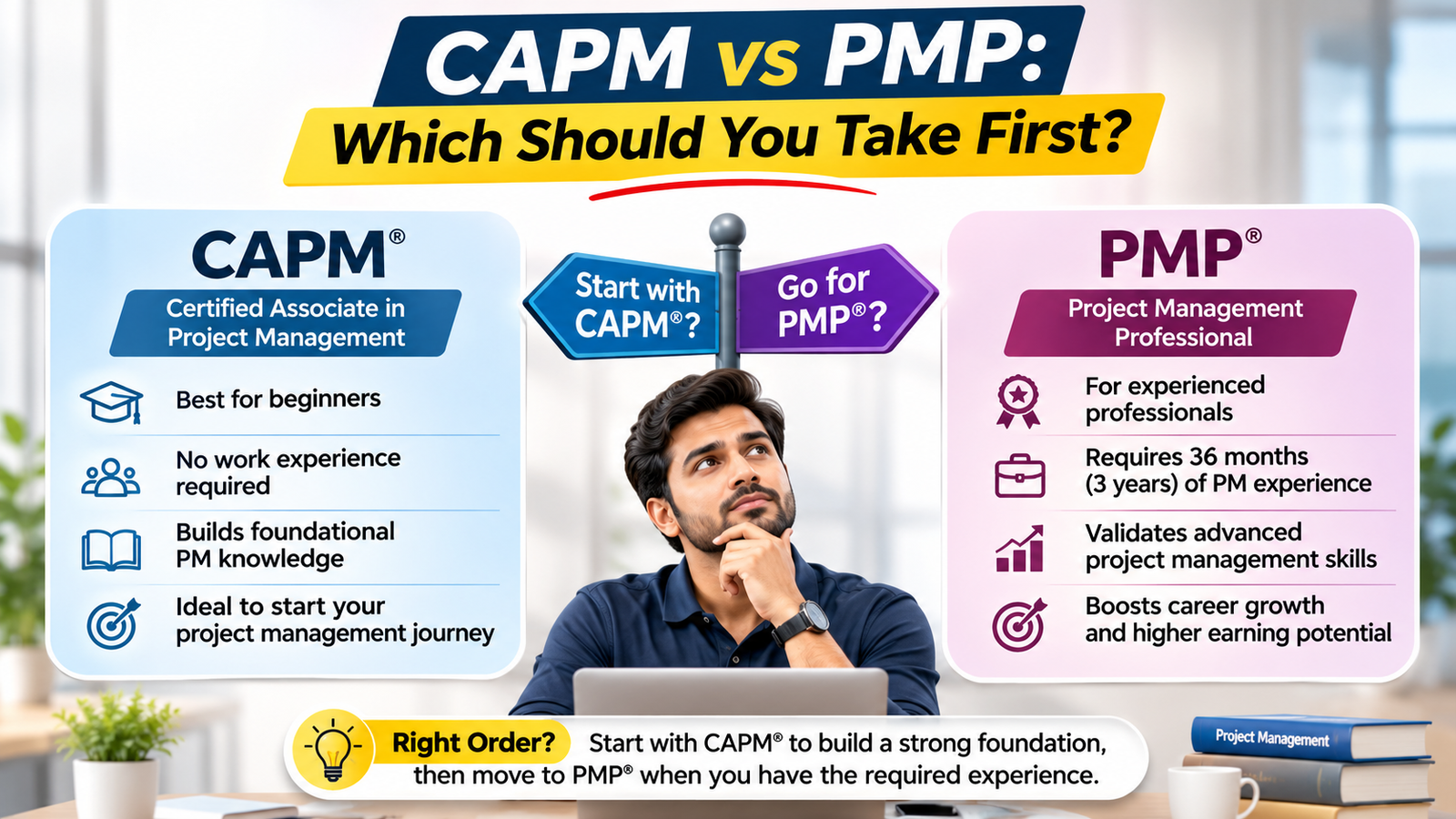
Both CAPM and PMP come from the Project Management Institute (PMI), and both carry weight with employers. But they are designed for people at very different stages. CAPM is built for those starting in project management; PMP is for those who have already been leading projects for years.
The real question for most people is not which one is "better", but which one makes sense right now. This guide compares the two side by side and gives you a simple way to decide whether to take CAPM first or go straight to PMP.
Quick Answer
Take CAPM first if you do not yet have the 36 months of project leadership experience PMP requires with a bachelor's degree. CAPM needs only a secondary qualification and 23 hours of project management education, and an active CAPM also counts toward PMP's 35-hour training requirement later. If you already meet PMP's experience rules, or will within a few months, skip CAPM and go straight to PMP.
In this guide
CAPM and PMP in One Line Each
- CAPM (Certified Associate in Project Management): an entry-level PMI certification proving you understand project management fundamentals, predictive and agile approaches, and business analysis. No work experience needed.
- PMP (Project Management Professional): PMI's flagship certification proving you have led projects and can apply project management across predictive, agile, and hybrid environments. Years of experience required.
CAPM vs PMP Side by Side
| Factor | CAPM | PMP |
|---|---|---|
| Level | Entry level | Experienced professional |
| Education | Secondary qualification (e.g., Class 12), age 18+ | Secondary qualification to bachelor's degree or higher |
| Experience | None | 24–60 months leading projects in the last 10 years (36 months with a bachelor's degree) |
| Training | 23 hours of project management education | 35 hours (or an active CAPM) |
| Questions | 150 (135 scored, 15 pretest) | 180 (170 scored, 10 pretest) |
| Duration | 180 minutes | 240 minutes |
| Question style | Mostly knowledge and understanding | Mostly scenario-based judgment, including case studies |
| Typical preparation | 3–6 weeks part-time | 6–12 weeks part-time |
| Renewal | Every 3 years: 15 PDUs + renewal fee | Every 3 years: 60 PDUs + renewal fee |
| Career signal | "I know project management" | "I have proven experience leading projects" |
Sources: PMI CAPM certification page; PMI PMP Examination Content Outline (2026). Checked 26 November 2026. Check current exam fees on pmi.org; PMI members pay less for both exams.
For full PMP eligibility rules, including how to count your experience months, see our guide to PMP eligibility. For a breakdown of fees, see PMP certification cost in India.
What Each Exam Covers
| CAPM domains | PMP domains (2026) |
|---|---|
|
|
CAPM checks that you understand how projects work and the vocabulary used to run them. PMP checks that you can make the right call in realistic situations, such as handling a conflict, responding to a scope change or choosing the right delivery approach. Our breakdown of the PMP exam pattern covers the PMP domains, question types, and scoring in detail.
Should You Take CAPM First? A Simple Decision Guide
| Your situation | Recommendation |
|---|---|
| Student, fresher or career switcher with no project experience | CAPM now, PMP once you have the experience |
| 1–2 years of experience, some coordination work, not yet leading projects | CAPM now, and ask for project responsibility at work to build PMP experience |
| Within 6–12 months of meeting PMP's experience requirement | Skip CAPM. Take PMP training now and apply as soon as you are eligible |
| Already meet PMP's experience requirement | Go straight to PMP |
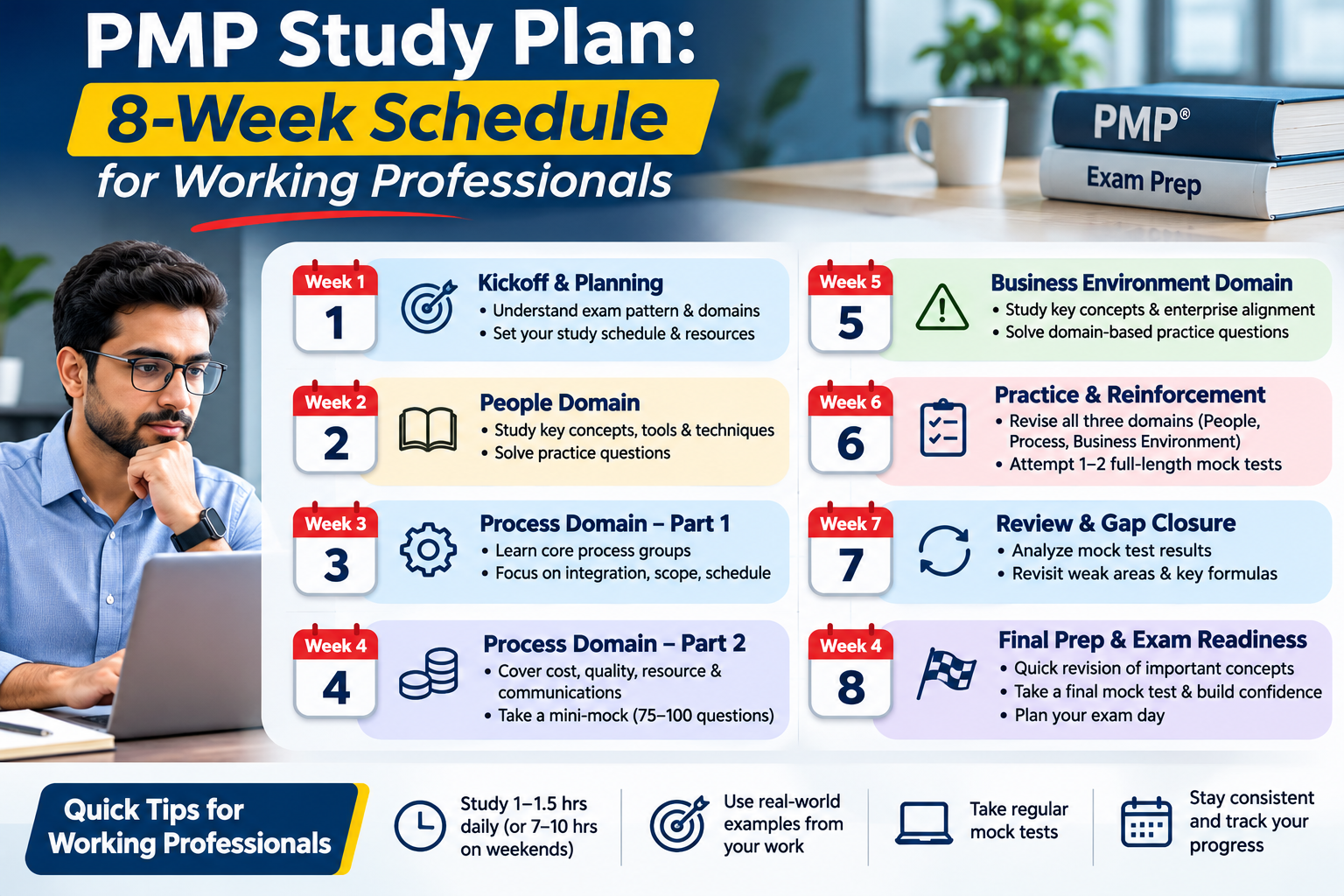
| Experienced but new to formal project management terms | Still go to PMP, but allow a longer study period (see our 8-week PMP study plan) |
The short version: CAPM is worth taking when PMP is more than about a year away. If PMP is close, CAPM mostly adds cost and delays the credential employers value more.
The CAPM-to-PMP Path
For early-career professionals, CAPM and PMP work well as a sequence:
- Earn CAPM. Complete 23 hours of project management education and pass the 3-hour exam.
- Build experience. Take on project leadership: lead a release, an implementation, a process improvement or an event. Keep a simple log of each project's dates, team and results.
- Keep CAPM active. Earn 15 PDUs and renew every 3 years. An active CAPM counts as the 35 hours of training for PMP, so you do not need to document separate training hours.
- Apply for PMP once you meet the experience requirement. Our guide on how to fill out the PMP application includes sample experience descriptions.
- Prepare and pass PMP. The concepts you learned for CAPM give you a head start, but PMP preparation still needs serious scenario practice.
Is CAPM Worth It in India?
CAPM helps when:
- You are a fresher or early-career professional competing for project coordinator, PMO analyst or junior project roles
- You want to show commitment to a project management career before you have the experience
- You are moving from a technical or operations role into project work
- You want a structured foundation in predictive, agile, and business analysis basics
CAPM helps less when:
- You already have several years of project leadership, where employers expect PMP
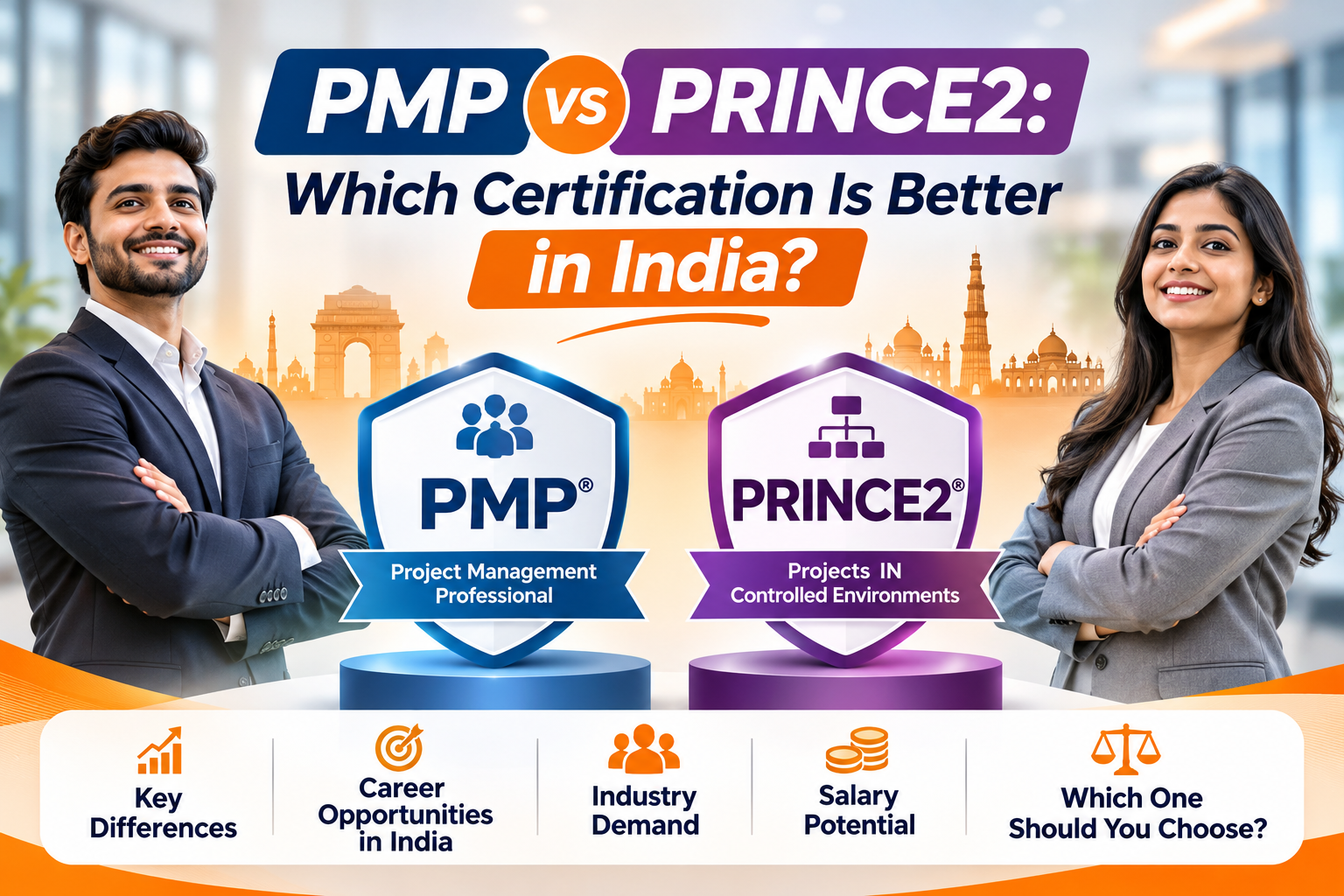
- Your target employers specifically ask for PRINCE2 or agile certifications. See PMP vs PRINCE2 for that comparison.
Freshers can also strengthen their profile with practical skills. A Lean Six Sigma Yellow Belt or hands-on scheduling with Microsoft Project pairs well with CAPM.
Start at the right level
Haworth Solutions offers live online training for both certifications. CAPM training covers the education hours you need to apply; PMP training provides the 35 contact hours, current exam content and full mock tests.
CAPM Course PMP CourseWant a certification with no experience requirement outside PMI? PRINCE2 Foundation is another entry-level option.
Frequently Asked Questions
Is CAPM required before PMP?
No. CAPM is optional. You can apply for PMP directly once you meet its experience and 35-hour training requirements.
Does CAPM count toward PMP?
Yes. An active CAPM certification counts as the 35 hours of project management education required for PMP. It does not reduce the experience requirement.
Can a fresher take CAPM?
Yes. CAPM requires a secondary qualification, a minimum age of 18 and 23 hours of project management education. No work experience is required.
Is CAPM easier than PMP?
Yes. CAPM has fewer questions, a shorter exam and focuses more on understanding concepts. PMP is longer and tests judgment in realistic, often complex scenarios.
How long is CAPM valid?
Three years. To renew, earn 15 PDUs during the cycle and pay the renewal fee.
Should I skip CAPM if I am close to PMP eligibility?
Usually yes. If you will meet PMP's experience requirement within about 6–12 months, it is better to complete 35 hours of PMP training and apply for PMP as soon as you qualify.



Leave a Comment