 Quality Management



















 IT Service Management



 Project Management


 Agile Management


 Web Development


 Cloud Computing
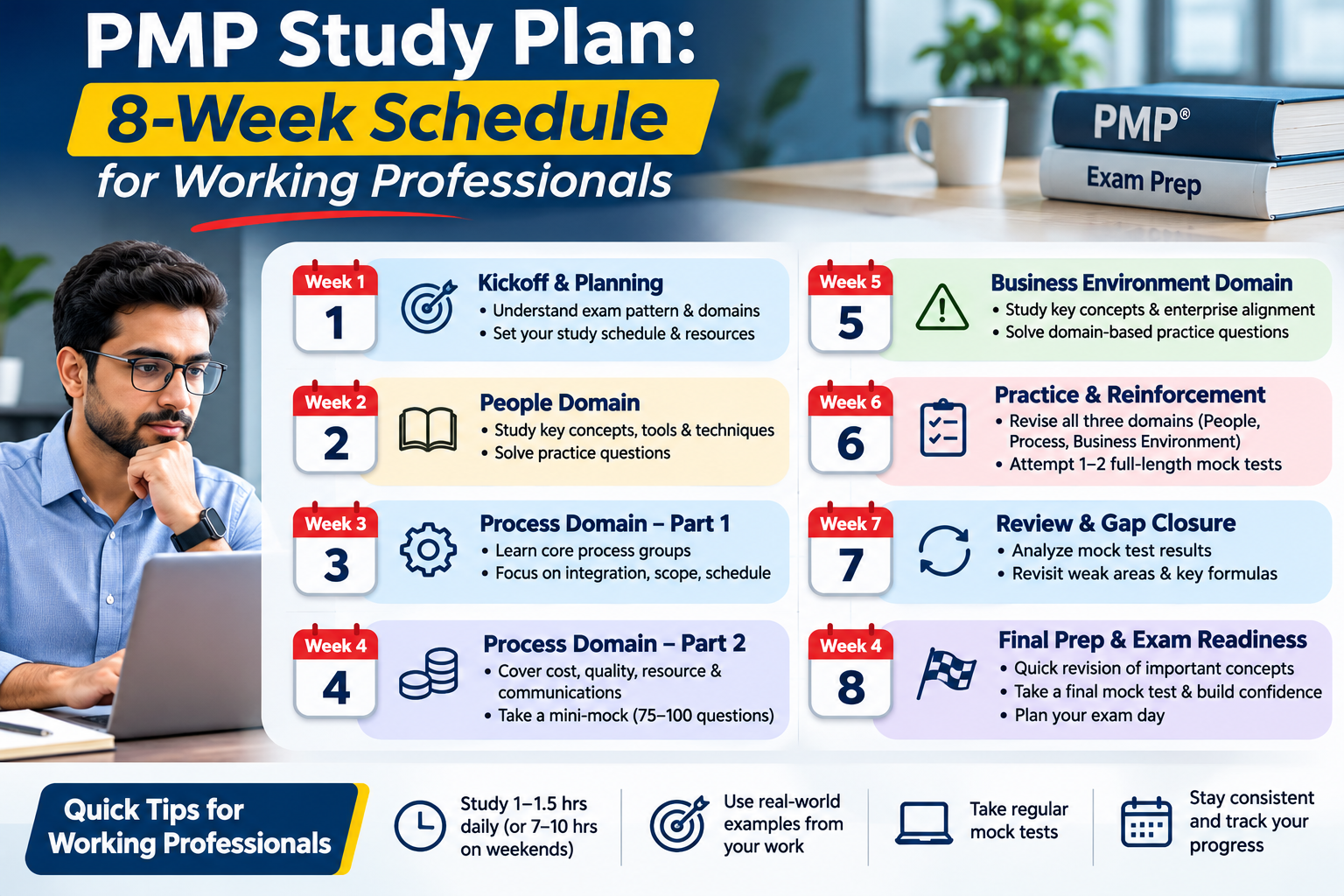
This guide gives you a realistic 8-week plan built around about 10 to 12 hours a week, mapped to the current 2026 PMP exam domains. It includes a weekly schedule, a daily routine, mock test targets, and ways to adjust the plan if you have more or less time.
Quick Answer
A working professional can prepare for the PMP in 8 weeks by studying about 10–12 hours a week: one hour on four weekday evenings and three hours on each weekend day. Spend weeks 1–6 learning the Process, People and Business Environment domains with agile and hybrid woven throughout, take a baseline mock test at the end of week 4, and use weeks 7–8 for two more full-length timed mocks and targeted revision. Book the exam once you score consistently above about 70–75% on full mocks.
In this guide
Before Week 1: Set Yourself Up
- Confirm eligibility. Check you have enough project leadership experience for your education level. See our guide to PMP eligibility.
- Complete your 35 contact hours or plan to finish them in the first weeks. Many people combine their training course with this study plan.
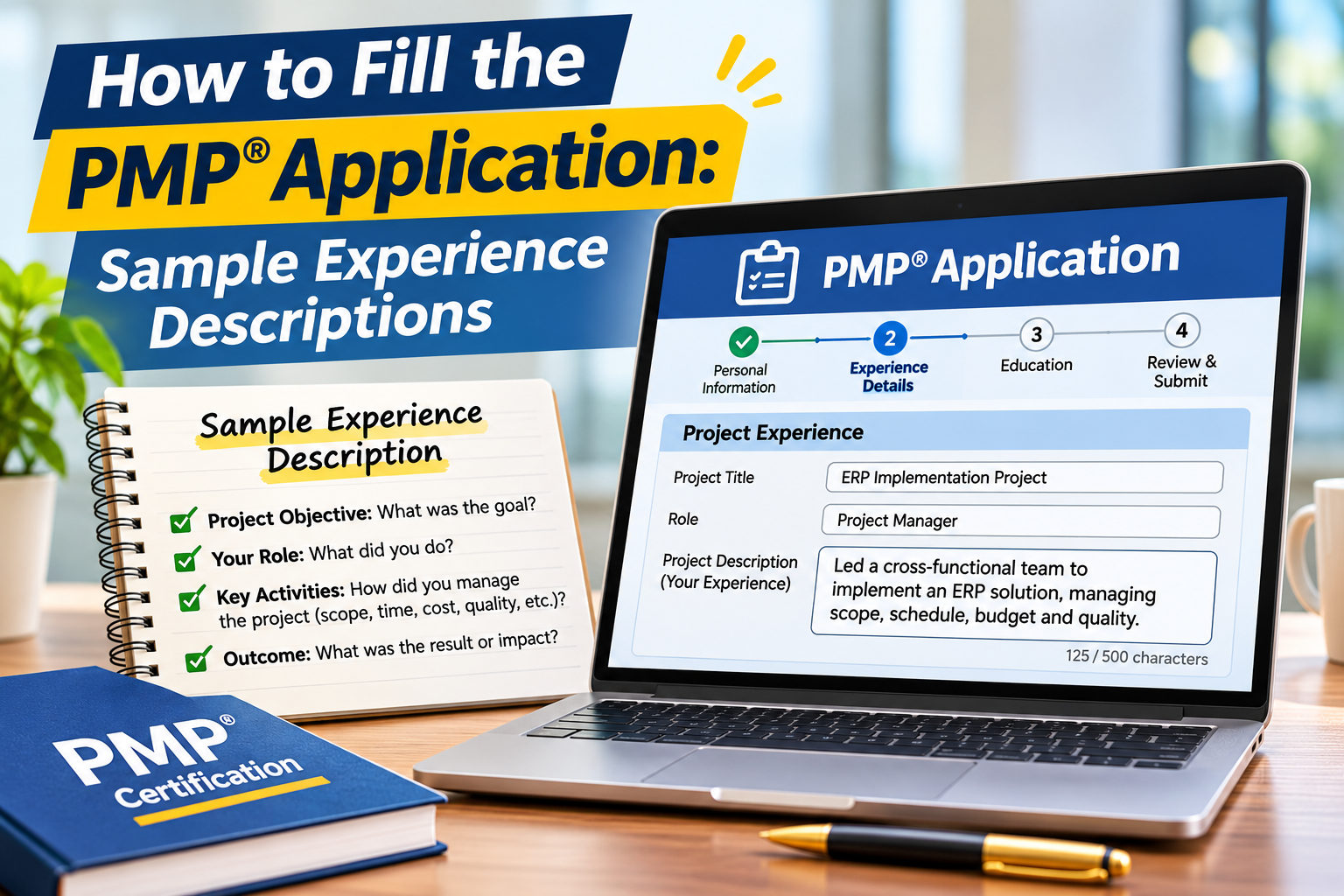
- Submit your application early. PMI review and a possible audit take time, so apply in week 1 or 2. Our guide on how to fill the PMP application includes sample experience descriptions.
- Understand the exam. Read our breakdown of the PMP exam pattern and domains so you know what you are preparing for.
- Pick your materials and stick to them. One main course, one reference guide, and one good bank of practice questions aligned to the 2026 outline. Too many sources cause confusion.
- Block time in your calendar now, as recurring meetings with yourself.
The 8-Week Plan at a Glance
Week-by-Week Schedule
| Week | Focus | Topics to cover | Practice | Hours |
|---|---|---|---|---|
| 1 | Foundations | Exam outline, project life cycles, predictive vs agile vs hybrid, value delivery, PM roles | 50-question diagnostic test | 10 |
| 2 | Process I | Integrated plan and delivery planning, scope and backlogs, schedule (incl. critical path), resources | 60 topic questions | 11 |
| 3 | Process II | Finance and earned value, procurement, quality, value-based delivery, project status, closure | 60 topic questions + EVM practice | 11 |
| 4 | People | Common vision, conflict, team leadership, stakeholder engagement and expectations, communication, knowledge transfer | Full mock 1 (weekend) | 12 |
| 5 | Business Environment I | Governance, compliance, change control, impediments and issues, risk management | Review mock 1 + 60 topic questions | 11 |
| 6 | Business Environment II + agile/hybrid | Continuous improvement, organisational change, external changes (incl. AI, sustainability), Scrum, Kanban, hybrid tailoring | Case-study and graphic question sets | 11 |
| 7 | Mock and fix | Weakest domain from mocks; re-read notes; revisit wrong answers | Full mock 2 + full review | 12 |
| 8 | Final review | Formulas, agile roles and events, mindset questions; light review in the last 2 days | Full mock 3 early in the week | 10 |
Week 1: Foundations
Read the exam content outline once, end to end. Learn how predictive, agile and hybrid approaches differ and when each fits. Take a short diagnostic test, not to score well, but to see where you stand. Submit your PMI application this week if you have not already.
Weeks 2–3: Process (41%)
This is the largest domain. Focus on planning and delivery in both predictive and agile settings: scope versus backlog, schedules versus iterations, budgets and earned value, procurement and contracts, quality and value delivery. Quality topics overlap with tools covered in Lean Six Sigma for project managers, such as Pareto charts and control charts.
Earned value formulas to know
| Cost variance | CV = EV − AC | Schedule variance | SV = EV − PV |
| Cost performance index | CPI = EV ÷ AC | Schedule performance index | SPI = EV ÷ PV |
| Estimate at completion | EAC = BAC ÷ CPI | Estimate to complete | ETC = EAC − AC |
| Variance at completion | VAC = BAC − EAC |
A CPI or SPI below 1.0 means over budget or behind schedule.
Week 4: People (33%)
People questions test judgment more than facts. Learn the servant-leadership mindset, conflict resolution approaches, how to engage and align stakeholders, and how to build and support teams. On the weekend, take your first full-length mock under real conditions. Do not worry about the score; it is your baseline.
Weeks 5–6: Business Environment (26%) and agile/hybrid
This domain grew sharply in the 2026 exam, so do not underestimate it. Cover governance, compliance, change control, issue management, risk, continuous improvement and organisational change. Our posts on FMEA and building a continuous improvement culture are useful background. In week 6, consolidate agile and hybrid: Scrum roles and events, Kanban, backlog refinement, and how to tailor an approach to the project.
Week 7: Mock and fix
Take the second full mock early in the week. Spend the rest of the week reviewing every wrong answer and every guess. Write a one-line note on why the correct answer was best. Return to your weakest domain for focused practice.
Week 8: Final review
Take the third full mock at the start of the week. Then revise formulas, agile terms and your notes from wrong answers. Keep the last two days before the exam light: quick review, good sleep, and a check of your exam-day logistics.
A Typical Study Week
| Day | Time | What to do |
|---|---|---|
| Monday | 1 hour | Learn new topic (video or class) |
| Tuesday | 1 hour | Read and make short notes |
| Wednesday | Rest | Optional: 15 minutes of flashcards on your commute |
| Thursday | 1 hour | Learn the next topic |
| Friday | 1 hour | 20–30 practice questions and review |
| Saturday | 3 hours | Deeper study block or a full mock |
| Sunday | 3 hours | Practice questions, review wrong answers, plan next week |
That adds up to about 10 hours. Early mornings often work better than late evenings for people with demanding jobs, because work rarely interrupts a 6 am study hour.
Mock Tests: When, How and What Score
- Take at least three full-length mocks (180 questions, 240 minutes) at the end of weeks 4, 7 and 8.
- Simulate the real exam: same time of day as your booking, no phone, two 10-minute breaks, and no going back to earlier sections after a break.
- Spend as long reviewing as testing. A four-hour mock deserves three to four hours of review.
- Track your scores by domain, not just overall, so you know where to focus.
- Target score: PMI does not publish a pass mark, but candidates who score consistently above about 70–75% on good-quality, 2026-aligned mocks are generally ready.
If your week 7 mock is well below target, push the exam back two or three weeks rather than risking a retake fee. See PMP certification cost in India for retake and exam fees.
Adjusting the Plan: 6, 8 or 12 Weeks
| Plan | Hours per week | Best for | How to adapt |
|---|---|---|---|
| 6 weeks | 15–16 | Experienced PMs, or those with a bootcamp | Combine weeks 2–3 and 5–6; keep all three mocks |
| 8 weeks | 10–12 | Most working professionals | Follow the plan above |
| 12 weeks | 7–8 | Heavy travel, shift work, or new to agile | Spread each content week over 1.5 weeks; add a fourth mock |
Tips for Studying While Working
- Connect topics to your own projects. When you study stakeholder engagement, think of a real stakeholder. You will remember it far better.
- Tell your manager and family. A little protected time is easier to get when people know the goal and the date.
- Use dead time. Flashcards and short question sets fit commutes and waiting rooms.
- Learn the PMI way of thinking. The best answer is usually the one a proactive, collaborative project leader would choose first: assess, involve the team, then act.
- Do not skip a week, shrink it. A busy week with three hours is better than a missed week.
- Protect sleep before mocks and the exam. Four hours of concentration needs a rested mind.
Printable Progress Tracker
Print this or copy it into a spreadsheet, and tick off each week.
| Week | Topics done | Hours (target / actual) | Practice score | ✓ |
|---|---|---|---|---|
| 1 Foundations | 10 / __ | Diagnostic: __% | ||
| 2 Process I | 11 / __ | __% | ||
| 3 Process II | 11 / __ | __% | ||
| 4 People | 12 / __ | Mock 1: __% | ||
| 5 Business Env. I | 11 / __ | __% | ||
| 6 Business Env. II + agile | 11 / __ | __% | ||
| 7 Mock and fix | 12 / __ | Mock 2: __% | ||
| 8 Final review | 10 / __ | Mock 3: __% |
Follow this plan with expert guidance
Our live online PMP training is built around the 2026 exam outline, provides your 35 contact hours, and includes full-length mock tests and doubt-clearing sessions that fit a working schedule.
View the PMP CourseNot eligible yet? Start with CAPM. Want hands-on scheduling skills alongside your study? Try Microsoft Project.
Frequently Asked Questions
Is 8 weeks enough to prepare for the PMP?
Yes, for most working professionals with project experience, if you study about 10–12 hours a week consistently and take at least three full mock tests.
How many hours of study does the PMP need?
Most candidates need roughly 80–120 hours in total, including the 35 contact hours of training. Experienced project managers may need less; those new to agile may need more.
How many mock tests should I take?
At least three full-length, timed mocks, with a thorough review of each. More practice helps only if you review your mistakes properly.
What mock score means I am ready?
PMI does not publish a pass mark, but consistent scores above about 70–75% on good, 2026-aligned mocks are a common readiness signal.
When should I book the exam?
Book a target date around week 9 once your application is approved, so you have a deadline. Move it if your week 7 mock is well below target.
Should I study agile separately?
Study it throughout. About 60% of the exam involves agile or hybrid approaches, so practise those scenarios every week, with a focused review in week 6.



Leave a Comment