
 Quality Management



















 IT Service Management



 Project Management



 Agile Management




 Web Development



 Cloud Computing


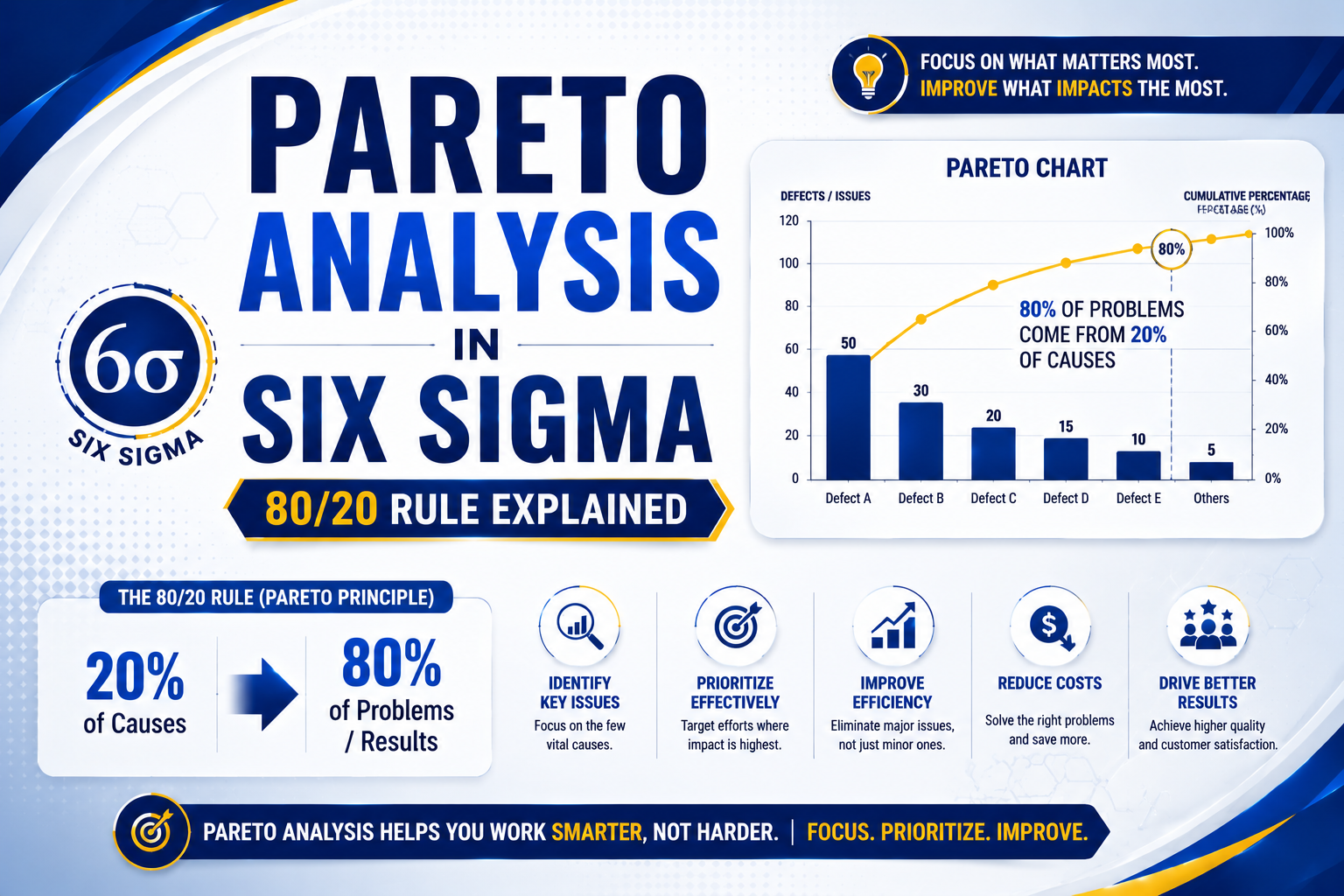
In today's fast-paced business environment, effective decision-making is crucial for success. One powerful tool that has gained immense popularity in quality management is Pareto Analysis, often referred to as the 80/20 Rule. This principle, rooted in the works of Italian economist Vilfredo Pareto, suggests that a small percentage of causes often lead to the majority of the effects. In this blog, we will explore Pareto Analysis in the context of Six Sigma, discuss its significance, and provide real-world examples relevant to the Indian audience.
What is Pareto Analysis?
Pareto Analysis is a statistical method used to identify the most significant factors in a dataset. By categorizing problems or causes based on their impact, organizations can prioritize their efforts effectively. The technique is commonly visualized using a Pareto chart, a bar graph that displays the frequency or impact of problems in descending order.
Understanding the 80/20 Rule in Six Sigma
The 80/20 Rule, a core principle of Six Sigma, posits that 80% of problems arise from just 20% of causes. This principle helps practitioners focus their resources on the most critical issues rather than spreading their efforts too thin. For instance, in a manufacturing firm, 80% of defects may come from just a few processes or components. By identifying these key areas, businesses can implement targeted improvements, resulting in significant quality enhancement.
The Importance of Pareto Analysis in Six Sigma
Pareto Analysis plays a vital role in Six Sigma methodologies, particularly in the Define-Measure-Analyze-Improve-Control (DMAIC) framework. Here are a few reasons why it's essential:
1. Prioritization of Issues
By using Pareto Analysis, organizations can easily pinpoint which problems require immediate attention. This prioritization ensures that time and resources are allocated effectively, leading to quicker resolution and improved productivity.
2. Data-Driven Decision Making
Pareto Analysis relies on solid data, helping organizations make informed decisions based on evidence rather than assumptions. This approach fosters a culture of continuous improvement and accountability.
3. Enhanced Resource Allocation
With a clear understanding of the most significant issues, companies can allocate resources more efficiently. This leads to better use of time, money, and personnel, ultimately enhancing the overall performance of the organization.
How to Create a Pareto Chart
Creating a Pareto chart is a straightforward process. Follow these steps to visualize your data effectively:
Step 1: Identify the Problem
Begin by determining the specific issue or area you want to analyze. It could be defects in a product, customer complaints, or any other challenge your organization faces.
Step 2: Collect Data
Gather relevant data related to the identified problem. This may include the frequency of defects, types of complaints, or other metrics that quantify the issue.
Step 3: Categorize the Data
Classify the data into categories based on common characteristics. For example, if you are analyzing defects, you might group them by type, such as design flaws, material defects, or assembly errors.
Step 4: Calculate Frequencies
Count the frequency of each category and calculate the cumulative totals. This will help you identify which categories contribute the most to the overall problem.
Step 5: Create the Pareto Chart
Using a spreadsheet or specialized software, create a bar chart with categories on the x-axis and frequencies on the y-axis. Arrange the bars in descending order to visualize the most significant issues easily. You can also add a cumulative line graph to show the cumulative percentage of total problems.
Real-World Pareto Principle Examples in India
Understanding the Pareto principle examples in the Indian context can help businesses relate the concept to their operations. Here are a few notable examples:
1. Manufacturing Sector
In Indian manufacturing, a company producing electronic components may discover that 80% of their defects stem from just 20% of their production processes. By focusing on these critical processes, they can reduce waste and improve product quality.
2. Customer Service
A leading Indian telecom provider might find that 80% of customer complaints arise from billing issues. By addressing these billing discrepancies, the company can enhance customer satisfaction significantly.
3. E-commerce
In the booming Indian e-commerce industry, a retailer could analyze returns and discover that 80% of returns come from 20% of products. By examining the quality and descriptions of these specific products, the retailer can minimize returns and improve customer experience.
FAQs about Pareto Analysis and Six Sigma
1. What is the main purpose of Pareto Analysis?
The main purpose of Pareto Analysis is to identify the most significant factors contributing to a problem, allowing organizations to prioritize their efforts and resources on addressing those critical issues.
2. How does Pareto Analysis relate to Six Sigma?
Pareto Analysis is an integral part of the Six Sigma methodology, particularly in the DMAIC framework. It helps in identifying key problems that require attention and informs data-driven decision-making.
3. Can Pareto Analysis be used in service industries?
Yes, Pareto Analysis is applicable across various industries, including service sectors like healthcare, finance, and telecommunications, to improve quality and efficiency.
4. How can I learn more about implementing Pareto Analysis in my organization?
Consider enrolling in Six Sigma training programs, workshops, or online courses that focus on quality management tools, including Pareto Analysis. Practical experience and case studies can also enhance your understanding.
Conclusion
Pareto Analysis, grounded in the 80/20 Rule, is a vital tool for organizations seeking to enhance their quality management processes. By focusing on the most significant issues, businesses can make informed decisions, allocate resources effectively, and drive continuous improvement. Whether you are in manufacturing, service, or e-commerce, understanding and applying Pareto Analysis can lead to substantial benefits.
Are you ready to implement Pareto Analysis in your organization and unlock the power of the 80/20 Rule? Contact us for expert guidance and training on Six Sigma methodologies!




Leave a Comment