
 Quality Management



















 IT Service Management



 Project Management



 Agile Management




 Web Development



 Cloud Computing


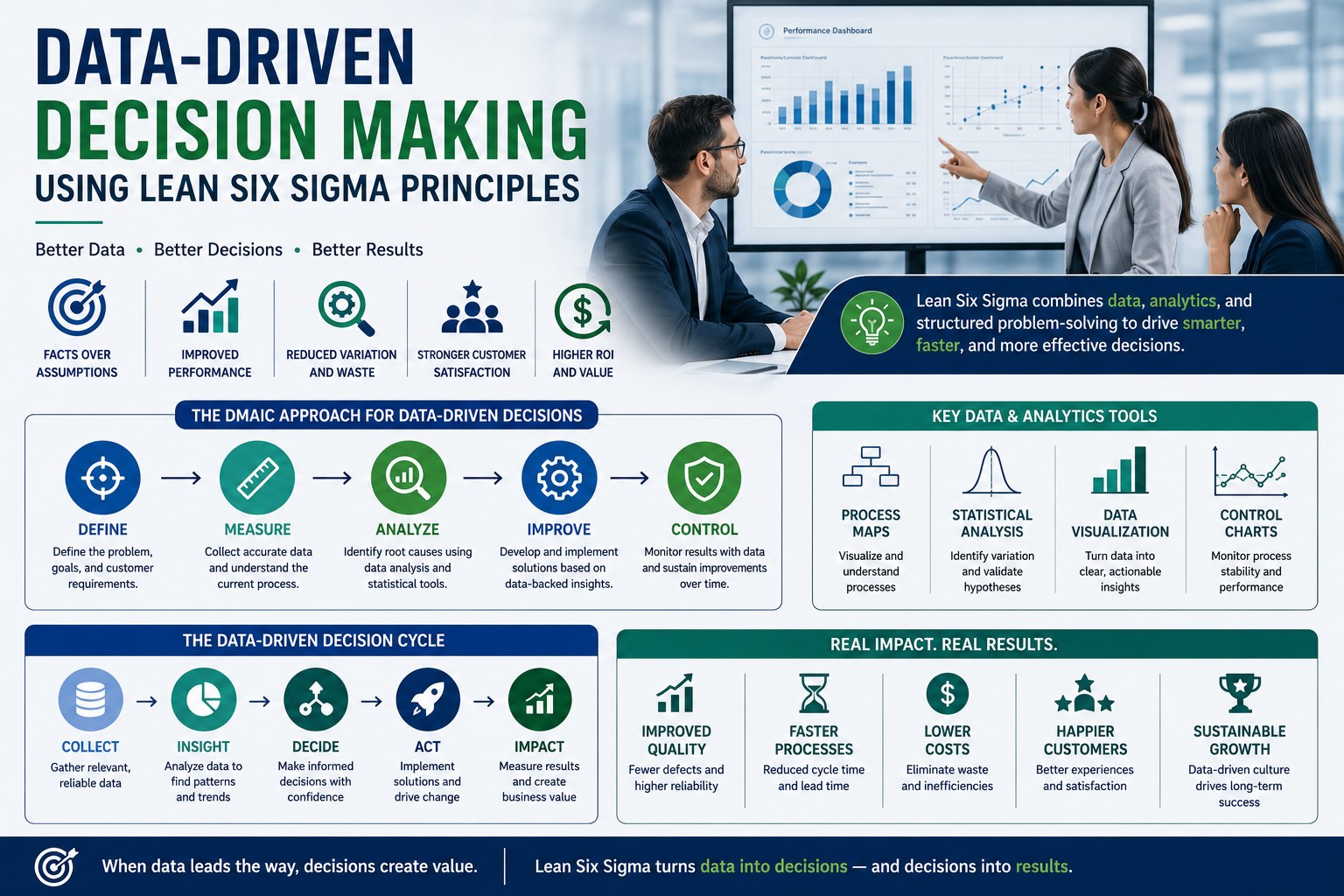
In today’s competitive landscape, organizations must make decisions based on solid data rather than intuition or guesswork. Data-driven decision making enables companies to leverage operational data analysis to enhance their processes, improve performance, and create value. One of the most effective methodologies for achieving this is Lean Six Sigma, a powerful combination of Lean manufacturing principles and Six Sigma quality control techniques. This blog will explore how Lean Six Sigma analytics can enhance business process analytics and enable organizations to drive meaningful process improvement metrics.
Understanding Lean Six Sigma
Before diving into data-driven decision making, it’s essential to understand the core principles of Lean Six Sigma. Lean focuses on eliminating waste and improving efficiency, while Six Sigma emphasizes reducing variation and improving quality. Together, they create a robust framework that supports continuous improvement.
Key Principles of Lean Six Sigma
- Define: Clearly identify the problem or process requiring improvement.
- Measure: Gather data related to the current performance of the process.
- Analyze: Evaluate the data to identify root causes of defects or inefficiencies.
- Improve: Implement solutions to address the root causes.
- Control: Monitor the process to ensure the improvements are sustained over time.
The Role of Data in Lean Six Sigma
Data is the cornerstone of Lean Six Sigma. It enables organizations to make informed decisions, identify bottlenecks, and track improvements. By utilizing lean six sigma analytics, businesses can transform raw data into actionable insights. Here’s how data-driven decision making enhances the Lean Six Sigma process:
Data-Driven Decision Making
Data-driven decision making involves using data analysis and interpretation to guide business decisions. This approach minimizes risks and maximizes the chances of success. In the context of Lean Six Sigma, data-driven decision making allows organizations to:
- Identify areas for improvement by analyzing process improvement metrics.
- Monitor performance over time through operational data analysis.
- Make informed decisions that align with organizational goals.
Leveraging Business Process Analytics
Business process analytics refers to the systematic analysis of business processes to improve efficiency and effectiveness. By integrating business process analytics with Lean Six Sigma methodologies, organizations can achieve deeper insights into their operations. Here’s how:
- Data visualization tools can highlight inefficiencies, allowing teams to focus on critical areas.
- Real-time data tracking enables swift identification of issues as they occur.
- Predictive analytics can forecast potential problems, allowing for proactive solutions.
Key Metrics for Process Improvement
To truly harness the power of data-driven decision making, organizations must track relevant metrics. Here are some essential process improvement metrics to consider:
1. Cycle Time
Cycle time measures the total time taken to complete a process from start to finish. Reducing cycle time can lead to enhanced efficiency and customer satisfaction.
2. Defect Rate
The defect rate indicates the percentage of products or services that fail to meet quality standards. Lowering this rate is crucial for improving overall quality and customer trust.
3. Process Yield
Process yield measures the ratio of successful outputs to total inputs. Increasing process yield is a direct indicator of improved efficiency and effectiveness.
4. Cost of Poor Quality
This metric quantifies the costs associated with failures, including rework, warranty claims, and lost sales. Reducing the cost of poor quality can significantly enhance profitability.
5. Customer Satisfaction
Ultimately, customer satisfaction is the most crucial metric. Regularly measuring customer feedback helps organizations align their processes with customer expectations.
Implementing Lean Six Sigma for Data-Driven Decision Making
Here are some steps to effectively implement Lean Six Sigma principles to foster data-driven decision making in your organization:
1. Foster a Culture of Continuous Improvement
Encourage employees at all levels to contribute to process improvement initiatives. This culture will promote collaboration and innovation.
2. Invest in Training
Provide staff with training in Lean Six Sigma methodologies and analytics tools. Well-trained employees are more likely to embrace data-driven decision making.
3. Utilize Technology
Leverage advanced analytics tools and software to collect and analyze data efficiently. Automation can significantly enhance the accuracy and speed of data analysis.
4. Establish Key Performance Indicators (KPIs)
Define KPIs that align with your organization’s goals. Regularly review these metrics to gauge progress and make informed decisions.
5. Engage Stakeholders
Keep stakeholders informed and involved throughout the process. This engagement fosters buy-in and support for your data-driven initiatives.
Challenges in Data-Driven Decision Making
While the benefits of data-driven decision making using Lean Six Sigma principles are significant, organizations may encounter several challenges, including:
- Data Quality: Poor-quality data can lead to misleading conclusions. Ensure that data collection processes are robust.
- Resistance to Change: Employees may resist new methodologies. Effective communication and training can alleviate concerns.
- Integration of Data Sources: Combining data from various sources can be complex. Utilize data integration tools to streamline this process.
FAQs
What is data-driven decision making?
Data-driven decision making is the practice of using data analysis to guide business decisions, reducing reliance on intuition or guesswork.
How does Lean Six Sigma support data-driven decision making?
Lean Six Sigma provides a structured framework to analyze data and identify areas for process improvement, ultimately leading to informed decision-making.
What are some common tools used in Lean Six Sigma analytics?
Common tools include process mapping, root cause analysis, statistical process control, and data visualization techniques.
Why are process improvement metrics important?
Process improvement metrics help organizations measure performance, identify inefficiencies, and track progress toward their improvement goals.
Can Lean Six Sigma be applied in any industry?
Yes, Lean Six Sigma principles can be applied across various industries, including manufacturing, healthcare, finance, and service sectors.
Conclusion
Data-driven decision making is essential for organizations looking to thrive in today’s rapidly evolving market. By integrating Lean Six Sigma principles and utilizing lean six sigma analytics, businesses can effectively harness the power of data to enhance their processes. Whether you’re a small startup or a large corporation, the principles of Lean Six Sigma can provide a roadmap for continuous improvement.
If you're ready to transform your organization through data-driven decision making, contact us today for expert guidance and support in implementing Lean Six Sigma principles. Together, we can drive meaningful improvements and achieve your business goals!



Leave a Comment