
 Quality Management



















 IT Service Management



 Project Management



 Agile Management




 Web Development



 Cloud Computing


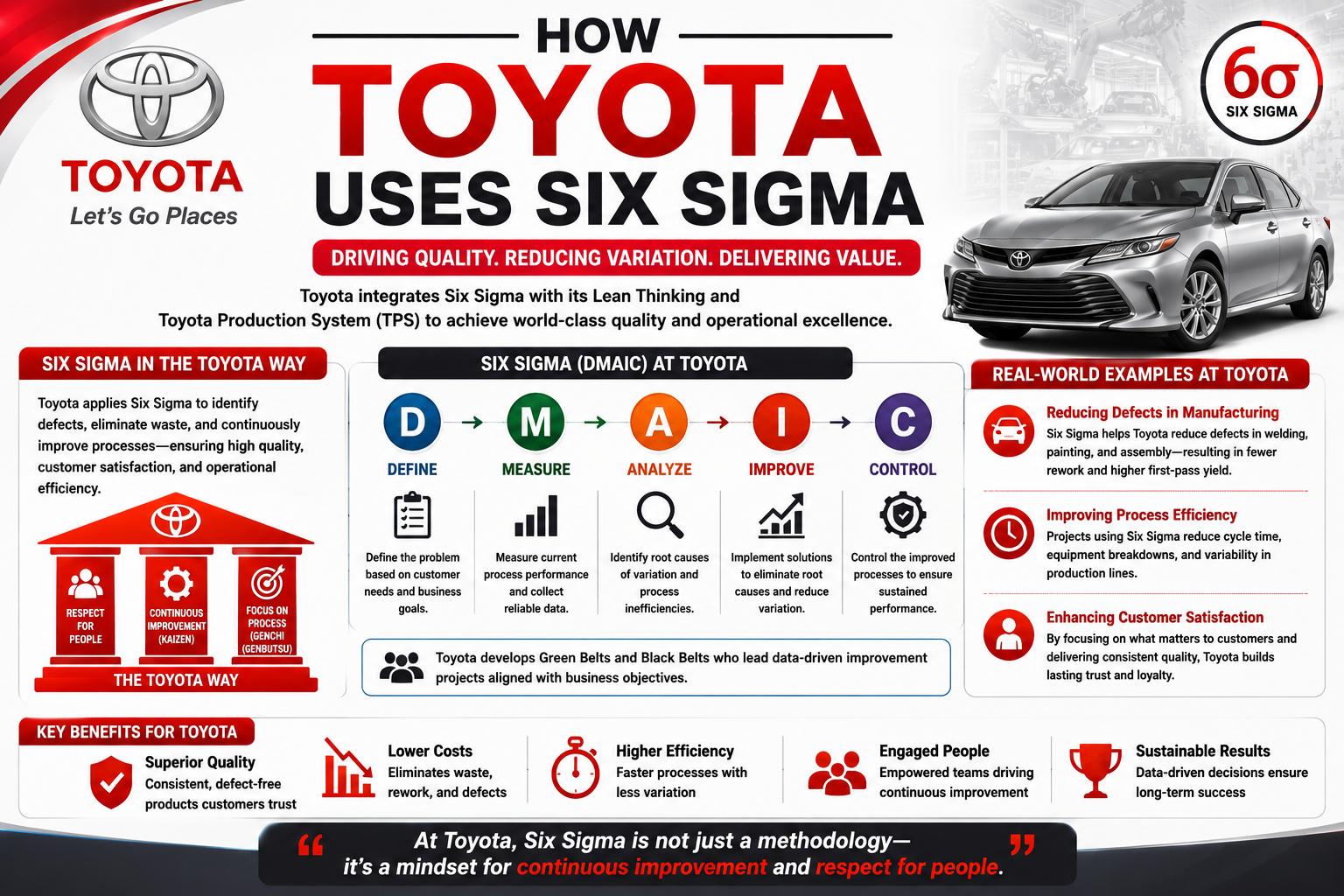
When it comes to manufacturing excellence, few names resonate as strongly as Toyota. Renowned for its efficient processes and commitment to quality, Toyota has consistently pushed the boundaries of what's possible in the automotive industry. One of the key methodologies that underpins Toyota's success is Six Sigma. In this blog, we'll delve into how Toyota Six Sigma is implemented, its significance, and provide real-world Six Sigma examples from its operations.
Understanding Six Sigma
Before we explore Toyota's application of Six Sigma, let’s first understand what Six Sigma is. Developed by Motorola in the 1980s, Six Sigma is a set of techniques and tools designed to improve processes by identifying and removing the causes of defects and minimizing variability. The goal is to achieve near-perfect quality, which translates to no more than 3.4 defects per million opportunities.
Why Six Sigma Matters to Toyota
Toyota's commitment to quality and efficiency is part of its corporate philosophy, known as the Toyota Production System (TPS). Incorporating Six Sigma into TPS allows Toyota to enhance its production processes and ensure that they meet the highest standards. This fusion has led to remarkable improvements in productivity, customer satisfaction, and overall profitability.
The Core Principles of Toyota Six Sigma
Toyota’s approach to Six Sigma is built around several core principles:
- Focus on Customer Requirements: Every process and improvement is geared towards meeting the needs of customers.
- Data-Driven Decision Making: Decisions are based on data and statistical analysis rather than intuition.
- Continuous Improvement: The philosophy of 'Kaizen' drives ongoing improvements in all aspects of the organization.
- Employee Involvement: All employees are encouraged to participate in problem-solving and process improvement.
Six Sigma Examples in Toyota's Manufacturing Process
To better understand Toyota's application of Six Sigma, let's look at a few notable manufacturing case studies that highlight its effectiveness.
1. Reducing Defects in Car Assembly
In the early 2000s, Toyota faced challenges with defects in its car assembly lines. Utilizing Six Sigma methodologies, they analyzed the assembly process to identify the root causes of defects. By implementing statistical process control and rigorous testing protocols, Toyota was able to reduce defects by over 50%. This not only improved product quality but also increased customer satisfaction.
2. Enhancing Supply Chain Efficiency
Toyota’s supply chain is one of the most efficient in the world, thanks in part to Six Sigma practices. By applying Six Sigma tools to analyze supplier performance and inventory management, Toyota was able to identify inefficiencies and reduce lead times significantly. This streamlined approach resulted in lower costs and faster delivery of vehicles to customers.
3. Improving Fuel Efficiency
Another compelling example of Toyota’s application of Six Sigma can be seen in their hybrid vehicle production. The company aimed to optimize fuel efficiency without compromising performance. By using Six Sigma techniques to analyze engine performance data, Toyota developed engines that delivered higher fuel efficiency while maintaining the power drivers expect. This initiative not only enhanced their vehicle lineup but also aligned with global sustainability goals.
The Role of Training in Toyota Six Sigma
For Toyota, the success of Six Sigma is heavily dependent on training and development. Employees undergo rigorous training to become Six Sigma Green Belts or Black Belts, equipping them with the tools and methodologies necessary to lead improvement projects. This commitment to employee education fosters a culture of continuous improvement and innovation.
Challenges Faced by Toyota in Implementing Six Sigma
While Toyota has successfully integrated Six Sigma into its operations, the journey has not been without challenges. Some of the notable challenges include:
- Resistance to Change: Employees accustomed to certain processes may resist new methodologies.
- Over-reliance on Data: In some cases, the focus on data can overshadow intuitive decision-making.
- Balancing Speed and Quality: Achieving a balance between fast production and high quality can be difficult.
Conclusion: The Future of Toyota Six Sigma
As the automotive industry continues to evolve, with the rise of electric vehicles and autonomous driving technologies, Toyota's commitment to Six Sigma will be crucial in navigating these changes. By continuously refining its processes and embracing new technologies, Toyota aims to maintain its position as a leader in the automotive market.
In summary, the integration of Toyota Six Sigma into its manufacturing processes has not only enhanced quality and efficiency but has also set a benchmark for other organizations. Companies looking to improve their operational excellence can draw valuable lessons from Toyota's successful application of Six Sigma.
FAQs
What is Six Sigma?
Six Sigma is a set of techniques and tools for process improvement, aimed at reducing defects and ensuring quality in manufacturing and business processes.
How does Toyota implement Six Sigma?
Toyota incorporates Six Sigma principles into its Toyota Production System, focusing on customer requirements, data-driven decisions, continuous improvement, and employee involvement.
What are some examples of Six Sigma at Toyota?
Examples include reducing defects in car assembly, enhancing supply chain efficiency, and improving fuel efficiency in hybrid vehicles.
What challenges does Toyota face with Six Sigma?
Challenges include resistance to change, over-reliance on data, and balancing speed with quality in production.
Call to Action
If you're a manufacturer looking to enhance your processes or a business leader interested in quality improvement techniques, consider exploring Six Sigma. Learn from Toyota's success and apply these principles to your operations. For more insights on Six Sigma and operational excellence, subscribe to our newsletter or contact us today!




Leave a Comment