
 Quality Management



















 IT Service Management



 Project Management



 Agile Management




 Web Development



 Cloud Computing


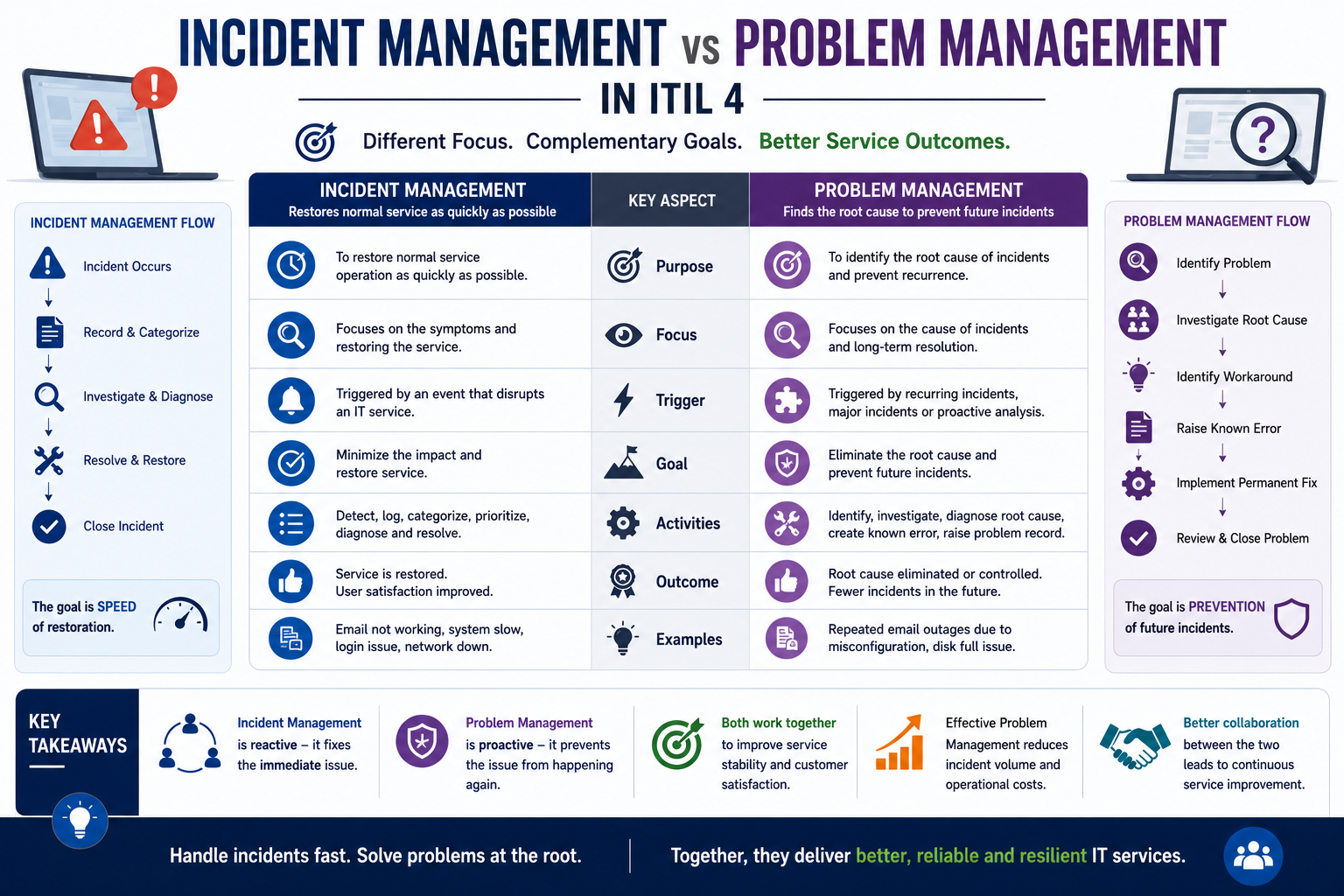
In the realm of IT service management (ITSM), understanding the nuances between incident management and problem management is crucial for organizations striving for operational excellence. As businesses increasingly rely on technology, the importance of a well-structured approach outlined by the ITIL 4 framework cannot be overstated. In this blog, we will explore the key differences between incident management and problem management in ITIL 4, helping you to grasp their significance in enhancing your organization's IT service delivery.
What is Incident Management in ITIL?
Incident management in ITIL refers to the process of managing the lifecycle of all incidents. An incident is defined as an unplanned interruption to an IT service or a reduction in the quality of an IT service. The primary goal of incident management is to restore normal service operation as quickly as possible, minimizing the impact on business operations.
The incident management process involves several stages, including:
- Identification: Recognizing that an incident has occurred.
- Logging: Recording the incident details for tracking.
- Classification: Categorizing the incident based on its type and severity.
- Investigation and Diagnosis: Understanding the root cause of the incident.
- Resolution and Recovery: Implementing a fix to restore service.
- Closure: Ensuring the incident is resolved and documenting the solution.
By focusing on quick resolution, incident management plays a vital role in maintaining the continuity of IT services, thereby enhancing user satisfaction and productivity.
What is Problem Management in ITIL?
Problem management, on the other hand, is a more strategic approach that deals with understanding and resolving the root causes of incidents. While incident management is reactive, problem management is proactive, aiming to prevent incidents from occurring in the first place.
The problem management process also consists of several key stages:
- Problem Identification: Recognizing recurring incidents or potential issues.
- Problem Logging: Documenting problems for future analysis.
- Investigation and Diagnosis: Analyzing problems to determine their root causes.
- Workarounds: Developing temporary solutions to reduce the impact of problems.
- Resolution: Implementing permanent solutions to eliminate the root causes.
- Closure: Documenting the problem resolution and any follow-up actions.
Effective problem management can lead to significant improvements in service quality, reducing the number and severity of incidents over time.
Key Differences Between Incident Management and Problem Management
Focus and Objectives
The primary focus of incident management is on restoring service as quickly as possible, while problem management aims to identify and eliminate the root causes of incidents to prevent future occurrences. This fundamental difference shapes the approach and processes involved in each area.
Processes and Activities
Incident management is a more immediate process, focusing on actions that need to be taken in response to service interruptions. In contrast, problem management involves in-depth analysis and often requires more time to identify solutions. While incident management deals with symptoms, problem management seeks to understand the underlying issues.
Documentation and Tracking
Incident management relies heavily on tracking incidents and their corresponding resolutions for future reference. On the other hand, problem management emphasizes documenting the problem's root cause and the steps taken to resolve it, which helps in building a knowledge base for future reference.
Team Collaboration
Incident management teams typically work closely with service desk personnel to address user-reported issues. In contrast, problem management teams may collaborate with various stakeholders, including developers, engineers, and IT operations, to diagnose and resolve complex problems.
Importance of Incident and Problem Management in ITIL 4
Both incident management and problem management are integral to the ITIL 4 framework, which emphasizes a holistic approach to IT service management. By implementing effective incident and problem management processes, organizations can:
- Enhance Service Quality: Quick resolution of incidents and elimination of root causes lead to improved service quality.
- Increase Customer Satisfaction: Reducing downtime and improving service reliability results in happier users.
- Reduce Costs: Proactively addressing problems can lead to fewer incidents and reduced operational costs.
- Improve Efficiency: Streamlined processes lead to better resource utilization and faster response times.
ITIL Certification and Its Relevance
For professionals looking to deepen their understanding of ITIL practices, obtaining an ITIL certification can be highly beneficial. These certifications cover various aspects of the ITIL 4 framework, including incident and problem management. With an ITIL certification, you can demonstrate your knowledge and skills to potential employers, making you a valuable asset in the field of IT service management.
Conclusion
Understanding the differences between incident management and problem management is essential for anyone involved in IT service management. While both processes aim to improve service delivery, they do so from different perspectives. By effectively implementing both incident and problem management within the ITIL 4 framework, organizations can enhance their IT services, improve user satisfaction, and drive operational excellence.
FAQs about Incident Management and Problem Management in ITIL 4
1. What is the main goal of incident management in ITIL?
The main goal of incident management is to restore normal service operation as quickly as possible, minimizing the impact on business operations.
2. How does problem management differ from incident management?
While incident management focuses on quickly resolving incidents, problem management seeks to identify and eliminate the root causes of those incidents to prevent future occurrences.
3. Why is ITIL certification important for IT professionals?
ITIL certification demonstrates a professional's knowledge and skills in IT service management, making them more attractive to potential employers and enhancing their career prospects.
4. Can incident and problem management processes be automated?
Yes, many organizations utilize ITSM tools that can help automate various aspects of incident and problem management, improving efficiency and response times.
5. How can organizations improve their incident management processes?
Organizations can improve incident management by adopting best practices, implementing ITIL guidelines, regularly training staff, and utilizing efficient ITSM tools.
Call to Action
If you're looking to enhance your organization's IT service management practices, consider investing in ITIL training and certification. Equip your team with the knowledge and skills needed to excel in incident and problem management. For more information on ITIL courses and certification, visit our website or contact us today!




Leave a Comment