
 Quality Management



















 IT Service Management



 Project Management



 Agile Management




 Web Development



 Cloud Computing


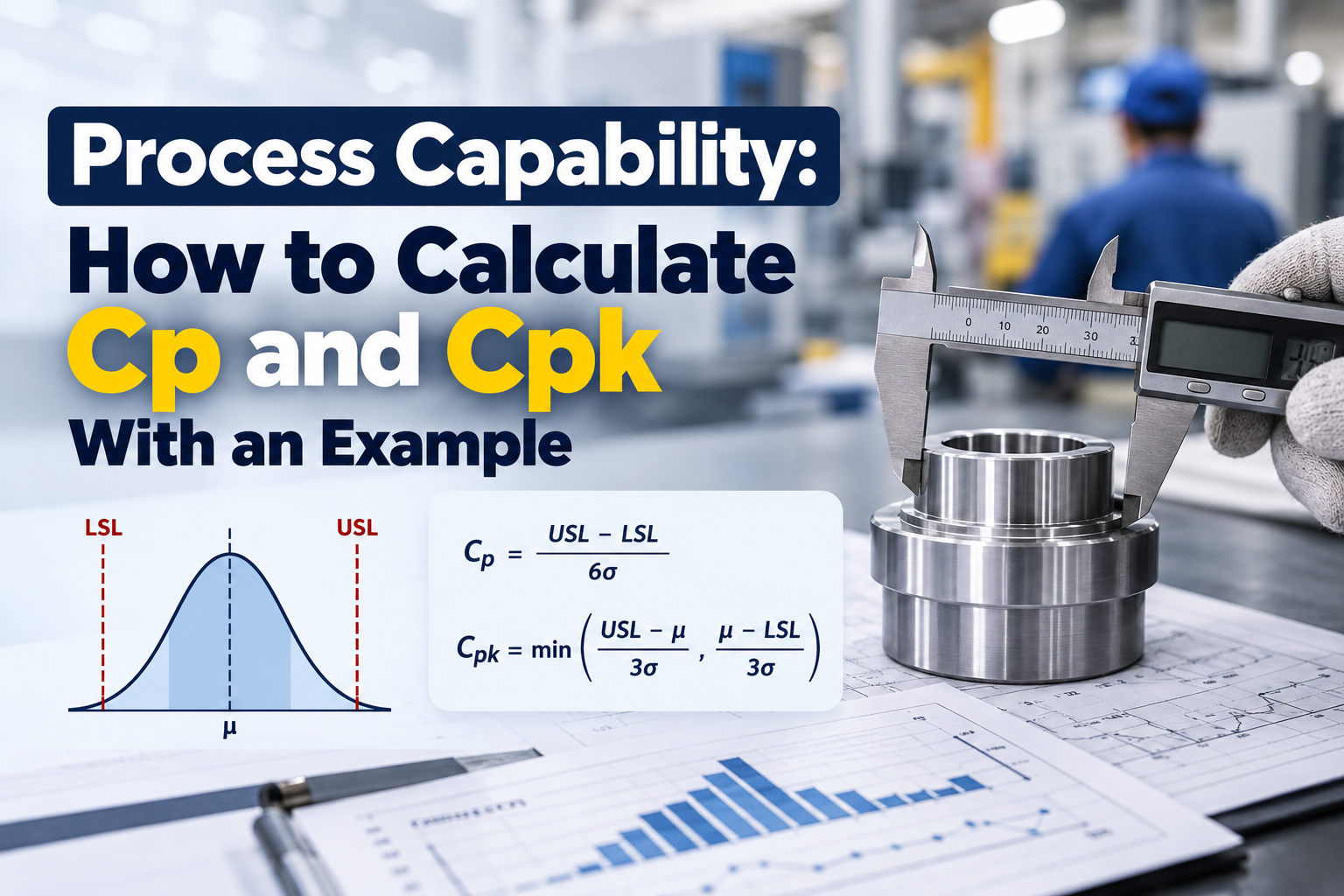
In today's competitive manufacturing environment in India, understanding process capability is vital for maintaining quality and efficiency. One of the key metrics in this context is the Cp Cpk calculation. This blog will guide you through the process of calculating Cp and Cpk, along with examples to help you grasp these concepts effectively.
What is Process Capability?
Process capability is a statistical measure that evaluates a process's ability to produce output that meets specified limits. It helps organizations understand how much variation exists in their processes and whether they can consistently meet customer specifications. A well-defined process capability leads to higher customer satisfaction and reduced costs associated with rework and scrap.
Understanding Cp and Cpk
Before diving into the Cp Cpk calculation, it's essential to understand the difference between Cp and Cpk:
1. Cp (Process Capability Index)
Cp measures a process's potential capability relative to its specification limits. It compares the width of the process spread (the natural variation of the process) to the width of the specification limits. A higher Cp indicates a more capable process. The formula for Cp is:
Cp = (USL - LSL) / (6 * σ)
- USL: Upper Specification Limit
- LSL: Lower Specification Limit
- σ: Standard deviation of the process
2. Cpk (Process Capability Index adjusted for centering)
Cpk considers how centered the process is within the specification limits. It provides a more realistic view of process capability by accounting for any shifts in the process mean. The formula for Cpk is:
Cpk = min[(USL - μ) / (3 * σ), (μ - LSL) / (3 * σ)]
- μ: Mean of the process
How to Perform Cp Cpk Calculation
Let's walk through a practical example to illustrate how to calculate Cp and Cpk.
Example Scenario
Imagine a manufacturing plant producing metal rods, where the specifications are as follows:
- Upper Specification Limit (USL): 15 mm
- Lower Specification Limit (LSL): 10 mm
Over a certain period, the average diameter (mean) of the rods produced is measured at 12 mm with a standard deviation (σ) of 1.2 mm. Let's calculate Cp and Cpk.
Step 1: Calculate Cp
Using the Cp formula:
Cp = (USL - LSL) / (6 * σ)
Substituting the values:
Cp = (15 - 10) / (6 * 1.2) = 5 / 7.2 ≈ 0.694
Step 2: Calculate Cpk
Now, we will use the Cpk formula:
Cpk = min[(USL - μ) / (3 * σ), (μ - LSL) / (3 * σ)]
First, we calculate the two components:
- First Component: (USL - μ) / (3 * σ) = (15 - 12) / (3 * 1.2) = 3 / 3.6 ≈ 0.833
- Second Component: (μ - LSL) / (3 * σ) = (12 - 10) / (3 * 1.2) = 2 / 3.6 ≈ 0.556
Now, take the minimum of the two components:
Cpk = min(0.833, 0.556) = 0.556
Interpreting Cp and Cpk Values
The Cp and Cpk values obtained tell us a lot about the process:
- Cp = 0.694: This value indicates that the process is not capable of producing items within the specifications consistently.
- Cpk = 0.556: This further suggests that not only is the process capable but also that it is off-center, meaning adjustments may be necessary to bring it within acceptable limits.
Importance of Cp and Cpk in Manufacturing
For manufacturers in India, understanding and calculating Cp and Cpk is crucial for several reasons:
- Quality Improvement: By monitoring these metrics, companies can identify areas for improvement, thereby enhancing product quality.
- Cost Reduction: Reducing defects and rework helps save costs, making the company more competitive in the market.
- Customer Satisfaction: Consistently meeting specifications leads to higher customer satisfaction and loyalty.
FAQs about Cp and Cpk Calculation
1. What is the difference between Cp and Cpk?
While Cp measures the potential capability of a process without considering its centering, Cpk takes into account how centered the process is within the specification limits. Cpk provides a more realistic view of the process's capability.
2. What does a Cp value less than 1 indicate?
A Cp value less than 1 indicates that the process is not capable of producing products that meet the specification limits consistently. In such cases, improvements are necessary.
3. How often should I calculate Cp and Cpk?
It's advisable to calculate Cp and Cpk regularly, especially after any changes in the manufacturing process, equipment, or materials. Regular monitoring helps ensure that the process remains capable over time.
Conclusion
Understanding the Cp Cpk calculation is essential for manufacturers aiming for excellence in quality and efficiency. By regularly calculating and analyzing these indices, organizations in India can improve their processes, reduce costs, and enhance customer satisfaction. Don't let your manufacturing processes fall behind—start monitoring your Cp and Cpk today!
Call to Action: If you found this blog helpful, please share it with your colleagues and fellow manufacturers! For more insights into quality management and process improvement, subscribe to our newsletter or visit our website.



Leave a Comment