
 Quality Management



















 IT Service Management



 Project Management



 Agile Management




 Web Development



 Cloud Computing


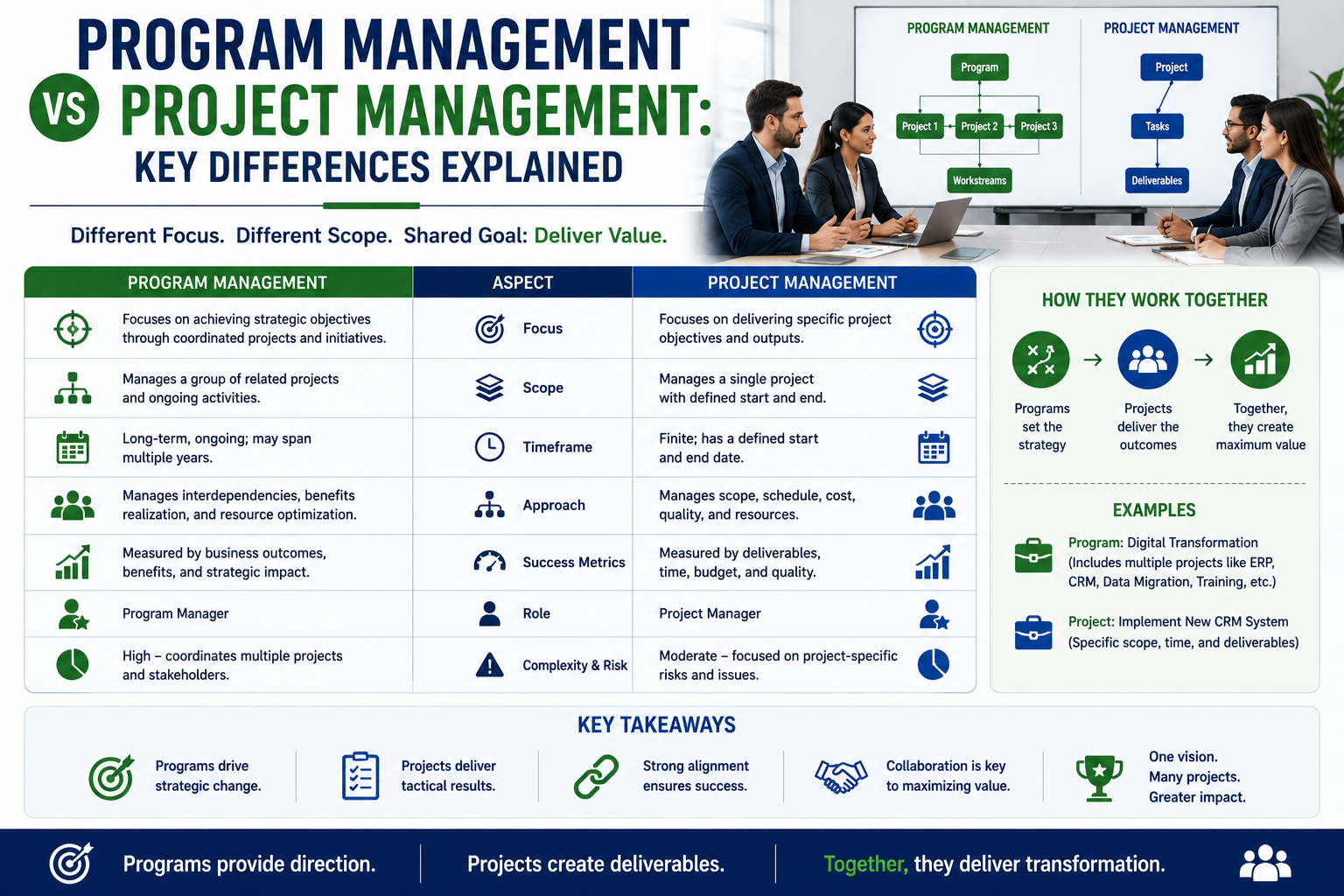
In the dynamic world of business, understanding the intricacies of program management vs project management is essential for organizations aiming to achieve their strategic objectives. While both disciplines are crucial for delivering results, they serve different purposes and require distinct skill sets. This blog will delve into the key differences between program management and project management, highlighting the roles of project managers and program managers, along with their respective skills, project governance, and project portfolio management.
Understanding Project Management
Project management involves the planning, execution, and closing of specific projects. A project is a temporary endeavor with a defined beginning and end, aimed at creating a unique product, service, or result. The primary focus of project management is to deliver these outcomes within the constraints of time, budget, and resources.
The Role of a Project Manager
The project manager plays a pivotal role in this process. They are responsible for ensuring that the project is completed on time, within budget, and meets the specified quality standards. Key project manager skills include:
- Leadership: Guiding the project team and stakeholders towards achieving project goals.
- Communication: Effectively conveying information to all project stakeholders.
- Risk Management: Identifying potential risks and developing mitigation strategies.
- Time Management: Ensuring that project milestones are met.
- Negotiation: Mediating between different stakeholders to resolve conflicts.
Diving into Program Management
On the other hand, program management encompasses a broader scope. It involves managing multiple related projects in a coordinated manner to obtain benefits and control not available from managing them individually. Program management aligns projects with the strategic goals of the organization.
The Role of a Program Manager
Program managers are responsible for overseeing the program's overall direction and alignment with business objectives. They ensure that individual projects within the program work together harmoniously. The program manager role demands a different set of skills, including:
- Strategic Thinking: Focusing on long-term goals and aligning projects with organizational strategy.
- Resource Management: Allocating resources across projects effectively.
- Stakeholder Engagement: Maintaining relationships with stakeholders at various levels.
- Program Governance: Establishing frameworks for decision-making and accountability.
- Change Management: Leading organizational changes that affect multiple projects.
Key Differences Between Program Management and Project Management
While both program and project management share similarities, the differences are significant. Below are the primary distinctions:
1. Scope
Project management focuses on individual projects with specific deliverables, while program management oversees a collection of related projects aimed at achieving strategic objectives.
2. Timeframe
Projects are temporary and have a defined end date, whereas programs are ongoing and may evolve over time as new projects are added or existing ones are modified.
3. Objectives
The objective of project management is to deliver a specific output, while program management aims to maximize benefits and improve overall organizational performance.
4. Success Metrics
Success in project management is often measured by the completion of the project on time and within budget. In contrast, program success is measured by the overall performance of the program in achieving strategic goals.
5. Complexity
Program management typically involves a higher level of complexity due to the interdependencies between projects and the need for strategic alignment. Project management, while it can be complex, is generally more straightforward.
Importance of Project Governance
Both project and program management benefit significantly from effective project governance. Project governance refers to the framework within which project decisions are made, ensuring that projects are executed efficiently and align with organizational goals.
Key Components of Project Governance
- Decision-Making Processes: Establishing clear processes for making project-related decisions.
- Stakeholder Engagement: Ensuring all relevant stakeholders are involved in decision-making.
- Performance Monitoring: Regularly assessing project performance against established metrics.
- Reporting Structures: Setting up clear reporting lines for accountability.
Project Portfolio Management: A Broader Perspective
Project portfolio management (PPM) extends the concepts of project and program management. PPM involves managing a collection of projects and programs to achieve strategic objectives and optimize resource allocation. It focuses on selecting the right projects that align with the organization's goals and ensuring that resources are used efficiently across the entire portfolio.
Benefits of Project Portfolio Management
- Strategic Alignment: Ensures that all projects and programs contribute to the organization's strategic goals.
- Resource Optimization: Allocates resources effectively across projects.
- Risk Management: Provides a holistic view of risks across the portfolio and enables better risk mitigation strategies.
- Improved Decision-Making: Facilitates informed decision-making by providing data and insights into project performance.
Conclusion
In conclusion, understanding the differences between program management and project management is vital for organizations looking to enhance their operational efficiency and strategic alignment. While both roles are essential, they cater to different aspects of project execution and organizational goals. Project managers focus on delivering specific projects, while program managers oversee the broader objectives that connect multiple projects. By establishing strong project governance and engaging in effective project portfolio management, organizations can drive success on both fronts.
FAQs
1. What is the main difference between program management and project management?
Program management oversees multiple related projects to achieve strategic objectives, while project management focuses on individual projects with specific deliverables.
2. What skills are essential for a project manager?
Essential project manager skills include leadership, communication, risk management, time management, and negotiation.
3. How does project governance benefit project management?
Project governance provides a framework for decision-making, stakeholder engagement, performance monitoring, and accountability, leading to more efficient project execution.
4. What is the role of a program manager?
The program manager is responsible for overseeing the program's overall direction, ensuring alignment with business objectives and managing interdependencies between projects.
5. Why is project portfolio management important?
Project portfolio management ensures that all projects and programs contribute to the organization's strategic goals, optimizes resource allocation, and improves overall decision-making.
Call to Action
If you’re looking to enhance your project and program management skills or implement effective project governance in your organization, consider enrolling in a specialized training program. Stay ahead in your career and ensure your organization achieves its strategic goals. Learn more about our courses today!



Leave a Comment