
 Quality Management



















 IT Service Management



 Project Management



 Agile Management



 Web Development



 Cloud Computing


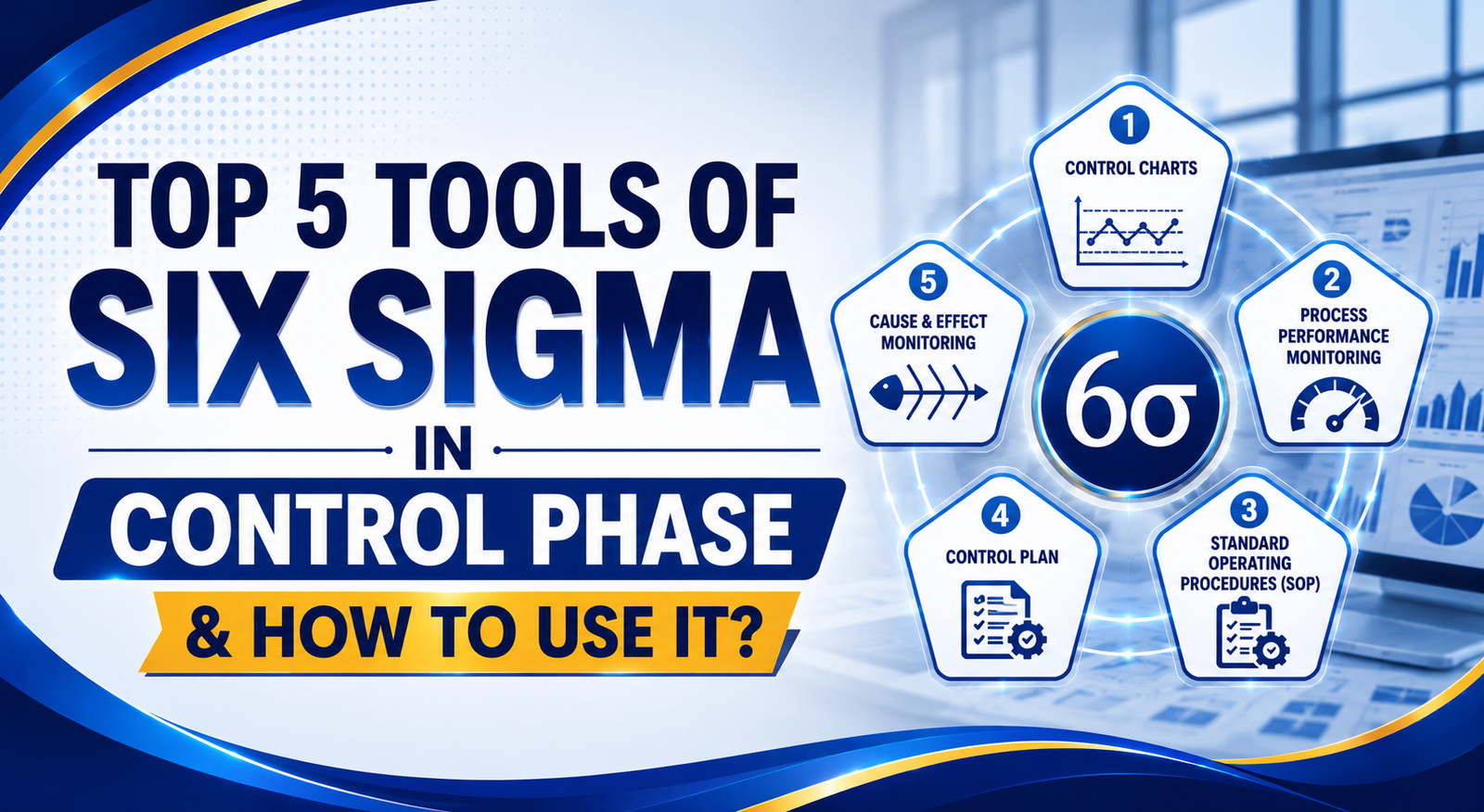
Six Sigma is a robust methodology aimed at improving processes by identifying and eliminating defects. Among its various phases, the Control phase is crucial as it ensures that the improvements made during the earlier phases are maintained over time. In this blog, we'll explore the top 5 Six Sigma tools of the Control phase and how to use them effectively to sustain quality improvements.
Understanding the Control Phase in Six Sigma
The Control phase is the final phase of the DMAIC (Define, Measure, Analyze, Improve, Control) process. It focuses on monitoring the improvements and ensuring that the processes remain stable and under control. This phase involves implementing control measures that help in maintaining the gains achieved during the Improve phase.
Top 5 Six Sigma Tools of Control Phase
1. Control Charts
Control charts are one of the most essential tools in the Control phase. They help in monitoring process behavior over time and determining if a process is stable or in control.
How to Use Control Charts:
- Select the appropriate type: Choose between variable control charts (X-bar and R charts) or attribute control charts (p-charts, np-charts) based on the data type.
- Collect data: Gather data from the process at regular intervals.
- Plot the data: Create the control chart by plotting the data points over time.
- Analyze: Look for trends, shifts, or any points outside the control limits, indicating potential issues.
2. Process Capability Analysis
This tool assesses how well a process can produce output within specified limits. It helps in determining whether a process is capable of meeting customer demands.
How to Use Process Capability Analysis:
- Define specifications: Identify the upper and lower specification limits (USL and LSL) for the process.
- Collect data: Gather data from the process performance.
- Calculate capability indices: Use parameters like Cp, Cpk, Pp, and Ppk to evaluate process capability.
- Interpret results: A Cp or Cpk value greater than 1.33 typically indicates a capable process.
3. Control Plans
Control plans are detailed documents that outline the necessary steps to maintain control over a process. They specify the measurement methods, control limits, and responsibilities.
How to Create a Control Plan:
- Define the process: Clearly outline the process steps and objectives.
- Identify key metrics: Select critical process parameters that need monitoring.
- Detail measurement methods: Specify how each metric will be measured and reported.
- Assign responsibilities: Designate team members responsible for monitoring and maintaining the process.
4. Standard Operating Procedures (SOPs)
SOPs are essential for ensuring consistency in processes. They provide step-by-step instructions for performing tasks, helping to reduce variability.
How to Develop SOPs:
- Gather input: Involve team members who are familiar with the process to gather insights.
- Draft the SOP: Write clear and concise instructions for each step of the process.
- Review and test: Validate the SOP by testing it in real scenarios and gather feedback.
- Train staff: Ensure all relevant personnel are trained on the SOPs to promote adherence.
5. Audits and Reviews
Regular audits and reviews are critical for identifying areas of improvement and ensuring compliance with the established control measures.
How to Conduct Audits:
- Schedule regular audits: Plan audits at specified intervals based on process criticality.
- Use checklists: Develop checklists to ensure all key areas are covered during audits.
- Document findings: Record observations and areas requiring attention.
- Follow-up: Implement corrective actions based on audit findings and monitor their effectiveness.
Conclusion
Incorporating these top 5 Six Sigma tools of the Control phase can significantly enhance your organization's ability to maintain process improvements. By effectively utilizing control charts, process capability analysis, control plans, SOPs, and audits, you can ensure that your processes remain efficient and effective over time.
FAQs
1. What is the primary goal of the Control phase in Six Sigma?
The primary goal of the Control phase is to ensure that the improvements made in the Improve phase are sustained over time, preventing the reoccurrence of defects.
2. How often should control charts be updated?
Control charts should be updated regularly, depending on the process frequency and the volume of data being collected. Daily or weekly updates are common in many industries.
3. Can process capability analysis be applied to all types of processes?
Yes, process capability analysis can be applied to both manufacturing and service processes, provided that measurable outputs can be defined.
4. What role do SOPs play in the Control phase?
SOPs provide standardized instructions that help maintain process consistency and quality, which is crucial for sustaining improvements in the Control phase.
5. How can audits help in the Control phase?
Audits help identify compliance issues and areas for improvement, ensuring that the processes are functioning as intended and that control measures are effective.
Call to Action
Ready to implement these Six Sigma tools in your organization? Start enhancing your control processes today! For more insights, tips, and expert guidance on Six Sigma, subscribe to our newsletter or contact us for personalized support.


Leave a Comment