
 Quality Management



















 IT Service Management



 Project Management



 Agile Management




 Web Development



 Cloud Computing


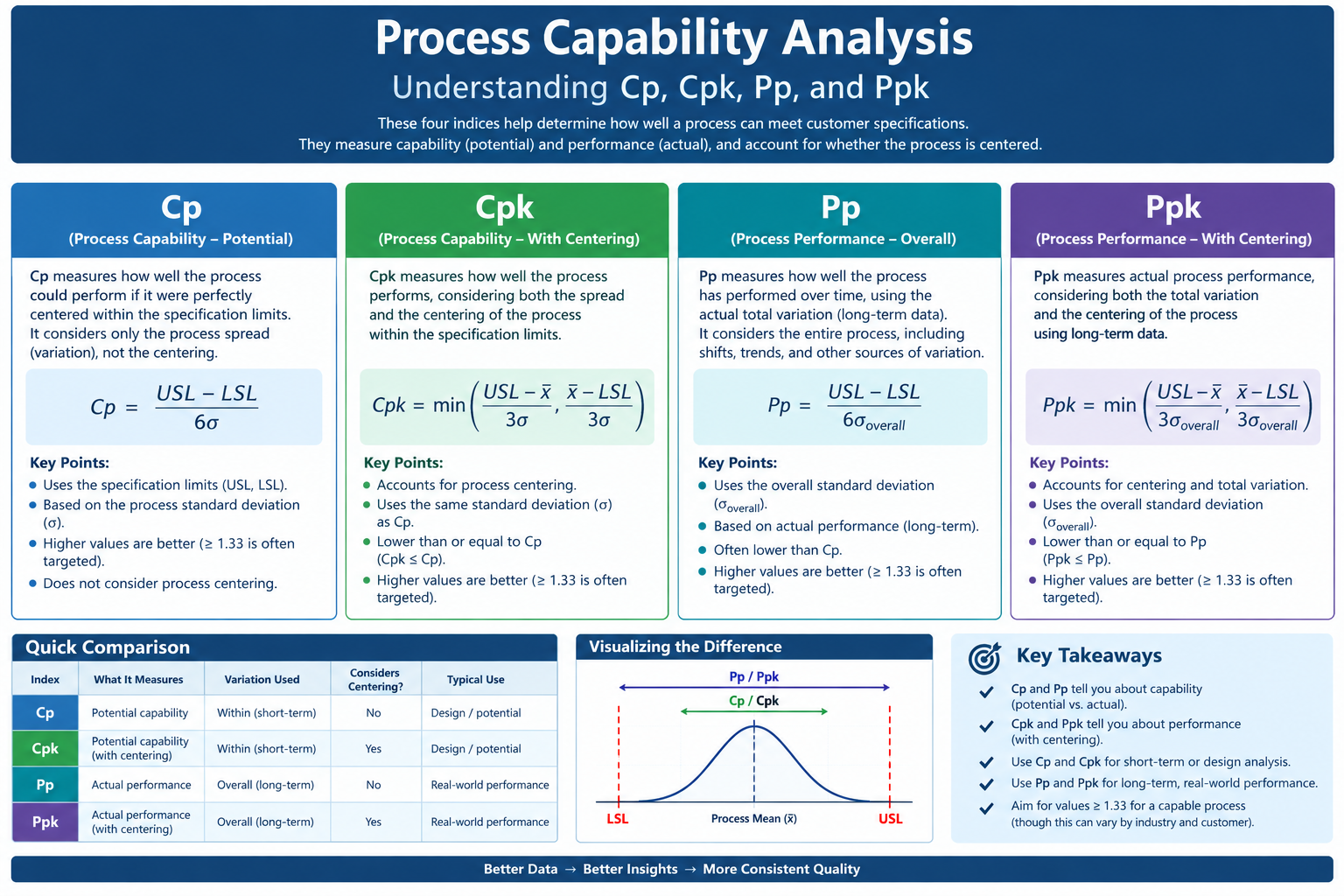
In the realm of manufacturing and quality control, ensuring consistency and reliability in processes is paramount. One of the most effective tools for achieving this is process capability analysis. This blog will delve into the intricacies of process capability, focusing specifically on Cp, Cpk, Pp, and Ppk, providing you with a comprehensive understanding of how these metrics can enhance your processes. Whether you’re a quality manager, an engineer, or a business leader in India, this guide will equip you with the knowledge to leverage these statistics for operational excellence.
What is Process Capability Analysis?
Process capability analysis is a statistical method used to determine how well a process can produce output within specified limits. It helps organizations assess the capability of their processes to meet customer requirements and quality standards. By analyzing the variability of a process, businesses can identify areas for improvement, ensuring that they consistently deliver products that meet quality standards.
Key Process Capability Indices: Cp and Cpk
Understanding Cp
The process capability index (Cp) measures the potential capability of a process. It compares the width of the specification limits to the width of the process distribution. Specifically, Cp is calculated using the formula:
Cp = (USL - LSL) / (6 * σ)
Where:
- USL = Upper Specification Limit
- LSL = Lower Specification Limit
- σ = Standard deviation of the process
A Cp value greater than 1 indicates that the process is capable of producing within the specifications. However, it does not account for the process mean, which is where Cpk comes into play.
Understanding Cpk
The Cpk index provides a more accurate representation of process capability by considering the process mean. It measures how close a process is running to its specification limits, accounting for any shifts in the process mean. The formula for Cpk is:
Cpk = min[(USL - μ) / (3 * σ), (μ - LSL) / (3 * σ)]
Where μ represents the mean of the process. A Cpk value of greater than 1 indicates that the process is capable and centered within the specification limits, making it a more reliable measure than Cp.
Understanding Pp and Ppk
Understanding Pp
While Cp and Cpk apply to processes that have been stabilized, Pp (Process Performance) and its counterpart Ppk are used to evaluate the overall performance of a process over time. Pp is calculated similarly to Cp but uses overall process data rather than the subset of data used for capability analysis:
Pp = (USL - LSL) / (6 * σ)
Pp essentially provides a view of how the process performed over a given period, making it useful for long-term evaluations.
Understanding Ppk
Like Cpk, Ppk (Process Performance Index) takes into account the process mean and is calculated as follows:
Ppk = min[(USL - μ) / (3 * σ), (μ - LSL) / (3 * σ)]
Ppk is particularly useful for understanding how well the process is performing over time, especially when there are changes in the process conditions or when the process is not in control.
Significance of Process Capability Analysis in Six Sigma
Process capability analysis is a core component of Six Sigma statistics, a methodology aimed at reducing defects and improving quality in processes. By utilizing the indices Cp, Cpk, Pp, and Ppk, organizations can effectively measure performance and identify areas for improvement. Six Sigma emphasizes a data-driven approach, and process capability analysis is essential for quantifying process performance.
In India, where competition is fierce and quality standards are rising, leveraging these tools can be a game-changer for businesses striving for excellence. By focusing on process capability, organizations can not only meet but exceed customer expectations, leading to increased satisfaction and loyalty.
How to Conduct a Process Capability Analysis
Conducting a process capability analysis involves a systematic approach. Here’s a simplified step-by-step guide:
- Define the Process: Clearly outline the process you wish to analyze, including its inputs, outputs, and relevant specifications.
- Collect Data: Gather data from the process over a significant time period. Ensure that the data is representative of the process under normal operating conditions.
- Calculate Statistics: Determine the mean and standard deviation of the process data. Use these to calculate Cp, Cpk, Pp, and Ppk.
- Analyze Results: Compare the indices to industry standards or internal benchmarks. Identify areas for improvement based on the results.
- Implement Improvements: Based on the analysis, develop and implement strategies aimed at improving process capability.
- Monitor and Control: Continuously monitor the process to ensure that improvements are sustained over time.
FAQs about Process Capability Analysis
1. What is the difference between Cp and Cpk?
While both Cp and Cpk measure process capability, Cp only considers the spread of the process data without accounting for the mean's position. Cpk, on the other hand, assesses how centered the process is around the target, providing a more accurate reflection of capability.
2. Why is process capability important in quality management?
Process capability is crucial in quality management as it helps businesses understand their processes' performance and reliability. It enables organizations to identify areas for improvement, reduce waste, and enhance customer satisfaction.
3. How often should process capability analysis be conducted?
It is advisable to conduct process capability analysis at regular intervals, especially after significant process changes or when introducing new products. Regular analysis helps in maintaining optimal process performance.
4. Can process capability indices be used in service industries?
Yes, while process capability indices are primarily used in manufacturing, they can also be applied in service industries to evaluate the performance of processes related to service delivery and customer satisfaction.
Conclusion
Understanding and applying process capability analysis through the indices Cp, Cpk, Pp, and Ppk is vital for businesses aiming for operational excellence. By leveraging these metrics, organizations in India can not only enhance their process capabilities but also foster a culture of continuous improvement, ultimately leading to higher customer satisfaction and better business outcomes.
If you're looking to improve your process capabilities and implement Six Sigma methodologies effectively, consider seeking expert guidance. Reach out to us today to learn how we can help you achieve your quality goals and drive your organization towards excellence.
Call to Action: Ready to enhance your process capabilities? Contact us now for a consultation and take the first step towards operational excellence!



Leave a Comment